
Falling is scary, but knowing how to get back up safely can make all the difference between a minor incident and a serious injury. Physical therapists have developed a specific technique for getting up after a fall that protects your body and uses proper leverage instead of raw strength. This method works for most people and situations, though it's always worth reviewing with your own physical therapist to make sure it's right for you.
First Things First: Don't Rush
After you fall, your instinct might be to jump right back up. Resist that urge. Take a few deep breaths and give yourself a moment to assess the situation.
Here's what to do immediately after a fall:
- Lie still for a few moments and breathe
- Move your arms and legs gently to check for pain or numbness
- Feel for any immediate sharp pain that could indicate a fracture
- Check if you hit your head or feel dizzy
- Look around for anything that might help you get up safely
If you experience severe pain, can't move a limb, feel dizzy, or suspect you've broken something, don't try to get up on your own. Call for help instead. There's no shame in asking for assistance when you need it.

The Safe Six-Step Method
Physical therapists teach this technique because it distributes your weight evenly and uses your strongest muscle groups, your legs and core, rather than putting all the strain on your arms and back.
Step 1: Roll Onto Your Side
From whatever position you've landed in, slowly roll onto your side. Bend your knees as you roll. This might take a minute if you're stiff or sore, and that's perfectly fine. Choose the side that feels most comfortable.
If you're on a hard floor, this position also gives you a moment to rest and gather your energy for the next steps.
Step 2: Push Your Upper Body Up
Use the arm that's closest to the ground to push yourself up. Extend that arm fully so you're propped up on one straightened arm, like you're doing a side plank. Your other arm can help stabilize you.
This movement gets your upper body off the ground without requiring you to do a full sit-up, which can strain your back and neck.
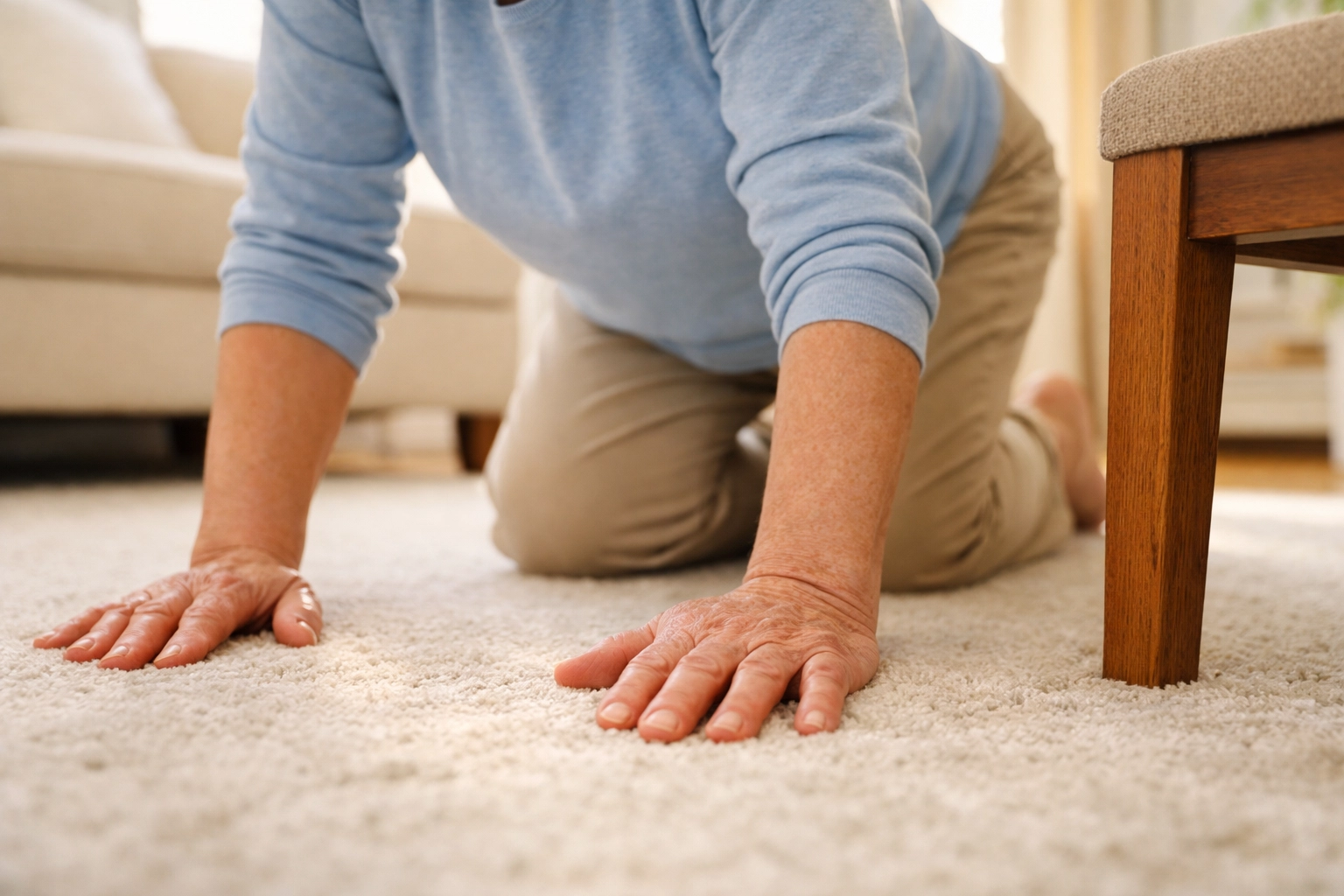
Step 3: Get Onto All Fours
Place your other hand on the ground next to your extended arm. Now push and rotate your body so you're on your hands and knees. Your palms should be flat on the floor with your knees hip-width apart.
This crawling position is stable and gives you a solid base for the next steps. Take a moment here if you need to catch your breath.
Step 4: Crawl to Furniture for Support
If there's a sturdy chair, couch, bed, or other furniture nearby, slowly crawl toward it. Keep your movements controlled and steady. If nothing is within easy reach, you can skip to the next step, though having something to hold onto makes things easier.
Once you reach the furniture, place both hands on it for support.
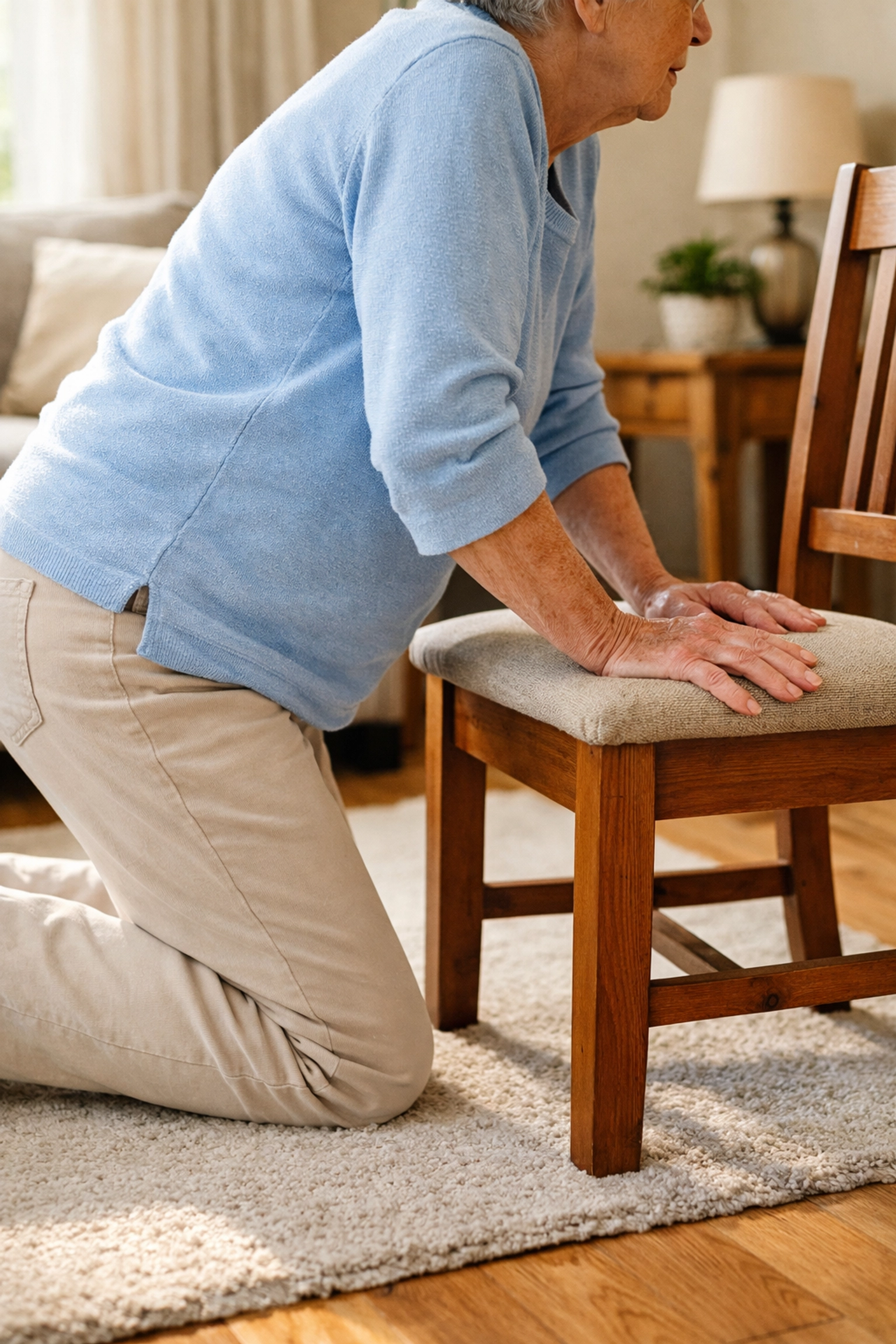
Step 5: Move Into a Kneeling Position
Bring one knee forward so you're in a kneeling position with both knees on the ground. Use the furniture to help pull yourself into this upright kneeling posture. Your back should be relatively straight, not hunched over.
This position lets you rest again before the final push to standing.
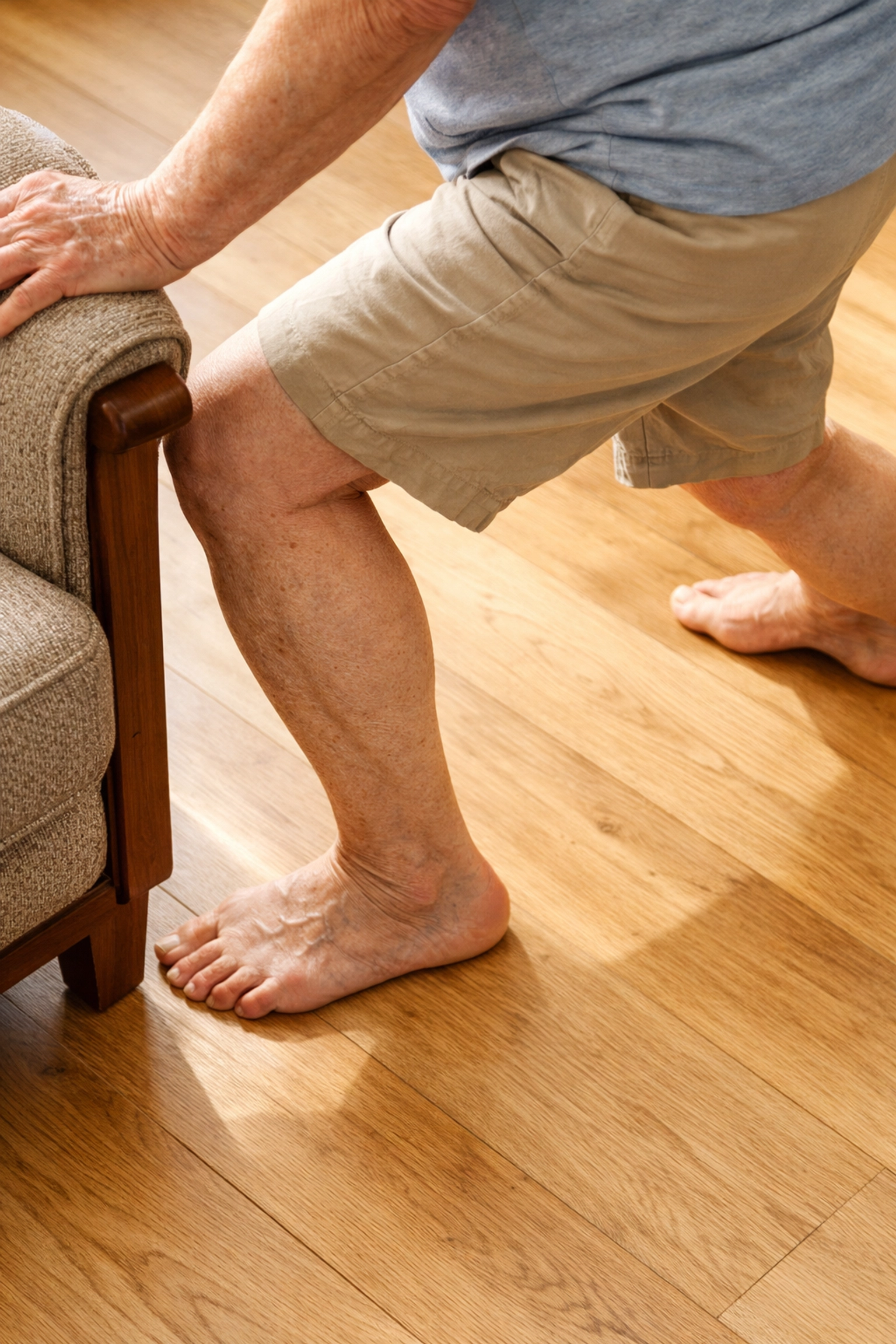
Step 6: Create a Low Lunge
Here's where you choose your stronger leg: the one you trust more to support your weight. Swing that leg forward so your foot is flat on the ground. Your knee should be bent at roughly a 90-degree angle, like you're doing a lunge.
Keep holding onto the furniture with both hands for balance.
Step 7: Push Up to Standing
Using your leg muscles and the furniture for support, push yourself up to a standing position. Press down through the foot that's flat on the ground and straighten that leg. Bring your other leg forward to meet it.
Stand still for a moment once you're up. Don't immediately start walking around.
What If You Can't Get Up?
Sometimes you simply can't manage the technique on your own, and that's a situation that requires a different approach.
If you've tried and can't get up:
- Stay as warm as possible by pulling any nearby blankets, coats, or towels over yourself
- Move toward a telephone or your medical alert device if you can crawl or scoot
- Bang on the floor or wall if you have neighbors who might hear you
- Call for help using your phone, medical alert button, or by yelling if someone might be within earshot
- Try to move onto a carpet or rug if you're on a hard, cold floor
Don't keep attempting to stand if it's not working. Repeated failed attempts will exhaust you and could cause additional injury. Conserve your energy and focus on getting help.
Practice Before You Need It
Here's something most people don't think about: practicing this technique when you haven't fallen makes it much easier to do when you actually need it. Your physical therapist can guide you through practice sessions where you intentionally lower yourself to the ground and then use the six-step method to get back up.
Practicing offers several benefits:
- Builds muscle memory so your body knows what to do
- Increases your confidence that you can get up if you fall
- Helps you identify which side is your stronger side
- Shows you how much effort each step requires
- Reveals which furniture in your home is sturdy enough for support
If you're working with a physical therapist, ask them to supervise your practice sessions. They can correct your form and suggest modifications for your specific needs.
Modifications for Different Situations
The basic six-step technique works in most situations, but sometimes you need to adapt it.
If you're in a tight space: You might not have room to fully extend your limbs. Focus on getting to your hands and knees first, then crawl toward a more open area before attempting to stand.
If you have knee problems: The kneeling positions might be painful. Consider using extra padding like a folded towel under your knees, or skip directly from all fours to a deep squat if you have the leg strength.
If you're outside: Grass, gravel, or uneven ground changes the dynamics. Getting to all fours is still your best bet, but you might need to crawl to a tree, fence, or bench for support rather than furniture.
If you're in the bathroom: The toilet can serve as excellent support furniture for getting up. The same goes for a sturdy towel bar (though not all towel bars can support body weight, so know which ones in your home are solid).

When to Seek Medical Attention
Getting up successfully doesn't mean everything is fine. You should contact your doctor or seek medical attention if:
- You hit your head during the fall
- You experience persistent pain anywhere
- You notice new bruising, swelling, or tenderness
- You feel confused or disoriented
- This is your first fall, or you've fallen multiple times recently
- You felt dizzy or lightheaded before you fell
- You couldn't get up without help
Falls often indicate an underlying issue: medication side effects, balance problems, vision changes, or environmental hazards. Your primary care provider can conduct a fall-risk evaluation to identify and address these factors.
Building Strength for Easier Recovery
The easier you can get up from the floor during practice, the easier it'll be after an actual fall. Several types of exercises can help:
Core strength exercises help you rotate and push your body from lying to sitting to kneeling. Even gentle movements like pelvic tilts or modified planks make a difference.
Leg strength exercises provide the power you need for that final push to standing. Sit-to-stand exercises using a chair are particularly relevant.
Upper body strength helps with the pushing movements in the early steps. Wall push-ups or counter push-ups build this gradually.
Balance training reduces your fall risk in the first place, which is always the best outcome.
Talk to a physical therapist about which exercises are appropriate for your current fitness level and any health conditions you have.
The Emotional Side of Falling
Falling can shake your confidence. Many people become afraid of falling again, which leads to moving less, which actually increases fall risk. This creates a harmful cycle.
Learning and practicing the safe getting-up technique helps break this cycle. When you know you can get back up, you're less afraid of falling. When you're less afraid, you're more likely to stay active and engaged in your daily activities.
Creating a Recovery Plan
Sit down and think through your recovery plan before you need it:
- Identify which furniture in each room is sturdy enough to use for support
- Keep your phone within reach, especially at night
- Consider a medical alert system if you live alone
- Tell family or friends about the getting-up technique so they can help you practice
- Remove tripping hazards that could cause falls in the first place
- Make sure you have good lighting throughout your home
Having a plan reduces panic if you do fall, and reducing panic makes the technique easier to execute.
Moving Forward
Learning how to get up safely after a fall is an important skill, but it's just one piece of the puzzle. The technique works best as part of a broader approach that includes fall prevention, strength building, home safety improvements, and regular check-ins with healthcare providers.
Take time to practice the six-step method in a controlled, safe way. Review it with your physical therapist. And remember that asking for help: whether it's assistance getting up after a fall or professional guidance in preventing falls: is always the smart choice.
Your safety matters, and knowing you have the skills to handle a fall if it happens can give you the confidence to keep living your life fully.

