
For many of us, the home we’ve lived in for decades is more than just a building; it’s a collection of memories. However, as we age, certain parts of the home that we never used to think twice about can start to feel a bit more challenging. Stairs are often at the top of that list.
Research shows that for adults over the age of 60, the risk of a serious injury from a fall on the stairs is significantly higher than for younger populations. But here’s the good news: most stair-related accidents aren't "just part of getting older." They are often the result of specific environmental pitfalls that can be fixed or managed.
If you or a loved one are planning to age in place, making the staircase a zone of safety rather than a source of anxiety is one of the best investments you can make in your independence. Let's walk through the biggest pitfalls and, more importantly, how to fix them.
The Traction Trap: Why Slipping is More Common Than Tripping
When we think of falling on stairs, we often imagine someone catching their toe on a step and tripping upward. In reality, most stair injuries occur while going down the stairs, and they usually involve a slip.
Polished wood, smooth tile, and even some types of stone look beautiful, but they offer very little grip. As we age, our gait changes slightly, and our ability to quickly recover our balance after a small slip decreases.
How to avoid the trap:
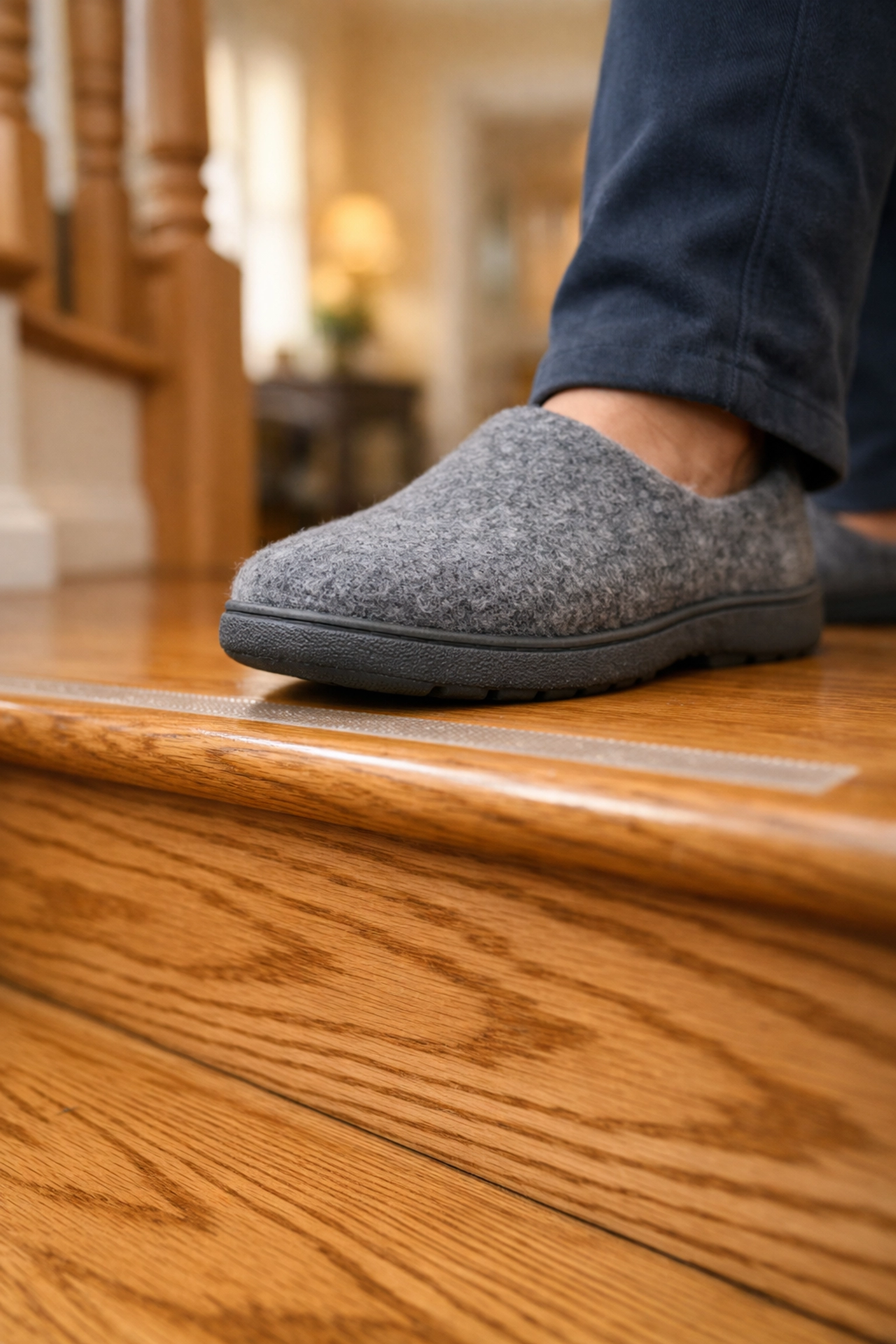
- Non-slip treads: Adding transparent or colored non-slip adhesive strips to the edge of each step can provide the necessary friction without ruining the look of your wood stairs.
- Carpet considerations: If your stairs are carpeted, ensure the carpet is a "low-pile" variety. Deep, plush shag carpeting can actually hide the edge of the step and make your footing feel unstable. Ensure the carpet is tightly tacked down; any bunching is a major hazard.
- Footwear at home: We all love the comfort of socks, but walking on stairs in socks is one of the easiest ways to lose your footing. Encourage the use of sturdy, rubber-soled slippers or shoes even when indoors.
The Darkness Danger: Why Standard Lighting Isn't Enough
Many older homes have a single light fixture at the top or bottom of the stairs, leaving the middle of the flight in a "grey zone" of shadows. Poor lighting is a major pitfall because it obscures the depth of the steps.
As vision changes with age: specifically as we lose some of our depth perception and contrast sensitivity: the ability to see exactly where one step ends and the next begins becomes vital. Shadows can play tricks on the eyes, making a flat landing look like a step, or vice versa.
How to avoid the danger:
- Dual-switch systems: Ensure there are light switches at both the top and the bottom of the stairs. No one should ever have to navigate stairs in the dark to reach a switch.
- Consistent brightness: Use high-lumen, "daylight" bulbs to ensure the entire flight is evenly lit.
- Motion-sensing LEDs: If rewiring isn't an option, battery-operated motion-sensor LED strips can be placed along the baseboards or under the lip of each tread. They light up automatically as you approach, providing a clear path without needing to fumble for a switch.
Handrail Hazards: More Than Just a Decoration
In many homes, handrails are treated more like an architectural accent than a safety device. They might be too thin to grab firmly, located on only one side of the wall, or: most dangerously: they might not run the full length of the stairs.
A proper handrail should be able to support a person's full body weight if they stumble. If you can only pinch the rail with your fingertips rather than wrapping your hand completely around it, it won't provide the "power grip" you need during a fall.
How to avoid the hazard:
- Install rails on both sides: This is one of the most effective modifications you can make. Having support for both hands allows for better balance and reduces the strain on a single side of the body.
- The "Full Length" rule: The handrail should start before the first step and continue slightly past the last step. This ensures you have support during the most critical moments: the transition onto and off of the staircase.
- Check the "Return": A safe handrail "returns" to the wall (curves back in) so that sleeves or bags don't get caught on the ends, which could cause a sudden jerk and a loss of balance.
The Clutter Culprit: The "Just for a Minute" Trap
We’ve all done it: we place a book, a pair of shoes, or a basket of laundry on the bottom step, intending to take it up the next time we head that way. In a household focusing on aging in place, this is a recipe for disaster.
Even a small object can cause a stumble, and on a staircase, a stumble can quickly escalate. Furthermore, for individuals with cognitive changes or dementia, clutter on the stairs can be confusing and lead to hesitation or missteps.
How to avoid the culprit:
- The "Zero Tolerance" Policy: Make it a house rule that nothing is ever placed on the stairs, not even for a second.
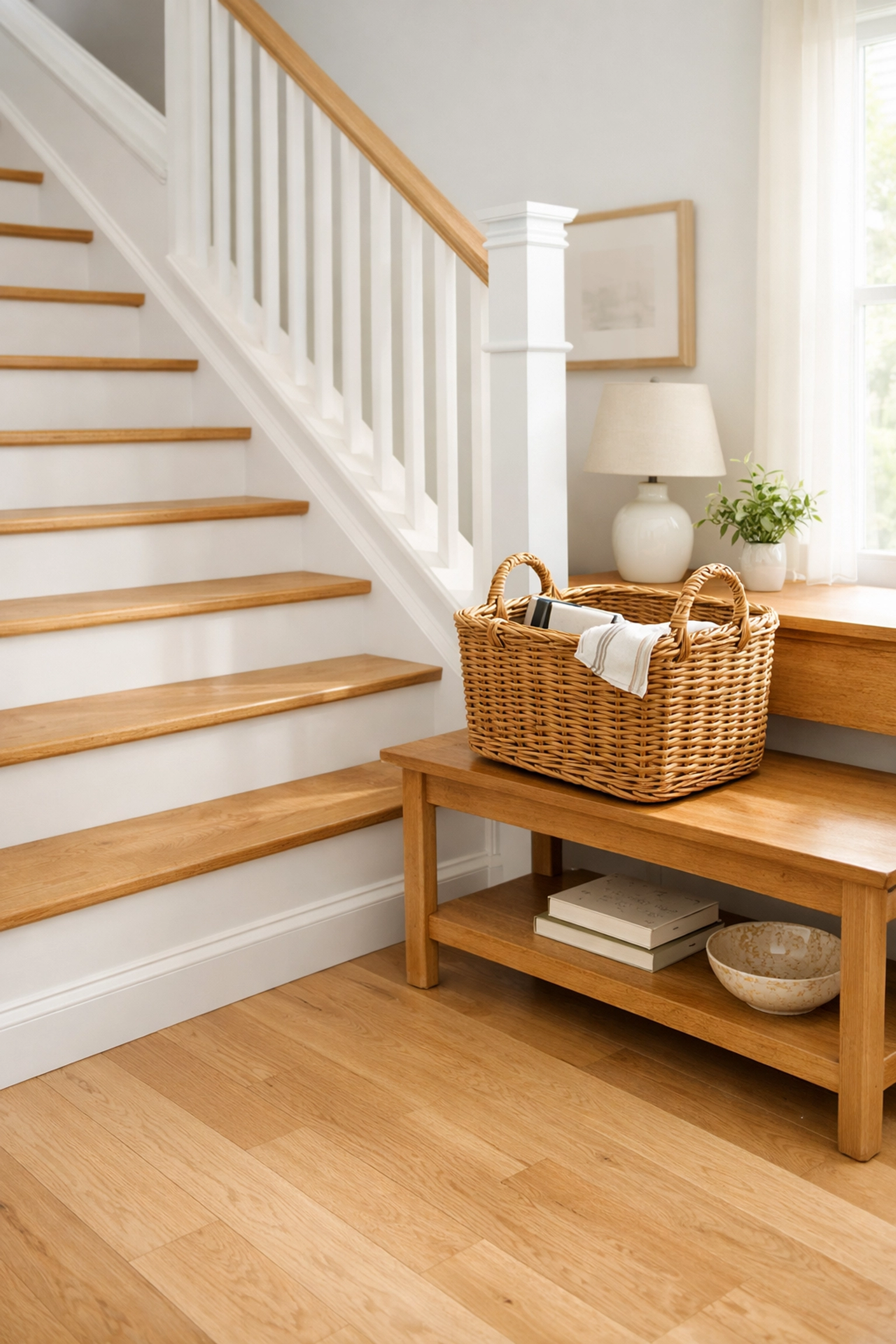
- Landing Baskets: If you need to move items between floors, place a dedicated basket on a table near the stairs, but never on the treads themselves.
- Remove Rugs: While a decorative rug at the top or bottom of the stairs might look nice, they are notorious for sliding or having edges that curl up. It's safer to remove them entirely or ensure they are secured with heavy-duty non-slip backing or rug tape.
Visual Contrast: Helping the Eyes Help the Feet
When the stairs, the risers, and the floor at the bottom are all the same color: usually seen with all-wood stairs or uniform carpeting: the staircase can look like a continuous "slide" to the aging eye. This lack of contrast makes it incredibly difficult to judge where the edge of the step is.
How to avoid the pitfall:
- Contrast Strips: Apply a strip of tape or paint in a contrasting color (like white on dark wood or black on light tile) right at the "nose" or edge of each step. This gives the brain a clear visual cue of where to place the foot.
- Highlight the Landings: Use a different color or texture for the floor at the top and bottom of the stairs so the transition to flat ground is obvious.
Structural Inconsistency: The Hidden Tripwire
Did you know that our brains "map" a staircase after the first two steps? If the first two steps are 7 inches high, your brain expects every single step after that to be exactly 7 inches high. If one step is slightly taller or shorter due to poor construction or a DIY renovation, your foot will likely catch on it.
How to check for this:
- The Ruler Test: Use a ruler to measure the height (riser) and depth (tread) of your stairs. If there is a variation of more than a quarter-inch between steps, that staircase is a high-risk zone.
- Repair Loose Boards: If a wooden step creaks or shifts when you step on it, it needs to be secured immediately. A shifting surface underfoot can trigger a panic response that leads to a fall.
When to Consider Avoiding Stairs Entirely
Part of a successful aging-in-place strategy is knowing when the environment can no longer be safely modified. While we want to maintain independence, physical changes can sometimes make stairs an unacceptable risk.
It might be time to move living quarters to the ground floor if you or your loved one experiences:
- Dizziness or Vertigo: Sudden bouts of lightheadedness are dangerous anywhere, but especially on stairs.
- Significant Shortness of Breath: If climbing three steps leads to extreme fatigue, the risk of a fall due to exhaustion increases.
- Recent Hospitalization: After a surgery or illness, balance and muscle strength are often compromised.
- Advanced Arthritis: When the pain in the knees or hips becomes so severe that it changes the way you walk, the mechanics of stair climbing become unsafe.
Beyond the Environment: Strength and Balance
While we focus a lot on the house, the person using the stairs is the other half of the safety equation. No matter how many handrails you install, maintaining leg strength and balance is key.
Simple exercises, often recommended by physical therapists, can make a world of difference. Strengthening the quadriceps and calves helps with the "lift" required for stairs, while balance exercises (like standing on one leg while holding onto a counter) help the nervous system stay sharp.
Summary Checklist for a Safe Staircase
If you’re looking at your stairs today, here is a quick "Safety Audit" you can perform:
- Is there a sturdy handrail on both sides?
- Does the lighting reach every single step without shadows?
- Are the edges of the steps clearly visible with contrasting colors?
- Are the stairs completely free of clutter, including the landings?
- Is the surface non-slip (no loose rugs or polished wood)?
- Can you wrap your hand fully around the handrail for a firm grip?
Taking the time to address these pitfalls isn't about admitting weakness; it’s about smart planning. By making these changes, you aren't just preventing a fall: you’re ensuring that your home remains a place of comfort and safety for many years to come.
Keeping things simple, clear, and well-maintained is the secret to successful aging in place. If a staircase feels like a mountain, it’s time to bring in the right tools and modifications to turn it back into a simple path from point A to point B.

