
Falls happen. Even with all the prevention strategies in the world, sometimes a senior will find themselves on the floor unexpectedly. While preventing falls is always the priority, knowing how to safely get up afterward is equally important. This knowledge can mean the difference between a minor incident and a serious injury compounded by hours spent on the floor.
Many older adults who fall stay on the ground for extended periods: not because they're injured, but because they don't know the safest way to get back up. This waiting period itself can lead to dehydration, pressure sores, hypothermia, and increased anxiety about future falls. The good news? Getting up after a fall is a skill that can be learned, practiced, and mastered.
Why the Right Technique Matters
When you fall, your first instinct might be to scramble to your feet as quickly as possible. That impulse is understandable but potentially dangerous. Rushing to stand can lead to dizziness, a second fall, or injury to joints and muscles that weren't properly supported during the recovery.
The safe approach involves moving your body through a series of positions that gradually bring you from lying down to standing. This sequential method gives your body time to adjust, allows you to assess for injuries along the way, and significantly reduces the risk of falling again during the recovery process.
Think of it like climbing stairs: you wouldn't try to leap from the bottom to the top in one jump. The same principle applies to getting up from the floor.
The Step-by-Step Method
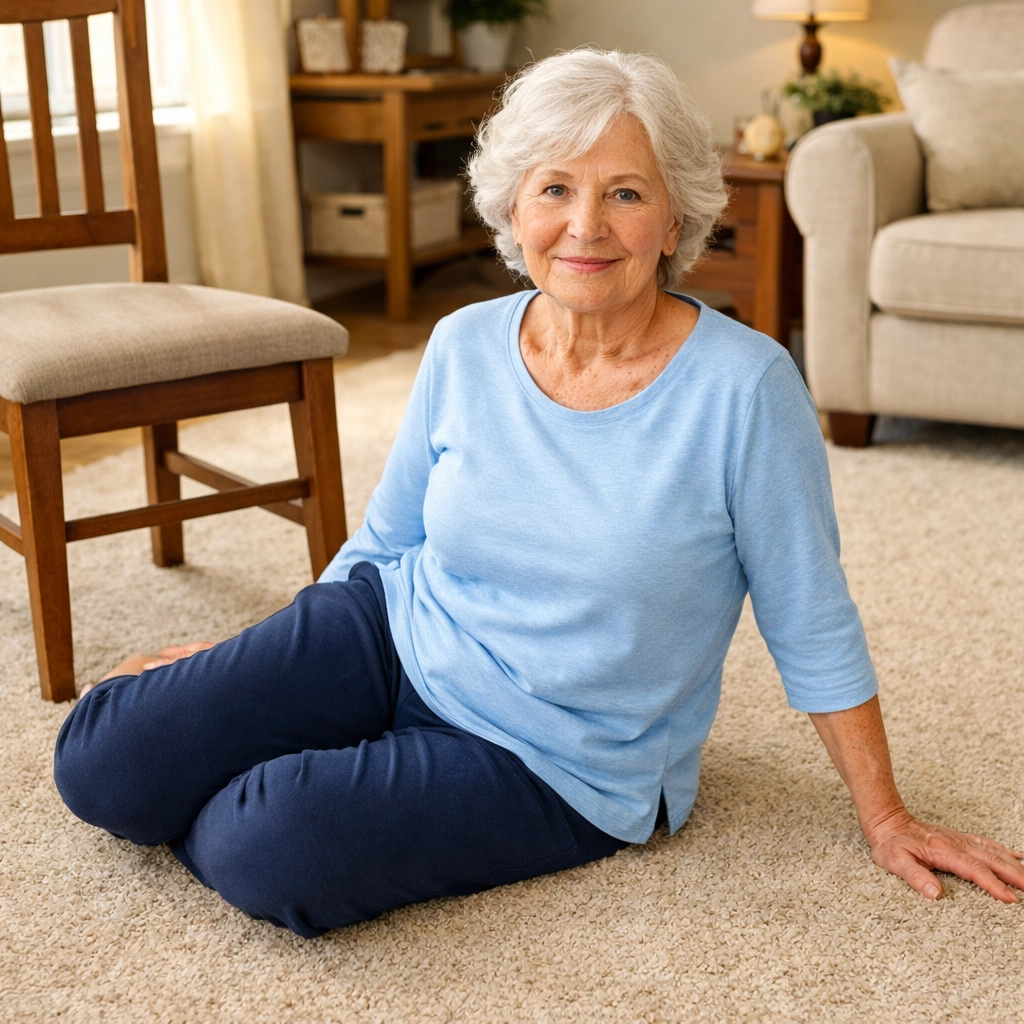
Step 1: Pause and Assess
Before you move at all, take a moment. Lie still for a few seconds and do a quick mental inventory. Can you move your fingers and toes? Do you feel sharp pain anywhere? Are you dizzy or disoriented? This brief pause helps you determine if you've been injured and whether it's safe to attempt getting up on your own.
If you're in severe pain, can't move a limb, or feel something is seriously wrong, don't try to get up. Stay where you are and call for help using your phone or medical alert device.
Step 2: Roll to Your Side
Assuming you feel capable of moving, start by rolling onto your side. If you're lying on your back, bend your knees and slowly roll to either your left or right side: whichever feels more comfortable. As you roll, extend one arm out to help support your upper body.
Take your time with this movement. There's no rush, and moving slowly helps prevent dizziness.
Step 3: Push to a Side-Sitting Position
From your side-lying position, use your free arm (the one not supporting you) to push yourself into a seated position. Your legs should be bent and both pointing in the same direction, with your bottom on the floor and your torso upright. This is called side-sitting.
This position gives you a chance to rest and further assess how you're feeling before continuing.
Step 4: Move to Hands and Knees
Now transition onto your hands and knees. This crawling position distributes your weight across four points of contact with the floor, making it stable and safe. If this movement feels too difficult, you can break it down further by first getting onto your forearms and knees, then pushing up to your hands.
Once you're on hands and knees, take a breath. You're doing great.
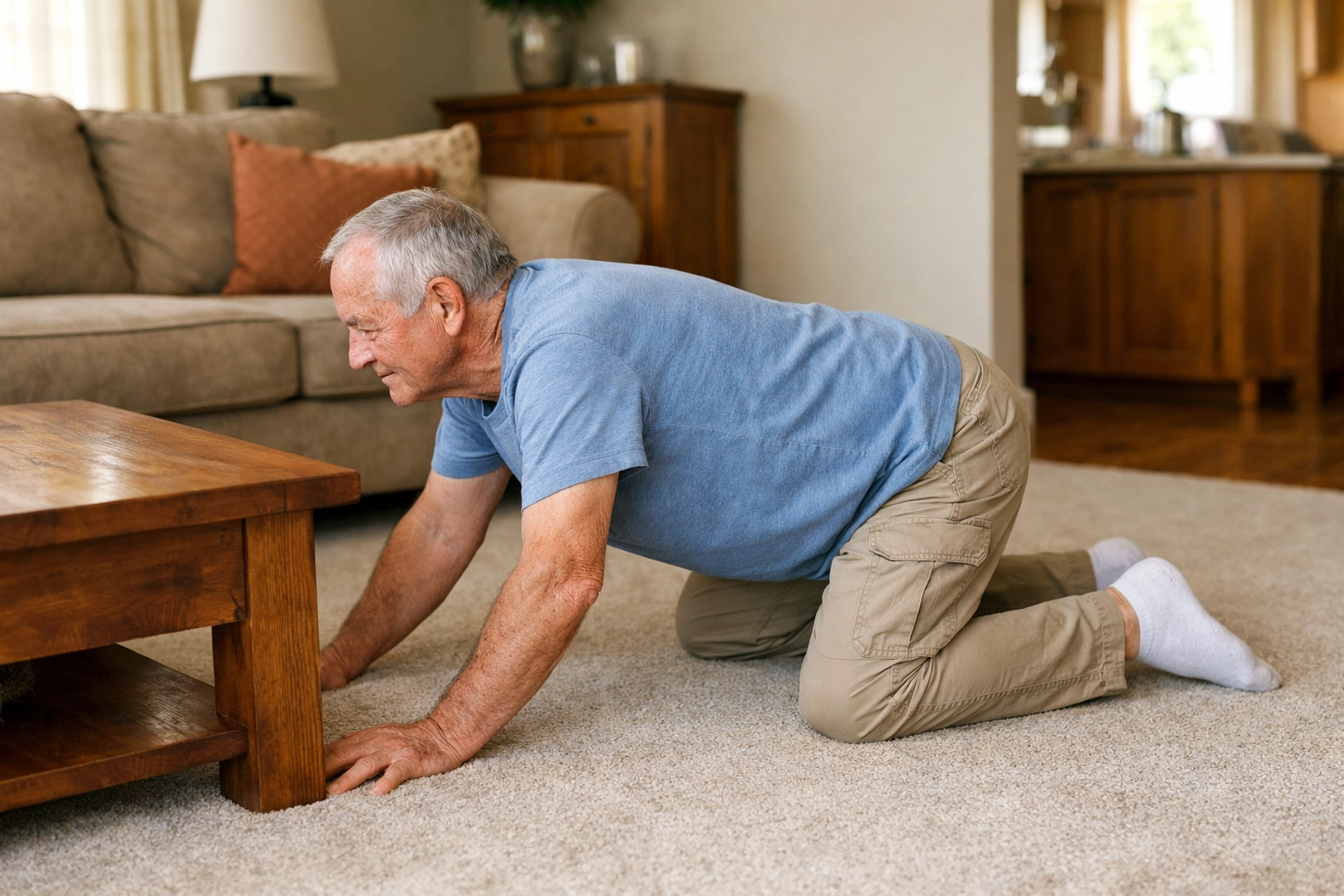
Step 5: Crawl to a Sturdy Support
Look around for the nearest piece of sturdy furniture: a chair, couch, bed frame, or wall. If you're already next to something supportive, you can skip this step. Otherwise, crawl slowly toward the most stable object you can reach.
Make sure whatever you choose can genuinely support your weight. A lightweight chair on wheels won't work. You need something solid and unmovable.
Step 6: Kneel Upright (High Kneel)
Using your chosen support, place both hands on it and push yourself up so you're kneeling upright. Both knees are still on the ground, but your torso is vertical now. Your hands on the support help you balance.
This position might feel a bit wobbly at first: that's normal. Keep your hands firmly on the support and take a moment to steady yourself.
Step 7: Move to Half-Kneeling
Here's where it gets a little trickier. From your upright kneeling position, bring one foot forward so it's flat on the floor, while keeping your other knee on the ground. You're now in what's called a half-kneeling position: it looks like you're about to propose.
Choose whichever leg feels stronger to be your front leg. Keep holding onto your support throughout this movement.
Step 8: Stand Up
Using your support and the strength in your front leg, push yourself up to standing. Think about pushing through your front heel as you rise. Your support is there to help with balance, not to haul yourself up with your arms.
If standing directly from half-kneeling feels too challenging, there's an alternative: from half-kneeling, pivot to sit on a chair or bed first, rest there, and then stand from the seated position. This two-stage approach is perfectly fine and sometimes safer.
What to Do Once You're Standing

Don't immediately start walking around. Once you're on your feet, hold onto your support and stand still for several minutes. This rest period is crucial: it allows your blood pressure to stabilize and helps you fully assess whether you've been injured.
While you're resting, think through what happened. Do you remember why you fell? Are you experiencing any pain, swelling, or unusual sensations? Did you hit your head?
Even if you feel fine, it's smart to let someone know about the fall. Call a family member, neighbor, or your doctor to report what happened. They can help you decide if you need medical attention. Some injuries, particularly to the head, might not cause obvious symptoms immediately.
If you notice any of the following, seek medical attention right away:
- Severe pain or inability to move a joint
- Obvious deformity or swelling
- Numbness or tingling that doesn't resolve
- Confusion or persistent dizziness
- Any head injury, even if you feel fine
Building the Strength to Get Up
Knowing the technique is only half the battle. Your body needs sufficient strength and flexibility to execute these movements. The good news is that you can prepare yourself through regular exercise.
The Centers for Disease Control and Prevention recommends doing strength and balance exercises at least three times per week. These exercises don't have to be complicated or require a gym membership. Simple movements done consistently make a real difference.
Exercises That Help
Knee Straightening: Sit in a sturdy chair. Slowly straighten one knee until your leg is extended in front of you. Hold this position for five seconds, then slowly lower your foot back to the floor. Do this ten times on each leg. This movement strengthens your quadriceps, which are essential for standing up.
Calf Raises and Heel Rocks: Stand while holding onto a counter, sink, or the back of a heavy chair. Rise up on your toes, hold briefly, then lower back down. Next, rock back on your heels, lifting your toes off the ground. Lower back down. Repeat this sequence ten times. This exercise improves ankle strength and balance.
Getting Down and Up Practice: If you're physically able and have someone with you for safety, practice the entire getting-up sequence from the floor. Do this slowly and carefully, treating it as an exercise rather than an emergency. The more familiar your body becomes with these movements, the more confidently you'll be able to perform them if you actually fall.
Preparing Your Environment

While strengthening your body helps, you should also set up your environment to make getting up easier and safer if a fall does occur.
Keep a phone accessible wherever you spend time. Consider keeping a phone in each major room, or carry a mobile phone in your pocket throughout the day. Medical alert systems that you wear as a pendant or bracelet can automatically detect falls and call for help.
Arrange your furniture thoughtfully. Having sturdy furniture pieces distributed throughout your home gives you crawling destinations if you fall. Just make sure these pieces are stable: secure bookcases to walls, check that chairs won't tip, and avoid relying on anything with wheels.
Adequate lighting helps you assess your situation and see where you're crawling. Consider motion-activated night lights for hallways and bathrooms.
Remove or secure area rugs, which can slip or bunch up if you're crawling across them. Clear floor spaces of clutter that might block your path to supportive furniture.
The Confidence Factor
Many seniors avoid practicing floor recovery techniques because they're afraid they'll fall during practice and won't be able to get up. This creates a circular problem: the fear prevents practice, and the lack of practice increases the difficulty if a real fall occurs.
If you want to practice but feel nervous, ask a physical therapist, family member, or caregiver to supervise. They can spot you without actually helping, allowing you to build confidence in your own abilities. You might also practice on a soft surface like a yoga mat or carpeted area rather than hard flooring.
Some community centers and senior organizations offer fall recovery workshops where you can learn these techniques in a supervised group setting. Learning alongside peers often feels less intimidating than practicing alone.
When Getting Up Isn't Possible
Despite your best efforts, there might be times when you simply cannot get up on your own. That's not a failure: it's a reality that preparation can address.
This is why medical alert systems exist. These devices can detect when you've fallen and automatically call for help, or they allow you to press a button to summon assistance. If you live alone or have any mobility concerns, a medical alert system provides valuable peace of mind.
Keep emergency numbers programmed in your phone. Know how to reach a neighbor or nearby family member quickly. Some people keep a spare key in a lockbox outside their home so that emergency responders can get in without breaking down the door.
Moving Forward with Confidence
Learning how to get up after a fall doesn't mean you're expecting to fall: it means you're being smart and prepared. Just like learning CPR doesn't mean you expect someone to have a heart attack, knowing fall recovery techniques is simply practical preparedness.
The sequential method: rolling to your side, sitting up, moving to hands and knees, crawling to support, kneeling, half-kneeling, and finally standing: works because it respects how your body naturally moves. Each position is stable and gives you time to assess before moving to the next.
Practice these movements when you're feeling well, build your strength through regular exercise, and prepare your environment to support safe recovery. With these tools, you'll have the confidence to handle a fall if one occurs: and the strength to help prevent falls in the first place.
Remember, the goal isn't to become an expert at falling. The goal is to have one more tool in your safety toolkit, one more reason to feel confident and independent in your own home.

