
Hey there. I’m Brian Kerr, the founder here at Fall Guys Products. Over the years, I’ve seen how much a walker or a rollator can change someone’s life. They aren’t just "medical equipment": they are keys to independence. They let you get to the kitchen to make coffee, join the family in the garden, and stay active in your own home.
However, there is a bit of a catch. Just having the walker isn't enough. You have to use it the right way. I often tell our community that a walker is like a high-performance tool; if you use a hammer to turn a screw, you’re going to have a hard time. The same goes for mobility aids.
Most falls involving walkers don't happen because the equipment broke. They happen because of small, easy-to-miss habits that sneak into our daily routines. Today, I want to walk you through the most common mistakes we see and, more importantly, how to fix them so you can move with total confidence.
The Foundation: Is Your Walker at the Right Height?
The most common mistake happens before you even take your first step. If the height of your walker isn't dialed in, the rest of your mechanics will be off.
Think about it: if the handles are too low, you’re forced to hunch over. This puts a massive amount of strain on your lower back, neck, and shoulders. More importantly, it shifts your center of gravity forward, making you "front-heavy" and much more likely to trip.
On the flip side, if the walker is too high, your elbows will be bent too much. You won't be able to push down through your arms to support your weight if you lose your balance. It's like trying to push yourself out of a pool with your hands at chin level: you just don't have the leverage.
The Fix: The Wrist Crease Rule
To get the perfect fit, stand up as straight as you comfortably can. Let your arms hang naturally at your sides. Look at where your wrist creases are (the spot where your hand meets your arm). The handgrips of your walker should be level with those creases. When you grab the handles, your elbows should have a slight bend: about 15 degrees. This keeps your muscles engaged and ready to support you without causing fatigue.

Mistake #1: The "Shopping Cart" Lean
We’ve all done it. We push the walker way out in front of us and then "chase" after it, leaning our weight onto the handles as we walk. While this might feel like you're moving faster, it’s actually one of the most dangerous ways to use a mobility aid.
When the walker is far in front of your body, it can't support you. If your toe catches on the edge of a rug, you’re already leaning forward into "empty space." The walker will likely roll further away, and you’ll head toward the floor.
The Fix: Walk Inside the Frame
You should always be walking inside the walker, not behind it. Your feet should stay between the back legs of the walker (or between the rear wheels if it’s a rollator). Think of the walker as a protective bubble. Move the walker forward just a few inches, then step into it. Keep your torso upright and your eyes looking forward, not down at your feet.
Mistake #2: The "Lifting Anchor" Move
This is a big one, and it happens every time someone goes to stand up from a chair or a sofa. The instinct is to reach out, grab the walker handles, and pull yourself up.
The problem? Walkers are designed to handle downward pressure, not horizontal pulling. Because they are lightweight, pulling on them can cause the walker to tip toward you. If that happens while you’re mid-rise, you have nothing to hold onto, and you’re likely to fall backward.
The Fix: Push, Don't Pull
Never use the walker to pull yourself into a standing position. Instead, use the armrests of your chair or push off the seat of the sofa. Once you are fully upright and have found your balance, then: and only then: should you reach forward and place your hands on the walker grips.

Mistake #3: Pivoting on a Dime
When it’s time to turn around: maybe to head back to the bedroom or turn toward the kitchen table: many people try to pivot on one foot while swinging the walker around. This is a recipe for a tumble. Pivoting can cause your feet to get tangled in the legs of the walker, or you might accidentally trip over your own toes.
The Fix: The Wide Turn
Treat your walker like a large vehicle. Instead of a sharp pivot, take small, deliberate steps in a gentle curve. Keep the walker in front of you as you turn. Move your feet and the walker together in a slow "march." It takes an extra three seconds, but it ensures your center of gravity stays right where it belongs: over your feet.
Mistake #4: Forgetting the "Park" Brake
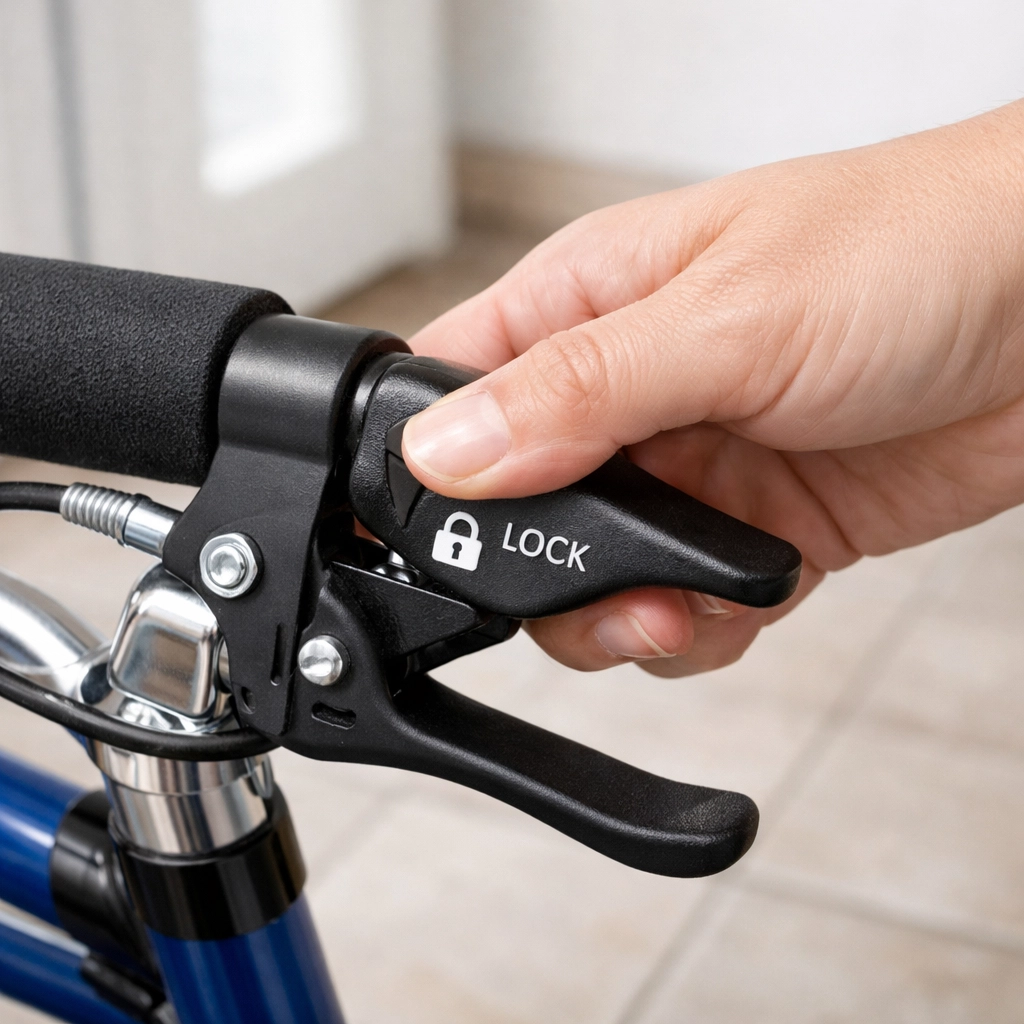
If you use a rollator (the kind with four wheels and a built-in seat), the brakes are your best friend: but only if you use them. Many falls happen because the rollator rolls away while someone is trying to sit down on the built-in seat or stand up from it.
The Fix: Click Before You Sit
Most rollators have brakes that "lock" when you push the levers down until they click. You must engage these locks every single time you intend to sit on the rollator seat or use it as a steadying point while standing up. Make it a habit. "Reach, Click, Sit." If the wheels can move, the rollator isn't a chair; it’s a skateboard.
Mistake #5: Looking at Your Feet
It’s natural to want to see where you’re stepping, especially if you’re worried about tripping. However, staring at your feet actually makes you more likely to fall. When you look down, your posture slumps, your neck rounds, and you lose track of what’s in front of you: like a pet, a doorway, or a change in flooring.
The Fix: Horizon Scanning
Try to keep your chin up and look about 10 to 15 feet in front of you. This allows your peripheral vision to map out the floor while your main focus stays on your environment. If you need to check a specific threshold, stop moving, look down to clear it, then look back up before you continue walking.
Mistake #6: Overloading the Front
We see this a lot with baskets and bags. It’s tempting to hang a heavy purse or a grocery bag over the front bar of the walker. While it’s convenient, it changes the weight distribution of the device. A front-heavy walker is harder to steer and much more prone to tipping forward if the wheels hit a small bump.
The Fix: Center Your Load
If you need to carry items, use a basket or a pouch specifically designed for your model of walker. These are usually positioned lower and more toward the center of the frame to keep the center of gravity stable. Keep the weight light: if it’s heavy enough to make the walker feel "tippy," it’s too much.
Mistake #7: The "Occasional" User Syndrome
Sometimes, we feel pretty good. Maybe it’s a "strong leg day," and we think, "I'm just going to the bathroom, I don't need the walker for this short trip."
In my experience, many falls happen during these short, unassisted trips. You might get a sudden dizzy spell, or the cat might dart under your feet. Without your mobility aid, you have no "safety net" to grab onto.
The Fix: Consistency is Safety
If your physical therapist or doctor has recommended a walker, use it for every trip, no matter how short. Think of it like a seatbelt. You don't put it on because you expect to crash; you put it on just in case something unexpected happens.

Maintaining Your Equipment
A walker is a mechanical device, and like a car, it needs a quick "safety check" every now and then.
- Check the Rubber Tips: If you have a standard walker (no wheels or wheels only on the front), the rubber tips on the back legs eventually wear down. When they get thin or smooth, they lose their grip and can slide on hardwood or tile. Replace them as soon as the tread looks worn.
- Check the Wheels: Make sure they aren't wobbly and that they spin freely. Hair and carpet fibers can get tangled in the axles, which can make the walker pull to one side.
- Check the Grips: If the foam or rubber on the handles is loose or sticky, it can cause your hands to slip. New grips are an inexpensive way to make an old walker feel new again.
Environmental Hazards to Watch For
Even with perfect technique, your environment plays a huge role. When using a walker, keep an eye out for:
- Throw Rugs: These are the #1 enemy of walkers. The legs or wheels can easily catch on the edge.
- Thresholds: The little wooden or metal strips between rooms. Approach them straight-on, not at an angle.
- Lighting: It’s hard to use a walker correctly in the dark. Make sure hallways and pathways to the bathroom are well-lit.
Working with the Pros
While I can give you these tips based on years of experience, nothing beats a one-on-one session with a Physical Therapist (PT) or Occupational Therapist (OT). They can watch you walk, fine-tune your height adjustments, and give you specific exercises to strengthen the muscles you use for balance.
If you’re finding that your walker feels "clunky" or you’re still feeling unsteady, don't be afraid to ask for a professional assessment. They can help you decide if you have the right type of aid. Sometimes a person using a standard walker would actually be much safer and more mobile with a rollator, or vice versa.
A Final Reassurance
Learning to use a mobility aid properly is a skill, just like driving or riding a bike. It might feel a little awkward at first, and you might have to consciously remind yourself to "walk inside the frame" or "lock the brakes." That’s okay.
The goal isn't to look like a pro on day one. The goal is to move safely so you can keep doing the things you love. By avoiding these common mistakes, you’re not just preventing a fall: you’re protecting your independence.
Stay safe out there, keep your chin up, and take it one step at a time. We're here to support you every inch of the way.

