
Hi there, I’m Brian Kerr, the founder of Fall Guys Products. If you or a loved one have recently started using a walker, I want to start by saying something important: a mobility aid is not a sign of "giving up." In fact, it’s the exact opposite. It is a tool for independence, a way to keep moving, and a vital piece of equipment that helps you stay engaged with the world.
However, just like any tool, whether it’s a lawnmower or a kitchen appliance, it only works safely if you know how to handle it. Over the years, I’ve seen many folks use their walkers in ways that actually increase their risk of falling, rather than decreasing it. It’s often the little habits, the small shortcuts we take, that lead to a stumble.
In this guide, we are going to break down the most common mistakes people make with their walkers and provide a clear, five-step path to using your mobility aid with confidence and safety.
Why Proper Technique Matters More Than You Think
A walker is designed to provide a wider base of support. When we stand on our own two feet, our "center of gravity" has to stay within the small area between our shoes. If we lean too far, we fall. A walker expands that area, giving us a much larger "safety zone."
But when we use a walker incorrectly, by pushing it too far ahead or leaning on it like a shopping cart, we move our center of gravity outside of that safety zone. Instead of the walker supporting us, we end up "chasing" the walker. If the walker slips or moves unexpectedly when you are in a compromised position, a fall is almost inevitable.
Using a walker properly isn't just about preventing falls, though. It’s also about ergonomics. Using a walker at the wrong height or with the wrong posture can lead to chronic back pain, shoulder strain, and wrist fatigue. We want you moving, but we want you moving comfortably.

The 5 Most Common Walker Mistakes
Before we get into the "how-to," let's look at what not to do. Do any of these sound familiar?
1. The "Chaser" Mistake
This is perhaps the most common error. Many people push their walker way out in front of them and then "chase" after it with their feet. When the walker is two feet ahead of you, it provides zero stability for your core. If you trip on a rug or a threshold while the walker is out there, you have nothing to grab onto that is actually under your center of weight.
2. Using the Walker to Pull Yourself Up
When getting out of a chair or off the bed, it is incredibly tempting to grab the handles of the walker and pull yourself up. Please, don't do this. Walkers are designed to be pushed down on, not pulled horizontally. If you pull on a walker, it can easily tip over toward you, leading to a nasty fall before you’ve even started walking.
3. The "Hunchback" Posture
If your walker is set too low, you’ll find yourself leaning forward and looking at the ground. Not only does this cause terrible back pain, but looking at your feet is a major fall risk. You need to be looking at the environment ahead of you to spot hazards like pets, cords, or spills.
4. The Sharp Pivot
When it’s time to turn around, many people try to "swivel" the walker and their body at the same time in one quick motion. This can cause the walker to tip or your feet to get tangled in the legs of the device.
5. Forgetting the Brakes (on Rollators)
If you are using a rolling walker (a rollator) with a seat, the most dangerous moment is the transition from standing to sitting. If those hand brakes aren't locked, the walker can roll away the moment your weight hits the seat, leaving you on the floor.
5 Steps to Using Your Walker Properly
Now that we know what to avoid, let’s walk through the right way to do it. These five steps are the foundation of safe mobility.
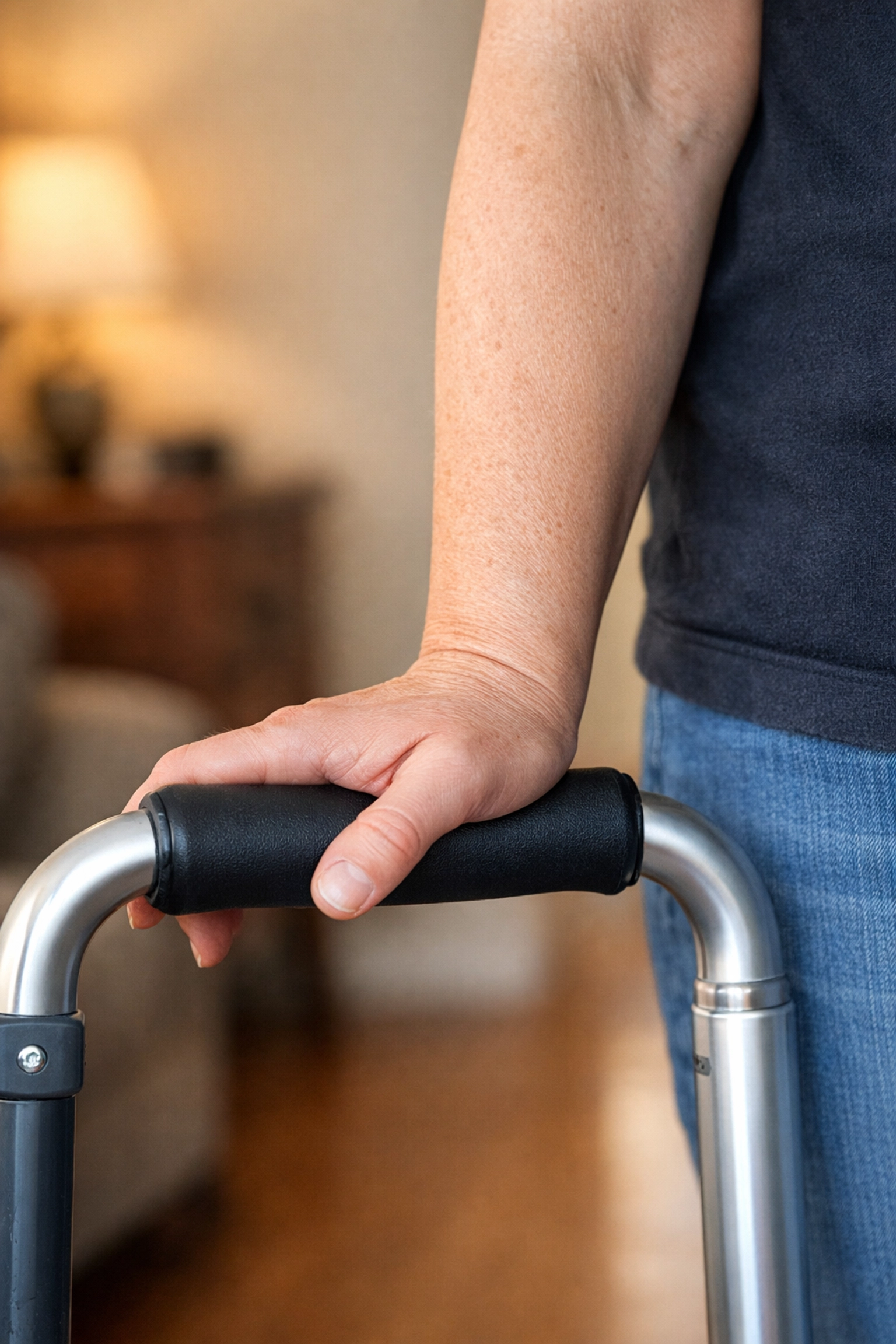
Step 1: Get the Height Just Right (The "Wrist Rule")
Proper use starts before you take your first step. If the walker isn't fitted to your body, nothing else will feel right.
To check the height:
- Stand up as straight as you can (have someone help you if you’re unsteady).
- Let your arms hang naturally at your sides.
- Look at the inside of your wrist: specifically the crease where your hand meets your arm.
- The top of the walker handles should line up exactly with that wrist crease.
When you grab the handles to walk, this height ensures that your elbows have a slight bend (about 15 degrees). This bend allows your muscles to act as shock absorbers and gives you the leverage you need to support your weight without straining your shoulders.
Step 2: Stay Inside the "Bubble"
Think of your walker as a protective bubble. To stay safe, your body needs to stay inside that bubble.
When you stand with your walker, your midsection should be roughly in line with the back legs of the walker (or the back wheels). You should never be so far back that you are reaching for the handles, and you should never be so far forward that you’re bumping your shins on the crossbar. Staying centered ensures that if you lose your balance, your weight goes directly down into the four points of contact on the floor.
Step 3: The "Move, Step, Step" Sequence
Walking with a mobility aid is a rhythm. If you rush the rhythm, you lose the stability. Whether you are using a standard folding walker or a front-wheeled walker, follow this three-part beat:
- Move: Push the walker forward about one comfortable arm's length. Ensure all four legs/wheels are firmly on the ground.
- Step: Step forward with your weaker leg first. Place your foot into the center of the walker's frame.
- Step: Step forward with your stronger leg, bringing it even with or slightly ahead of the first foot.
By moving the walker first, you are "setting" your base of support before you move your weight.
Step 4: Look Ahead, Not Down
It is a natural instinct to look at your feet when you’re worried about falling. However, your feet know what they’re doing: it’s the floor ten feet in front of you that you need to worry about.
Try to keep your chin up and your eyes scanning the horizon. This helps maintain a more upright posture, which keeps your center of gravity over your hips rather than out over your toes. If you are worried about what’s immediately in front of your feet, use your peripheral vision rather than tilting your whole head down.
Step 5: Master the Sit-to-Stand Transition
Most falls happen during transitions: moving from a seated position to a standing one. Here is the safest way to get up using a walker:
- Scoot: Sit on the edge of the chair so your feet are firmly on the floor.
- Position the Walker: Pull the walker close to you, but do not hold it yet.
- Push, Don’t Pull: Place your hands on the armrests of the chair or the surface of the bed. Push down through your arms and legs to stand up.
- Reach: Once you are upright and have your balance, reach for the walker handles one at a time.
When sitting down, do the reverse. Back up until you feel the chair against the back of your legs. Reach back for the armrests with your hands, and slowly lower yourself down. Never hold onto the walker as you sit, as it can tip toward you.

Special Considerations for Different Types of Walkers
Not all walkers are created equal, and the way you use them can vary slightly depending on the model.
Standard Folding Walkers
These have no wheels. They offer the most stability but require the most energy because you have to pick the walker up entirely to move it forward. These are best for people with significant balance issues or those who only need to move short distances. When using these, make sure all four rubber tips hit the floor at the exact same time to avoid a "see-saw" effect.
Front-Wheeled Walkers
These have two wheels in the front and two tennis balls or glides in the back. These are great because you can maintain a more natural walking gait without lifting the device. You simply slide it forward. The key here is to ensure the back glides don’t "catch" on carpet edges.
Rollators (Four-Wheeled Walkers)
These have four wheels, a seat, and hand brakes. They are wonderful for people who have the balance to manage a moving device but need frequent rests. Because all four wheels move, these can "run away" from you on a slope. Always keep your hands near the brakes, and always lock the brakes before you sit on the built-in seat.
Maintaining Your Mobility Aid
A walker is a mechanical device, and it needs a little "TLC" to stay safe. I recommend doing a quick "safety check" once a week:
- Check the Tips: If you have a standard walker, look at the rubber tips on the bottom. If the tread is worn down (like a bald tire), they can become slippery on hardwood or tile. Replace them immediately if they look smooth.
- Inspect the Glides: If you use tennis balls or plastic glides on the back of a wheeled walker, check for holes. A worn-out glide can scratch your floors or "snag" on a rug.
- Test the Brakes: If you have a rollator, squeeze the brakes. If they feel "mushy" or don't stop the wheels instantly, the cables might need tightening.
- Tighten the Bolts: Give the walker a little shake. If it rattles or feels "wiggly," some of the adjustment buttons or bolts may be loose.

Final Thoughts from Brian
Using a walker is a skill, and like any skill, it takes practice. For the first few days, you might feel a bit clumsy or self-conscious. That’s completely normal. The goal isn't to be "fast"; the goal is to be "steady."
If you find that you are still struggling with your balance even with a walker, I highly recommend talking to a Physical Therapist. They are the absolute experts in gait training. They can watch you walk, identify the specific muscles that might be weak, and give you exercises to make you even more confident on your feet.
At Fall Guys Products, our mission is to help you stay in the home you love, safely and independently. A walker is a big part of that equation. Use it correctly, treat it well, and it will keep you moving forward for years to come.
Stay safe, stay active, and keep that chin up!

