
Using a walker is a major step toward maintaining independence. It’s a tool that bridges the gap between needing help and staying mobile on your own terms. However, simply having a walker in your hands isn’t enough to guarantee safety. Like any specialized piece of medical equipment, there is a right way and a wrong way to use it.
When used correctly, a walker provides a stable base of support that helps you navigate your home and community with confidence. When used incorrectly, it can actually become a tripping hazard or lead to secondary issues like back pain and shoulder strain.
I’ve seen many folks start using a walker without any formal training, assuming it’s as intuitive as pushing a shopping cart. While there are similarities, the nuances of body mechanics matter immensely. In this guide, we’re going to look at the seven most common mistakes people make with their walkers and, more importantly, how to fix them so you can move safely.
1. The "Shopping Cart" Trap: Walking Inside the Walker
One of the most frequent mistakes we see is someone stepping too far into the frame of the walker. While it might feel like you’re more "inside" the safety zone, you’re actually shifting your center of gravity.
When your body is positioned entirely inside the walker, your center of balance often ends up behind the device. Walkers are designed to support weight that is pushed downward and slightly forward. They offer virtually no support if you begin to tip backward. If you lose your balance while standing deep inside the frame, the walker could tilt up or scoot away from you, leaving you with nothing to grab.
The Fix: Find the "Sweet Spot"
Instead of stepping into the middle of the frame, aim to keep the walker slightly in front of you. Think of it as a rolling or sliding support system that stays just a half-step ahead.
- Positioning: Stand with your feet roughly in line with the back legs or the rear wheels of the walker.
- The Movement: Push the walker forward a short distance, then step into it. Your toes should generally stay behind the front bar of the walker.
- Posture: Maintain a slight forward lean: not a slouch, but a purposeful engagement with the handles: similar to how you would push a heavy door open.
2. The Dangerous Turn: Crossing Your Legs
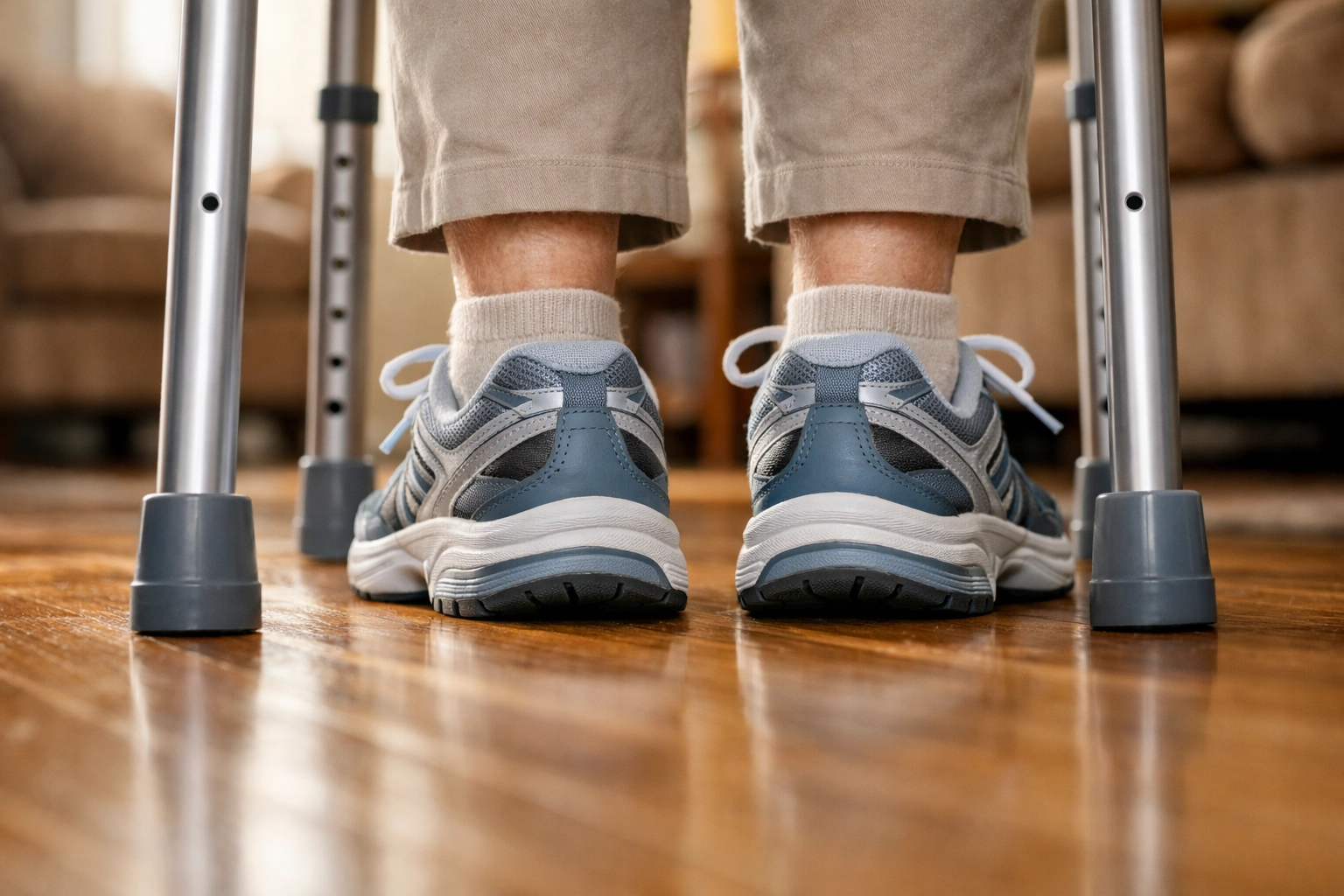
Turning is statistically the most dangerous movement for walker users. Research indicates that the majority of falls in senior living environments occur during a transition or a change in direction. The most common error is "crossing over": stepping one foot over the other while trying to pivot.
When you cross your legs, your base of support becomes extremely narrow. If the walker moves unexpectedly or if you lose your balance mid-step, your feet are literally tangled, making a recovery nearly impossible.
The Fix: The "Clock" Method
Turning should be a slow, deliberate process of many small steps rather than one or two big pivots.
- Turn the Walker First: Stop moving forward. Rotate the walker in the direction you want to go while your feet stay still.
- Step to Follow: Once the walker is angled correctly, take small steps to bring your body in line with it.
- Keep Your Base Wide: Keep your feet about shoulder-width apart throughout the entire turn. Never let one foot cross the "midline" of your body. Think of it like a clock: move from 12 to 1, then 1 to 2, rather than trying to jump from 12 to 3 in one motion.
3. The Hunchback Effect: Incorrect Handle Height
If you find yourself leaning way over or, conversely, feeling like your shoulders are up in your ears, your walker is likely the wrong height.
A walker that is too low forces you to hunch over. This rounds your spine, puts immense pressure on your lower back, and forces your gaze toward the floor rather than the path ahead. A walker that is too high prevents you from putting proper weight through your arms, which means the device won't stabilize you if you stumble.
The Fix: The "Wrist Crease" Rule
Adjusting your walker is a one-time task that pays dividends every single day. Here is the clinical standard for getting the height right:
- Stand as straight as possible with your arms hanging naturally at your sides.
- Look at your wrist. There is a natural crease where your hand meets your arm.
- The top of the walker handles should align exactly with that wrist crease.
- When you grip the handles, you should have a slight bend in your elbows (about 20 to 30 degrees). This allows you to use your arm muscles effectively to support your weight.

4. Using the Wrong Walker for Your Balance Level
Not all walkers are created equal. There are standard walkers (no wheels), front-wheeled walkers (two wheels), and rollators (four wheels and a seat). Using the wrong one for your specific physical needs is a recipe for instability.
For instance, rollators are great for people who have the endurance to walk but need frequent rests. However, because they have four wheels and hand brakes, they can "run away" from someone who has significant balance issues or who tends to lean heavily on the device for support. Conversely, a standard walker requires you to lift it with every step, which can lead to fatigue and tripping if you don't have the upper body strength.
The Fix: Get a Professional Assessment
Choosing a mobility aid shouldn't be a DIY project based on what’s on sale.
- Consult a Physical Therapist: A PT can evaluate your gait, your strength, and your balance to recommend the specific type of walker that fits your needs.
- Consider the Environment: If you walk mostly on thick carpets, a front-wheeled walker with "skis" or glides on the back legs is often better than a four-wheeled rollator, which can get bogged down.
- Test the Brakes: If you choose a rollator, ensure you have the hand strength to engage the brakes fully before you ever try to sit on the built-in seat.
5. The "Death Grip" and Arm Extension
It’s natural to feel like you need to hold onto the walker for dear life, especially if you’ve had a fall in the past. However, gripping the handles too tightly can lead to hand fatigue and even carpal tunnel issues. Furthermore, many users push the walker too far out in front of them, effectively "reaching" for their support.
When your arms are fully extended and locked out, you lose the ability to react to a bump in the rug or a slick spot on the floor. Your arms act as shock absorbers; if they are locked, the force of a stumble goes straight to your shoulders and neck.
The Fix: Relaxed Control
Your relationship with the walker should be firm but flexible.
- The "Soft" Elbow: Keep that 20-30 degree bend we mentioned earlier. This allows your biceps and triceps to help stabilize you.
- Check Your Distance: If your arms are straight out, the walker is too far away. Bring it back toward you. You should be able to look down and see the back legs of the walker near your mid-foot.
- Grip Maintenance: If the plastic grips are uncomfortable, look into foam or gel covers. They can reduce the need to squeeze so hard to maintain control.

6. Neglecting Equipment Maintenance
A walker is a mechanical device. Over time, parts wear out. The most common maintenance mistake is ignoring the rubber tips on the bottom of the legs or the brakes on a rollator.
Rubber tips are designed to grip the floor. When they wear down, they become smooth and slick, which can cause the walker to slide out from under you on tile or hardwood floors. Similarly, rollator brakes can loosen over time, meaning that when you "lock" them to sit down, the walker might still roll backward.
The Fix: The Monthly Safety Check
Mark your calendar to give your walker a "tune-up" once a month.
- Inspect the Tips: Look at the rubber feet. Do they have plenty of tread left? If they look smooth or if you can see the metal of the walker leg poking through, replace them immediately.
- Check the "Skis": If you use plastic glides on the back of a front-wheeled walker, ensure they haven't worn down to a sharp point, which can snag on carpets.
- Brake Test: Lock the brakes on your rollator and try to push it. It shouldn't budge. If it does, the cables likely need tightening.
- Tighten Bolts: Ensure the folding mechanism clicks securely into place and that no screws have wiggled loose.
7. Lack of Practice on Varied Surfaces
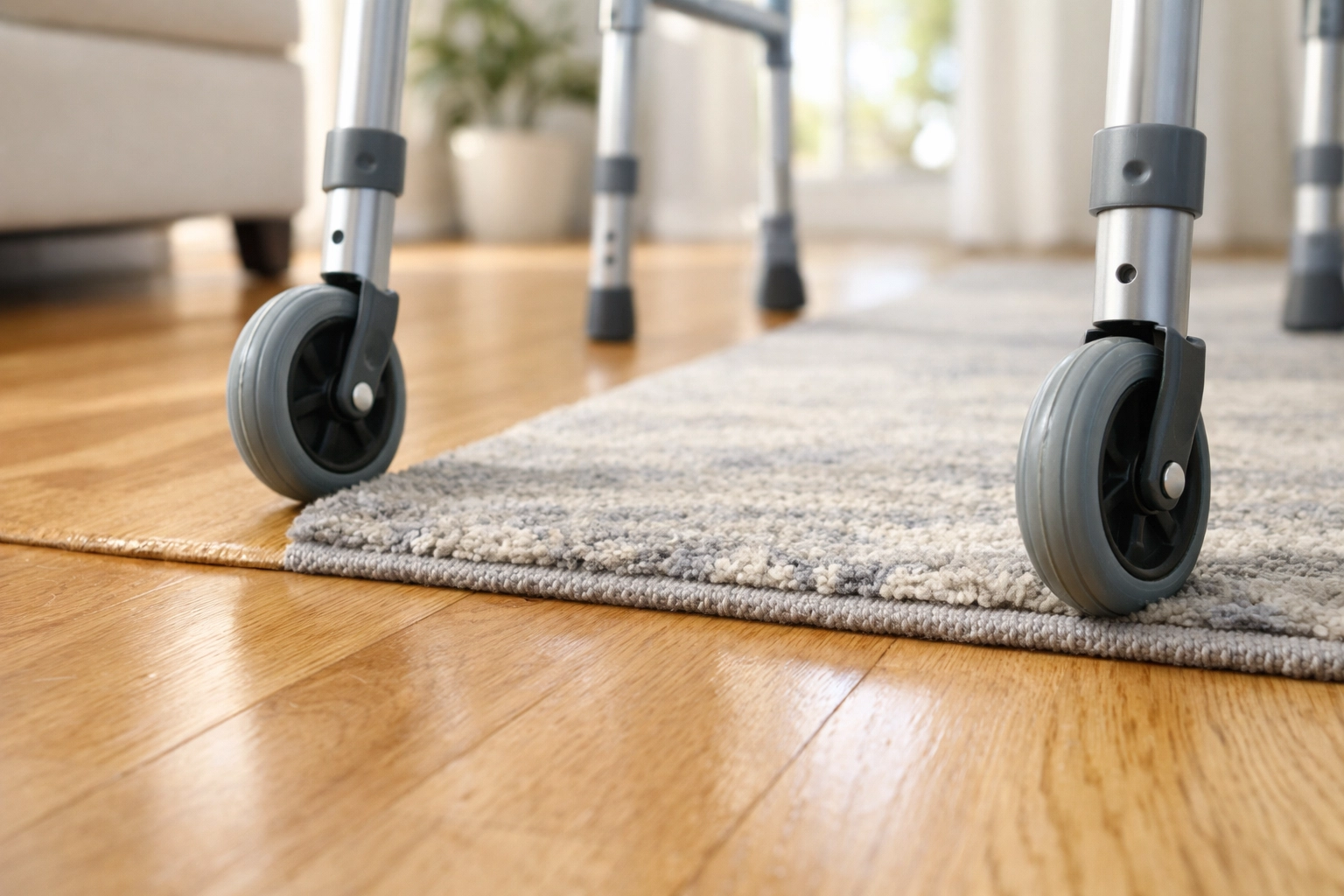
Many people learn to use their walker in a hospital hallway or a flat PT clinic. But the real world is full of transitions: from hardwood to thick rugs, from flat sidewalks to sloped driveways, and from indoor lighting to bright sun.
The mistake here is assuming that the technique that works on a linoleum floor will work on a gravel path or a plush carpet. Most walker-related falls occur at "transition points": the little lip between the bathroom and the hallway, or the edge of a rug.
The Fix: Controlled Exposure
Don't wait for an emergency to navigate a difficult surface.
- The "Lift and Set": If you encounter a rug or a small threshold, don't try to "plow" through it. Stop, lift the front wheels or legs over the obstacle, set them down securely, and then step forward.
- Outdoor Awareness: When walking outside, keep your head up. Looking down at your feet prevents you from seeing the uneven sidewalk or the wet leaves ahead.
- Light the Way: Ensure your home transitions are well-lit. Shadows can make a flat floor look like a step, causing you to lift the walker unnecessarily and lose your balance.
Moving Forward With Confidence
A walker is a tool of empowerment. It’s the difference between staying home and joining the family for a walk in the park. By avoiding these common pitfalls, you aren't just preventing falls; you're improving your posture, reducing your pain, and building the confidence to stay active.
Remember that using a walker is a skill. Like any skill, it takes practice and a bit of mindfulness. If you find yourself struggling with any of these points, don't hesitate to reach out to a healthcare professional for a quick "refresher" session. They can help you fine-tune your technique and ensure your equipment is in top shape.
Safety isn't about moving less; it's about moving smarter. Take the time to check your handle height, watch your feet during turns, and give those rubber tips a quick inspection today. Your future self will thank you for the extra bit of care.

