
Staircases are often the most architectural and beautiful parts of a home, but they are also the most demanding in terms of physical navigation. For many of us, going up and down the stairs is something we do on autopilot. We’ve done it thousands of times, and our bodies move through the motions without much conscious thought. However, as we age or as our mobility needs change, the margin for error on a staircase becomes significantly smaller.
Stair safety isn't just about preventing a major fall; it’s about maintaining independence and confidence within your own home. When a person feels uneasy about their stairs, they often start limiting their movements: staying on one floor and avoiding parts of their home they once loved. By identifying common mistakes and implementing practical fixes, we can transform the staircase from a source of anxiety into a safe, functional part of the house.
Here are seven common mistakes people make with stair safety and, more importantly, how you can fix them.
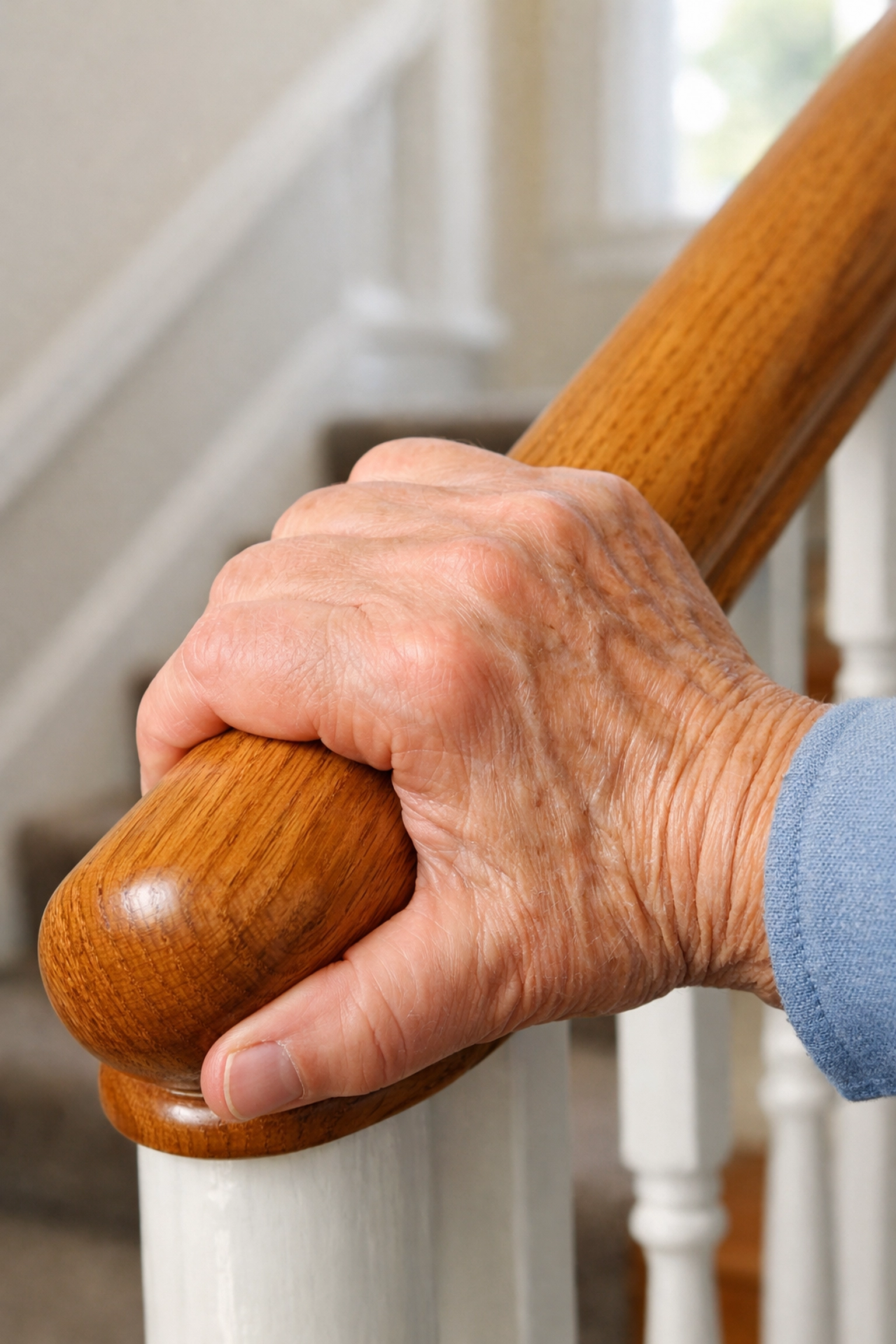
1. The "Ghost Grip": Neglecting Proper Handrail Use
The most common mistake people make is simply not using the handrail. Perhaps you’re carrying a laundry basket, a phone, or a cup of tea. Maybe you feel steady enough that you don't think you need it. But the handrail is your primary safety net.
A handrail provides more than just a place to lean; it offers sensory feedback to your brain about where your body is in space. This is known as proprioception. When your hand is on a rail, your brain gets a constant stream of data about your balance, making it easier to adjust if you have a slight wobble.
The Fix:
First, commit to the "one hand free" rule. Never carry items in both hands while using the stairs. If you must move items between floors, consider using a small backpack or installing a "stair basket" (kept safely at the top or bottom, never on the steps) to move things in batches.
Second, check the quality of your handrails. A proper handrail should be "graspable." This means you can wrap your fingers all the way around it to create a "power grip." Many decorative handrails are too wide or too flat, allowing only a "pinch grip," which is much weaker. If your rail isn't sturdy or is hard to grab, consider replacing it or adding a second rail on the opposite wall. Having rails on both sides of the staircase is the gold standard for safety.
2. The "Vertical Sprint": Rushing the Journey
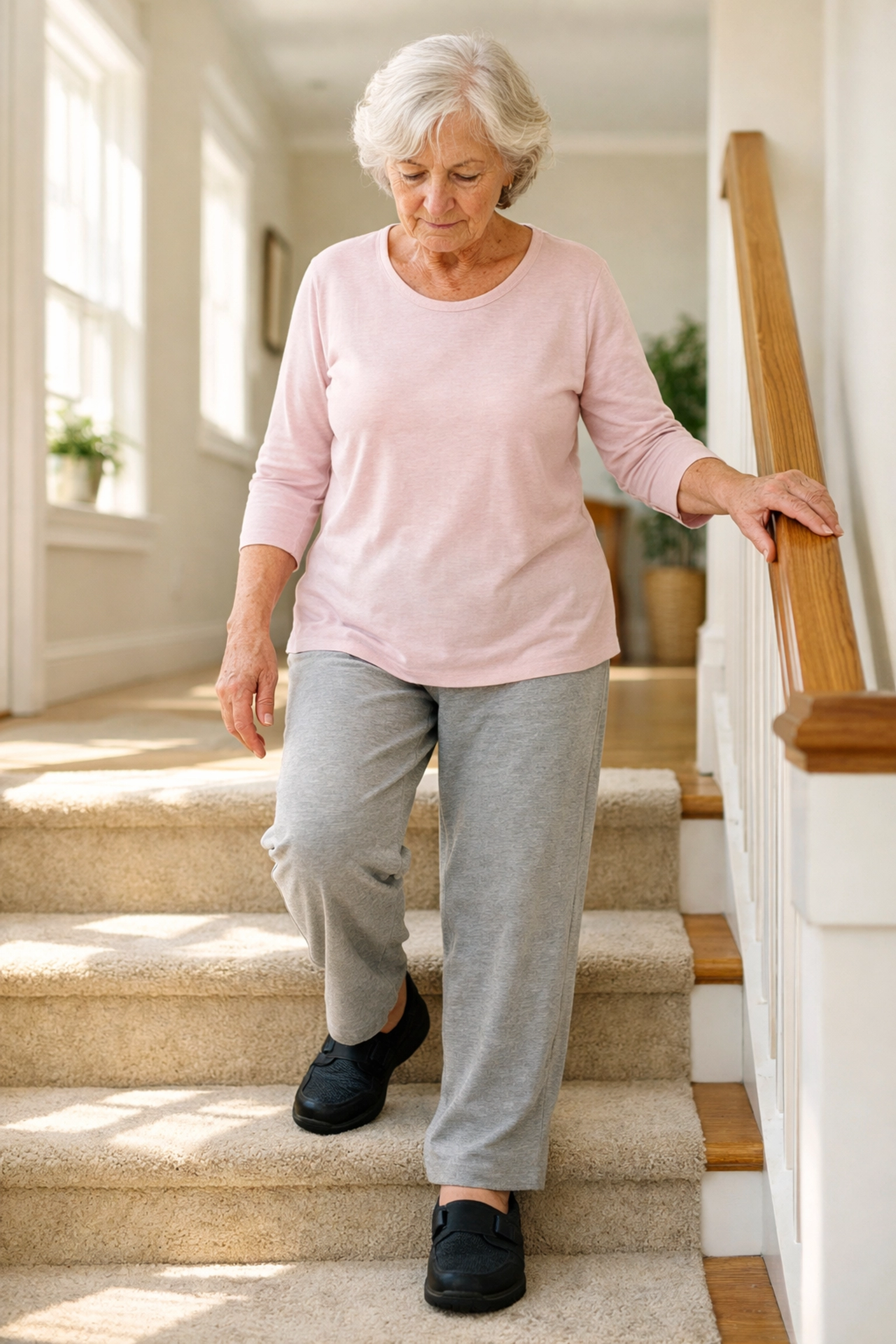
In our busy lives, we are often in a hurry. We hear the doorbell ring or the phone buzz, and we naturally speed up. On a staircase, speed is the enemy of stability. When you rush, your center of gravity moves forward, and your foot placement becomes less precise. You are more likely to "overstep" or catch your heel on the edge of a tread.
Descending is actually more dangerous than ascending. When going down, gravity is pulling you forward, and the impact on your joints is higher. Most falls occur on the top three or bottom three steps, often because people start to speed up as they see the "finish line."
The Fix:
Practice mindful movement. Treat the staircase as a transition zone that requires 100% of your attention. Take one step at a time, ensuring your entire foot is firmly planted on the tread before moving the next foot. If you find yourself rushing because of a ringing phone, remember: the person calling can wait. Your safety is more important than a quick response.
3. Treating Stairs as Temporary Storage
We’ve all done it. We have a pile of books, a pair of shoes, or a stack of mail that needs to go upstairs, so we leave it on the bottom step to take up "next time." This creates a significant tripping hazard. Even if you think you’ll remember it’s there, in a moment of distraction or in dim light, that small object can lead to a loss of balance.
Clutter doesn't just refer to objects you’ve placed there. It also includes loose rugs at the top or bottom of the stairs. These "landing" areas are critical transition points where your gait changes, and a bunched-up rug can easily catch a toe or a walker.
The Fix:
Adopt a "zero-tolerance" policy for objects on the stairs. Nothing should ever be placed on a step, even "just for a minute." To make this easier, place a small table at the top and bottom of the stairs to hold items that need to be moved.
Regarding rugs, either remove them entirely from the landing areas or ensure they are secured with high-quality non-slip backing or double-sided rug tape. Ideally, the transition from the stairs to the floor should be as smooth and unobstructed as possible.
4. Navigating the "Twilight Zone": Poor Lighting
Vision plays a massive role in balance. As we age, our eyes require more light to see clearly, and our ability to perceive depth can diminish. If a staircase is dimly lit, it becomes difficult to distinguish where one step ends and the next begins. Shadows can also be deceptive, making a flat surface look like a step or vice versa.
Many stairways have a single light at the top or bottom, leaving the middle section in a "twilight zone." Furthermore, if the light switch is only at one end of the stairs, people often choose to navigate in the dark rather than walk back to flip the switch.
The Fix:
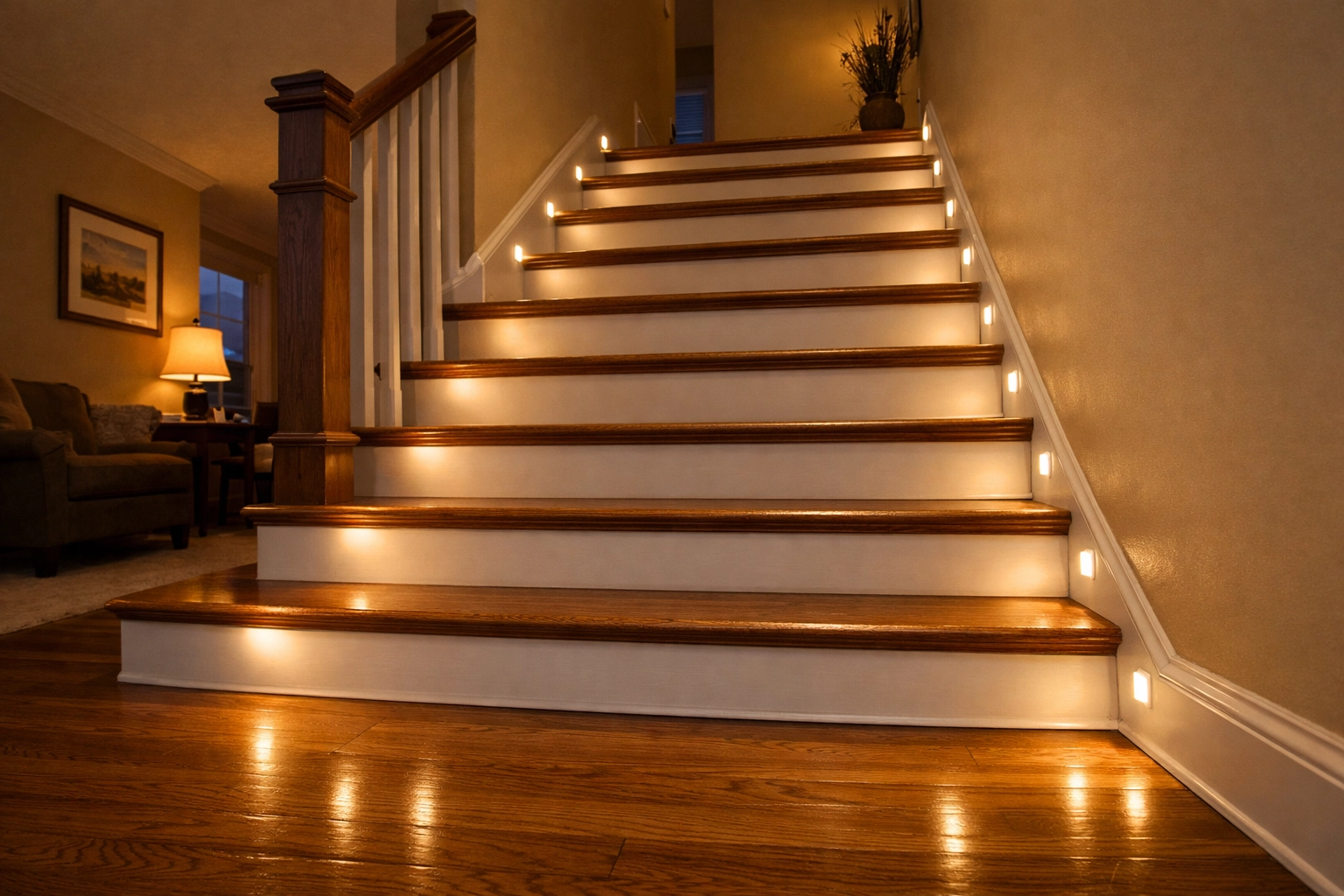
Ensure there are light switches at both the top and bottom of the stairs (three-way switches). If rewiring isn't an option, there are excellent battery-operated, motion-sensor LED lights that can be stuck directly onto the wall or the underside of the handrail.
For even better visibility, consider "step lighting" or LED strips that run along the length of each tread. This clearly defines the edge of each step. Additionally, make sure the bulbs you use have a high "color rendering index" (CRI) to help with depth perception, and avoid high-glare bulbs that can be blinding.
5. The Footwear Fail: Socks and Slippers
Walking on stairs in socks, especially on wooden or polished stone steps, is essentially like walking on ice. Socks provide zero traction. Similarly, loose-fitting slippers or "scuffs" that don't have a back can easily slip off your foot mid-step, causing you to trip.
Even some athletic shoes can be problematic if the soles are too thick or "chunky," as they can reduce the sensory feedback your feet receive from the ground, making you feel disconnected from the surface you're walking on.
The Fix:
The safest way to navigate stairs is in well-fitting shoes with non-slip soles. If you prefer to be shoeless at home, consider "grip socks" with rubberized treads on the bottom, though even these are less stable than a supportive shoe.
If your stairs are naturally slippery (like polished wood), consider adding transparent non-slip adhesive strips to the edge of each tread. These provide necessary friction without hiding the beauty of the wood.
6. The Multi-Tasking Trap: Distraction
We live in a world of constant distraction. It’s common to see people checking their email, texting, or having intense conversations while moving between floors. On stairs, a split second of distraction can lead to a missed step.
Cognitive load: the amount of mental effort being used: directly impacts balance. If your brain is busy processing a complicated work email or a stressful conversation, it has fewer resources to dedicate to the complex motor task of climbing stairs.
The Fix:
Make the stairs a "no-phone zone." Finish your text or hang up your call before you start your ascent or descent. If someone starts a conversation with you while you’re on the stairs, wait until you reach a flat landing or the end of the staircase before engaging. By giving the stairs your full attention, you allow your brain and body to coordinate effectively.
7. Overlooking the "Red Flags" of Wear and Tear
Stairs undergo a lot of stress over the years. Over time, carpet can become loose or frayed, wooden treads can crack or become slick, and handrails can wiggle in their mountings. We often become "house blind" to these changes because they happen so slowly.
A loose carpet edge is particularly dangerous because it can act as a loop that catches the toe of a shoe. Similarly, a handrail that gives even an inch when you lean on it won't be there for you if you actually need it to arrest a fall.
The Fix:
Conduct a monthly "stair audit." Walk up and down the stairs specifically looking for problems.
- Check every single tread: Is the carpet tight? Are there any protruding nails or staples?
- Check the "nosing" (the edge of the step): Is it worn down or slippery?
- Give the handrail a firm shake: Is it securely anchored to the wall studs?
If you find a problem, fix it immediately. Stretching a loose carpet or tightening a bracket is a small task that can prevent a significant injury.
A Professional Perspective on Prevention
While fixing these seven mistakes will significantly improve your home safety, it’s also important to look at the "human" side of the equation. Stair safety isn't just about the environment; it’s about the person using it.
If you or a loved one are feeling increasingly unsteady on the stairs, it may be beneficial to consult with a physical therapist. They can perform a mobility assessment to check for strength imbalances or vision issues that might be contributing to the problem. Often, simple exercises to strengthen the quadriceps, calves, and core can make navigating stairs feel much easier and safer.
Additionally, consider the "visual contrast" of your stairs. If the carpet and the floor at the bottom are the same color, it can be hard to tell where the last step ends. Adding a contrasting strip of tape or a different colored tread edge can provide a clear visual cue to your brain that the "transition" is happening.

Final Thoughts
Your home should be a place where you feel completely secure. By taking a proactive approach to stair safety: fixing the lighting, clearing the clutter, and being mindful of how you move: you aren't just preventing falls; you are preserving your freedom of movement.
Stair safety is a combination of good habits and a well-maintained environment. It doesn't require a total home renovation to make a difference. Small, thoughtful changes: like replacing a lightbulb, wearing the right shoes, or finally tightening that wobbly handrail: create a cumulative effect of safety that allows you to move through your home with peace of mind.

