
Getting your first walker is a bit like getting a new pair of glasses. At first, it feels a little foreign, and you might even feel a bit self-conscious. But once you realize how much clearer the world: and your mobility: becomes, it quickly turns into an essential part of your daily life.
I’m Brian Kerr, and here at Fall Guys Products, we’ve seen how much confidence a walker can restore. However, a walker is only as helpful as the way it’s used. It is a tool designed to enhance your stability, but if you’re using it incorrectly, it can actually become a tripping hazard or lead to chronic pain in your back, shoulders, and wrists.
Most of the time, the mistakes we see aren't because someone is being careless; it’s simply because nobody ever gave them a formal "user manual" for walking. Today, we’re going to fix that. Here are the seven most common mistakes people make with a walker and the simple, practical ways to fix them.
1. Setting the Height Incorrectly
This is the most common issue we see. Walkers are not "one size fits all" right out of the box. Most people either leave them at the height they were in the store or adjust them based on what "feels" right while they are slouching.
The Mistake:
If your walker is set too low, you’ll find yourself hunching over. This puts an incredible amount of strain on your lower back and neck. It also shifts your center of gravity too far forward, which increases your risk of falling head-first if the walker hits a bump. On the flip side, if the handles are too high, your arms will be bent at an awkward angle. This forces your shoulders up toward your ears, leading to rapid muscle fatigue and reduced control over the device.
The Fix:
You want to find the "Goldilocks" height. Here is the step-by-step way to do it:
- Stand up as straight as you comfortably can.
- Let your arms hang naturally at your sides.
- Look at where the crease of your wrist is (the spot where your hand meets your arm).
- Adjust the walker handles so they align perfectly with that wrist crease.
When you actually grip the handles to walk, your elbows should have a slight, comfortable bend: usually about 15 degrees. This allows your arms to act as shock absorbers and gives you the most leverage to support your weight.

2. Walking "Behind" the Walker Instead of "In" It
When people are nervous about falling, their instinct is often to push the walker far out in front of them, as if they are scouting the terrain ahead.
The Mistake:
If you push the walker too far forward, you end up "chasing" it. This leaves a large gap between your body and the frame. If you trip while the walker is two feet in front of you, the walker won't be there to support you; instead, it might even roll further away as you try to grab it. This "reaching" posture also puts your spine in a vulnerable, bent position.
The Fix:
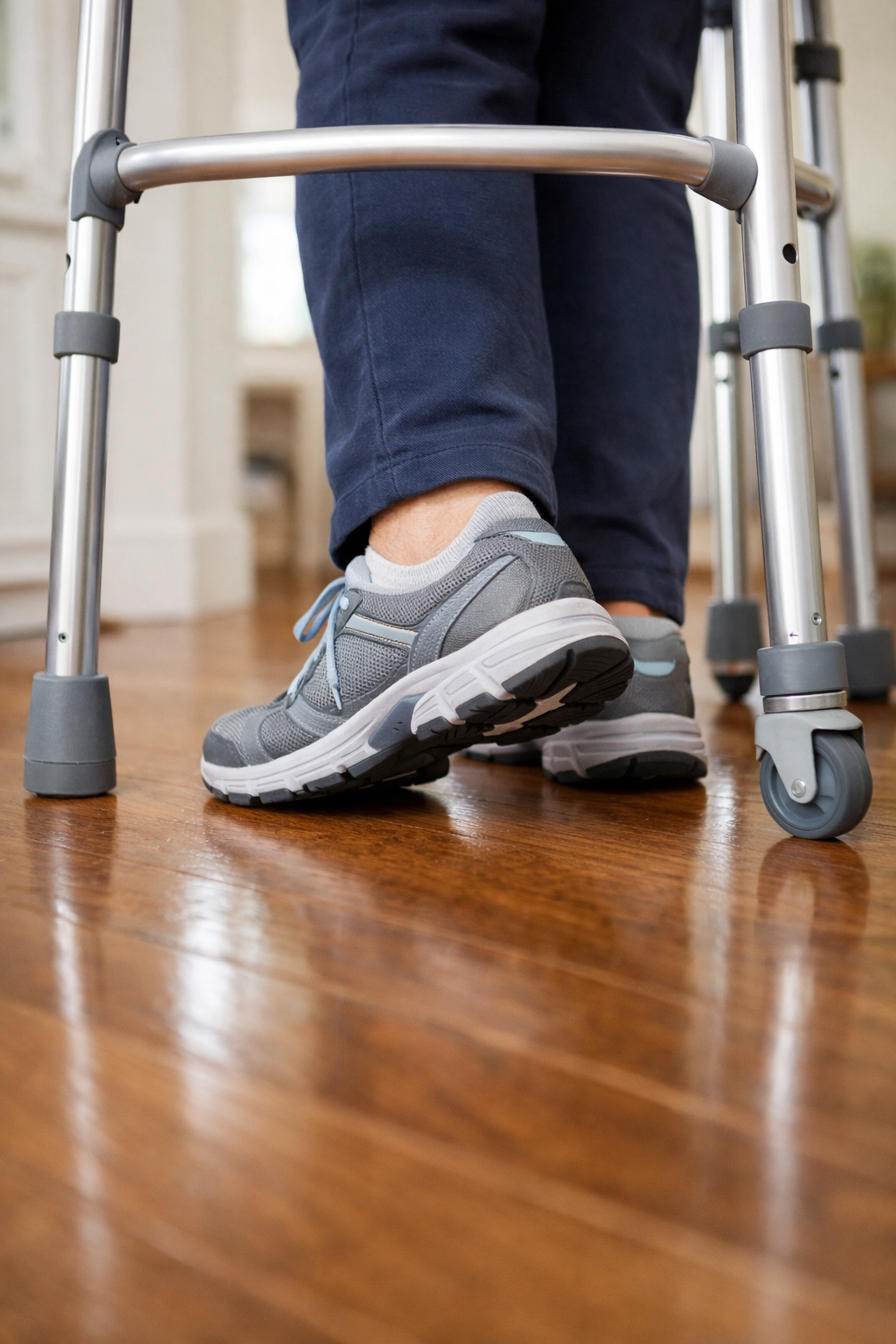
You want to walk inside the walker, not behind it. Think of the walker as a frame that surrounds your center of gravity.
- Move the walker forward only about one step’s length.
- Step forward into the center of the frame.
- Your feet should stay roughly between the back legs of the walker.
By keeping the walker close to your body, you ensure that if you do lose your balance, the sturdy handles are directly beneath your hands, ready to take your weight instantly.
3. Forgetting the Brakes During Transitions
If you use a rollator: the type of walker with four wheels and a built-in seat: the brakes are your best friend. But they are often the most underutilized feature.
The Mistake:
The most dangerous moment for walker users is the transition from sitting to standing (or vice versa). If you try to sit down on the walker seat or stand up from a chair while the walker wheels are unlocked, the device can roll away. We’ve seen many avoidable falls happen because the walker scooted forward just as someone was placing their weight on it.
The Fix:
I like to use the phrase "Lock before you rock."
- Before you sit down on the walker seat, push the brake handles down until you hear or feel a distinct "click." This locks the wheels in place.
- Give the walker a little nudge with your body to make sure it’s not budging.
- Only then should you turn around and lower yourself onto the seat.
- The same applies when standing up from the walker or a separate chair: keep those brakes engaged until you are fully upright and have your balance.
4. Turning Too Sharply (The Pivot Mistake)
In our busy lives, we’re used to pivoting on a dime. We turn our bodies quickly to answer a phone or grab something from a counter. With a walker, that quick pivot can be a recipe for a fall.
The Mistake:
When you twist your upper body and pivot on one foot while holding a walker, your feet can easily get tangled in the legs of the device. Furthermore, sharp turns can cause a walker to tip sideways if the weight isn't distributed evenly across the four legs.
The Fix:
Think of yourself as a large ship or a bus: you need a "wide turning radius."
- Instead of twisting your hips, take several small, deliberate steps to turn.
- Keep your body facing the front of the walker at all times.
- Move the walker slightly, then move your feet to match it.
It might take a few extra seconds, but keeping your feet clear of the frame is the safest way to change direction.
5. Using the Walker to "Pull" Yourself Up
This is perhaps the most instinctive mistake on this list. When you’re sitting in a low chair and need to stand up, it’s tempting to grab the walker handles and pull yourself toward a standing position.
The Mistake:
Walkers are designed to support vertical weight (pushing down). They are not designed for horizontal force (pulling toward you). Because walkers are lightweight, pulling on the handles will likely cause the walker to tip over toward you. This leaves you with no support and a metal frame falling on top of you.
The Fix:
Always push off from the surface you are sitting on.
- Slide your bottom to the edge of the chair.
- Place your hands on the armrests of the chair or the seat itself.
- Push down through your legs and arms to rise to a standing position.
- Once you are steady on your feet, reach forward and grip the walker handles.
If the chair doesn't have arms, try placing one hand on the chair and the other on the walker (only if the walker is against a wall or the brakes are locked), but the safest method is always pushing off the stable chair.
6. Overloading the Front with Weight
It is very convenient to use your walker as a shopping cart or a moving shelf. We’ve seen people hang heavy purses, grocery bags, and even thick winter coats over the front crossbar.
The Mistake:
Walkers are precision-balanced tools. When you hang a heavy weight off the front, you shift the center of gravity forward. This makes the walker much more likely to tip forward if you hit a rug, a door threshold, or a crack in the sidewalk. It also makes the walker much harder to maneuver, as the front wheels (or glides) are being pressed into the ground with extra force.
The Fix:
If you need to carry items, use accessories specifically designed for your walker.
- Many rollators come with a basket or a pouch located underneath the seat. This keeps the weight centered and low to the ground.
- For folding walkers, you can buy "walker bags" that attach to the side or the inside of the frame.
- Always try to keep the weight balanced. If you have a heavy item, it’s better to ask for help or use a dedicated rolling cart rather than risking the stability of your mobility aid.
7. Leaning Too Much on the Handles
A walker should be a support system, not a replacement for your legs.
The Mistake:
Some users lean so heavily on the handles that their arms are taking 80% of their body weight. Not only does this cause wrist pain and potential carpal tunnel issues, but it also makes the walker incredibly unstable. If you are leaning all your weight into the handles and the walker hits a slick spot or a bump, it will shoot out from under you.
The Fix:
The goal is to stand as tall as possible.
- Use the walker for balance and light support.
- Engage your core muscles to help keep your body upright.
- If you find that you must lean heavily just to move, it may be a sign that you need to speak with a physical therapist about strengthening exercises, or perhaps you need a different type of mobility aid that offers more robust support.

Bonus: Maintenance and "Walker Health"
Beyond how you move your body, the physical state of the walker matters just as much. A well-maintained walker is a safe walker.
Check the Tips and Skis:
If you use a standard folding walker with rubber tips on the back, check them once a month. Once the rubber wears down and the metal pipe starts to peek through, the walker becomes incredibly slippery on hardwood or tile floors. If you use "walker skis" or tennis balls, ensure they haven't worn through to the plastic, which can snag on carpets.
Tighten the Bolts:
Walkers take a lot of vibration, especially if you use them outside on sidewalks. Every few months, give the walker a quick "shake test." If you hear rattling, check the bolts and adjustment buttons. A loose handle or a wobbly wheel can quickly turn into a mechanical failure.
Keep it Clean:
It sounds simple, but dirt and hair (especially pet hair) can get caught in the axles of the wheels. This causes the wheels to "stick" or drag, which can pull the walker to one side and throw off your balance. A quick wipe-down and a check of the wheel wells can prevent this.
A Note on Professional Guidance
While these fixes are a great starting point, nothing replaces the eyes of a professional. If you or a loved one are struggling with a walker, I highly recommend scheduling a single session with a Physical Therapist (PT). They can watch you walk in your own home, adjust the walker to your specific body mechanics, and give you personalized tips that a blog post simply can't.
Using a walker correctly shouldn't feel like a chore. Once you fix these common mistakes, you’ll likely find that you’re less tired at the end of the day, your back feels better, and: most importantly: you feel a lot more confident moving through your home and your community.
At Fall Guys Products, our goal is to help you stay upright and active. A walker is a fantastic tool for that mission: let's make sure you're getting the most out of it! Stay safe out there.

