
Stairs are often the most intimidating part of a home as we get older or deal with mobility changes. I’ve spoken with countless families who view their second floor almost like a forbidden zone because the risk of a fall feels too high. But here’s the thing: stairs don’t have to be a source of anxiety. Most accidents on staircases aren’t "freak occurrences": they are the result of small, overlooked hazards that have been there for years.
In my time at Fall Guys Products, I’ve seen that stair safety is less about major renovations and more about understanding the geometry of movement and the biology of aging. When we address the common mistakes people make, we can turn a "hazard zone" back into a functional part of the home.
Let’s walk through the seven most common mistakes I see and, more importantly, how you can fix them today.
1. Ignoring the "Consistency Rule" of Stair Geometry
The human brain is an incredible machine. When you start climbing a flight of stairs, your brain "maps" the height of the first two steps. It then assumes every single step following those will be the exact same height. If one step is even a quarter-inch higher or lower than the rest, your foot won't clear the edge, or it will land sooner than expected. This is called a "trip and fall" or a "stumble."
The Mistake: Many older homes have stairs that have settled over time, or DIY repairs that resulted in uneven riser heights (the vertical part) or tread depths (the horizontal part).
The Fix: Take a tape measure and check your stairs. In the building world, we look for risers that are ideally about 7 inches high and treads that are at least 11 inches deep. If you find a step that is significantly different from the others, it needs professional attention. If a full repair isn't possible immediately, you must mark the "odd" step with high-contrast safety tape so your brain gets a visual cue to break its rhythm.
2. Relying on "Decorative" Handrails
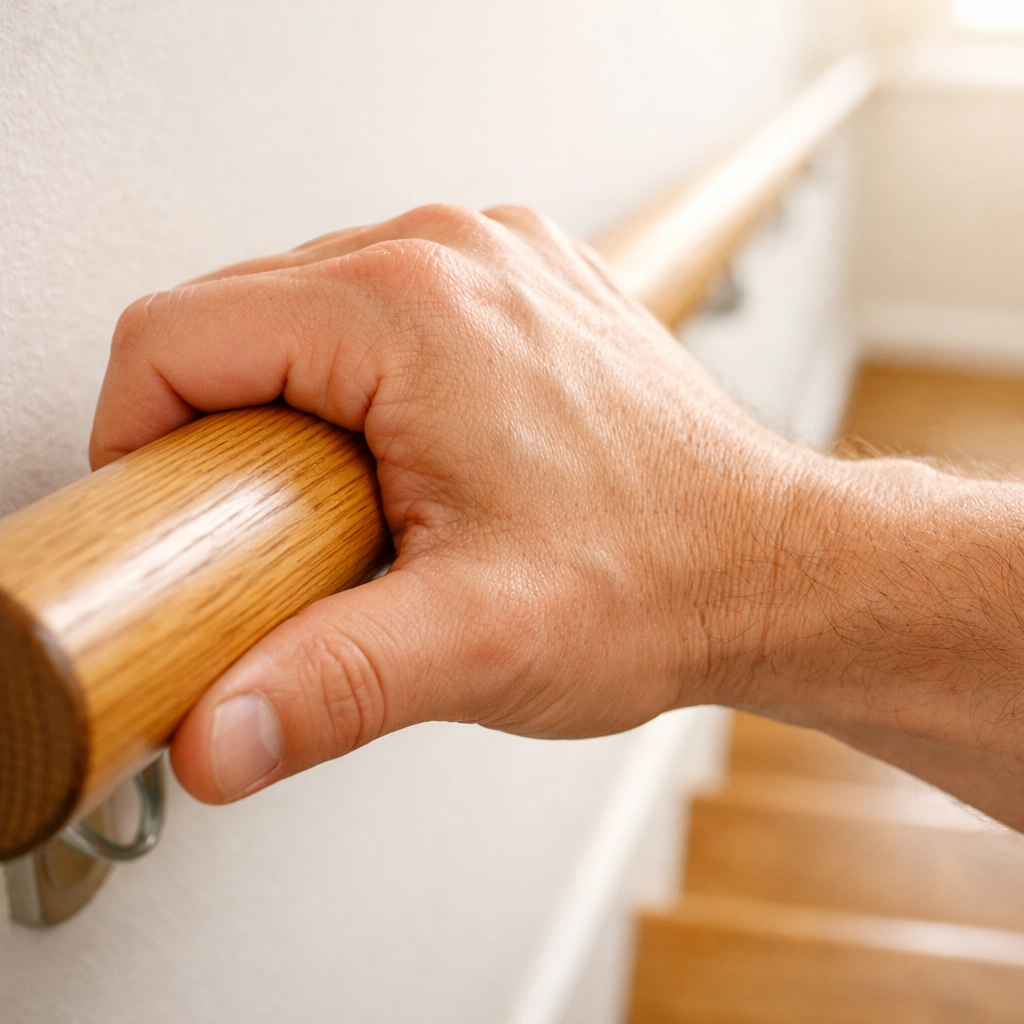
I see this all the time: beautiful, polished wooden handrails that look great but are nearly impossible to actually grip. If a handrail is too wide, too ornate, or too close to the wall, you can’t get your hand all the way around it. In a moment of instability, a "pinch grip" (using just your fingers) will not save you. You need a "power grip" (wrapping your whole hand around the rail).
The Mistake: Having only one handrail, or having rails that are too thick or loose.
The Fix:
- Install Dual Rails: Every staircase should have a handrail on both sides. This allows you to use your dominant hand regardless of whether you are going up or down.
- Check the Circumference: A safe handrail should be circular or oval with a diameter of about 1.25 to 2 inches. You should be able to wrap your thumb and fingers around it so they almost touch.
- Check the Clearance: There should be at least 1.5 inches of space between the rail and the wall so your knuckles don't hit the sheetrock.
- Extend the Ends: The handrail should extend about 12 inches past the top and bottom step. This gives you a "lead-in" and "lead-out" so you aren't searching for a grip while your feet are already on the move.
3. Underestimating the "Transition Zone" Lighting
Most people have a light at the top of the stairs and a light at the bottom. While that sounds sufficient, it often creates a "glare and shadow" effect. If the light is too bright at the top, it can cast long shadows over the middle steps, making it hard to see where one tread ends and the next begins. As we age, our eyes require more light to see clearly, and our ability to distinguish depth in shadows decreases.
The Mistake: Relying on a single overhead bulb or having "dead spots" of light in the middle of the flight.
The Fix:
- Layered Lighting: Install LED strip lighting under the lip of each step or along the baseboards. This illuminates the actual surface you are stepping on without creating glare in your eyes.
- Motion Sensors: Use plug-in motion-sensor lights at the top and bottom landings. This ensures you never have to "fumble for a switch" in the dark.
- Color Temperature: Use "warm white" bulbs rather than "cool blue" or "daylight" bulbs on stairs. Cool light can often wash out textures, making it harder to see the edge of the step.
4. Treating Stairs as Temporary Storage
We’ve all done it. You have a pile of mail, a pair of shoes, or a book that needs to go upstairs, so you set it on the bottom step to take up "next time." This is one of the leading causes of household falls. Even if you think you’ll remember it’s there, a moment of distraction: a ringing phone or a doorbell: can lead to a catastrophic trip.
The Mistake: Using the stairs as a staging area for items moving between floors.
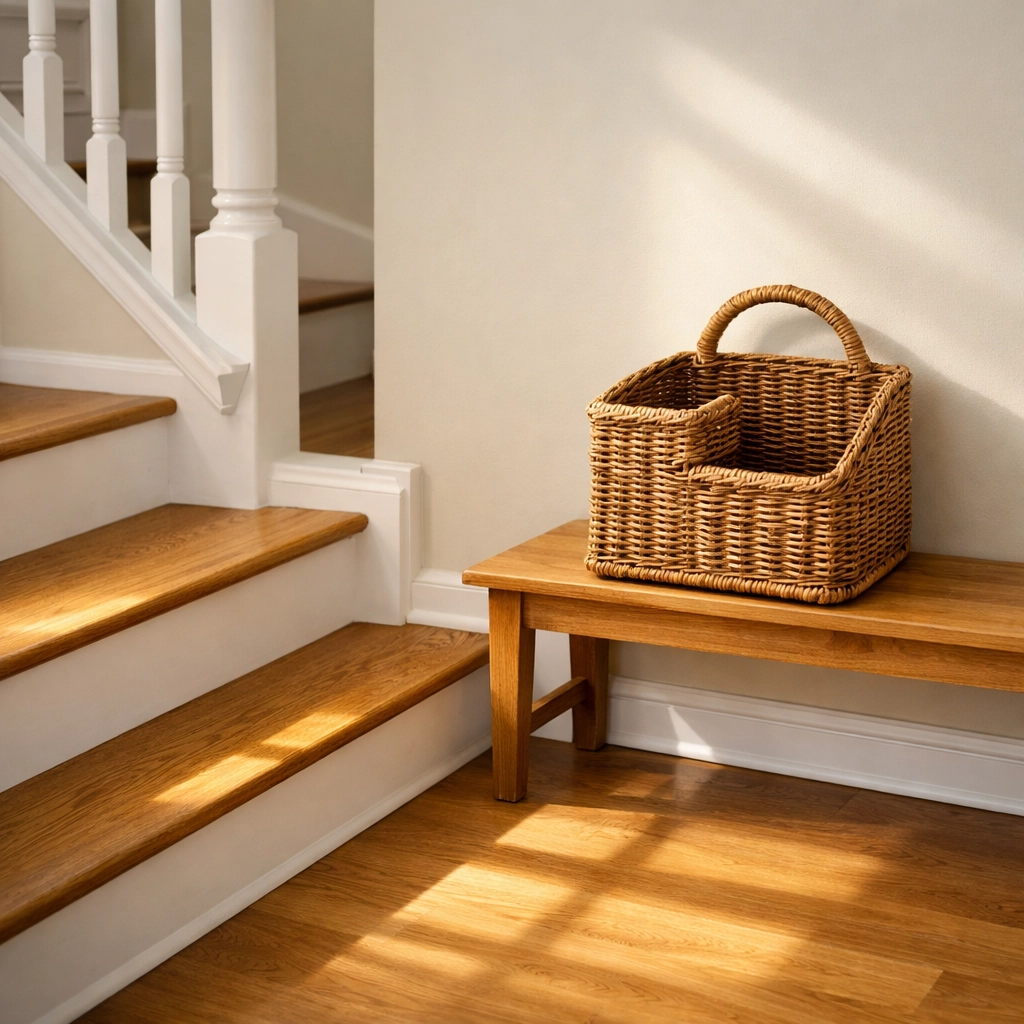
The Fix: Adopt a "Zero Items" policy for the staircase. If something needs to go up, it either goes up immediately or it sits in a dedicated "stair basket" that is kept on a table near the stairs, but never on the steps themselves. Clear sightlines are non-negotiable for safety.
5. Overlooking Surface Friction and Footwear
The material of your stairs matters just as much as the structure. Polished hardwood looks elegant, but it can be as slippery as an ice rink if you’re wearing socks. On the flip side, thick, plush carpeting can "round off" the edge of the step, making it harder for your foot to find a firm purchase.
The Mistake: Walking on stairs in stocking feet or keeping worn-out, loose carpeting on the treads.
The Fix:
- Non-Slip Strips: If you have wooden or tile stairs, apply clear or high-contrast anti-slip adhesive strips to the edge of each tread.
- Carpet Inspection: If your stairs are carpeted, ensure the carpet is pulled tight and "waterfalled" securely over the edge of each step. If it’s loose or bunching, it needs to be restretched or replaced.
- Proper Footwear: Never walk on stairs in just socks. Bare feet are better, but supportive, rubber-soled indoor shoes are the gold standard. Avoid "backless" slippers which can easily slide off your heel mid-step.
6. The "Single Trip" Mentality
As humans, we love efficiency. We try to carry the laundry basket, the trash, and a glass of water all in one trip. When you do this on stairs, you are breaking two of the most important rules of mobility: keeping your center of gravity stable and maintaining a clear line of sight.
The Mistake: Carrying large or heavy objects that block your view of your feet or prevent you from using the handrail.
The Fix:
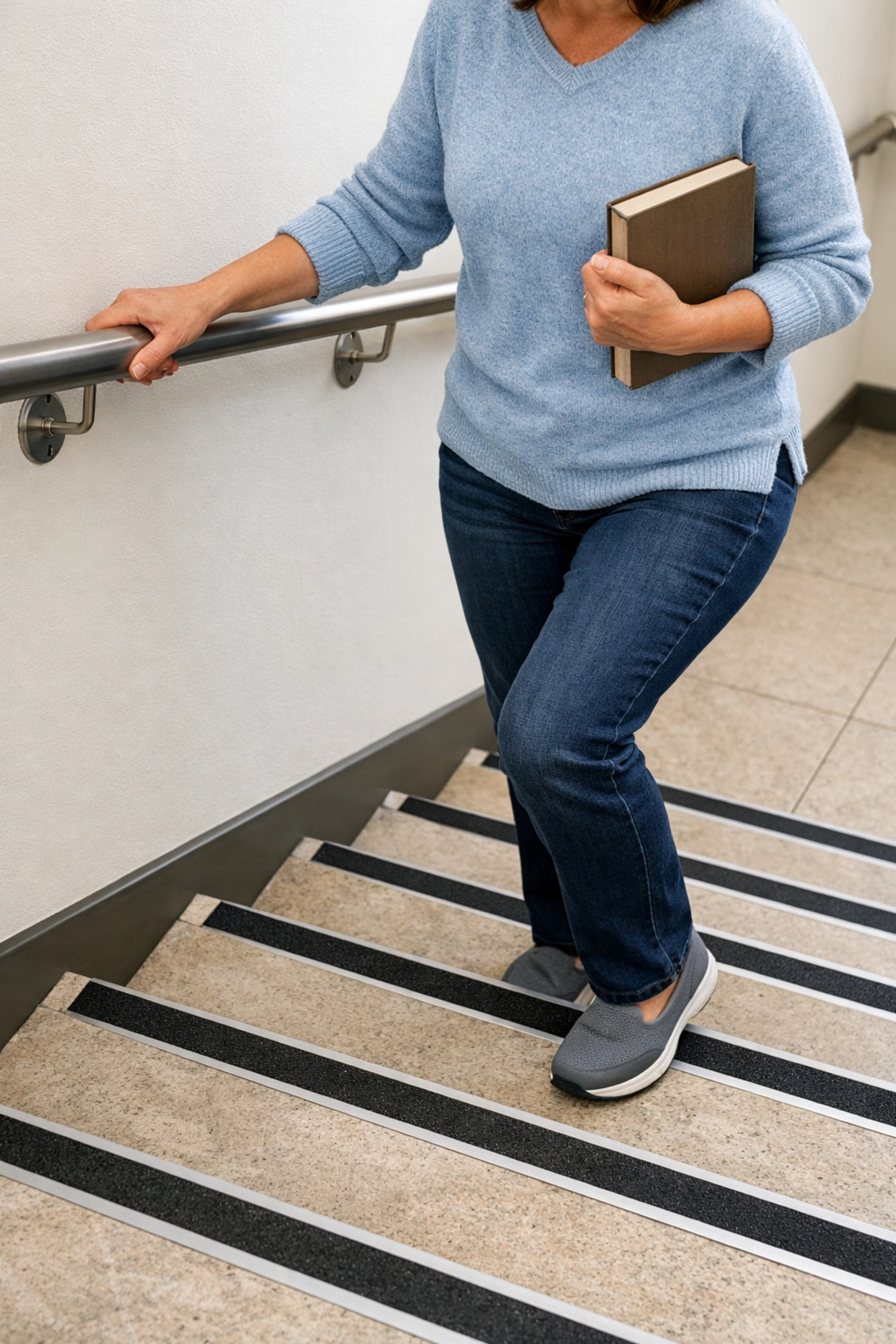
- The One-Hand Rule: Always keep at least one hand free for the handrail. If an object requires two hands to carry, don't take it up the stairs yourself.
- Break It Down: Take smaller loads. It might take three trips to move the laundry, but those three safe trips are much faster than a recovery from a fall.
- Visual Check: Always ensure you can see over the top of whatever you are carrying. If you can't see the next step, you are walking into a blind spot.
7. Neglecting the "Visual Edge"
As we age, our contrast sensitivity: the ability to see the difference between two similar colors: often declines. If your stairs are all one uniform color (like dark wood or beige carpet), the steps can blend together into one long, confusing ramp. This makes it incredibly difficult to judge exactly where to place your foot.
The Mistake: Having monochromatic stairs without any visual definition of the edges.
The Fix:
- Contrast Strips: Apply a strip of tape or paint in a contrasting color to the "nose" (the very edge) of each step. If the stairs are dark wood, use a light-colored strip. If they are light carpet, use a darker edge.
- Highlight the Landings: Make sure the top and bottom landings are visually distinct from the stairs. Using a different colored rug (with a non-slip pad!) at the landing can signal to your brain that the "climb" is over.
A Note on Physical Preparation
Beyond fixing the environment, we have to think about how we move. A common habit when going down stairs is to "tuck" the chin and look straight down at our feet. While it's important to see where you're going, looking too far down can actually throw off your balance.
Try to look about two to three steps ahead. This gives your brain enough lead time to plan the movement without pulling your head so far forward that you lose your center of gravity.
When to Seek Professional Advice
If you or a loved one are experiencing dizziness, significant joint pain, or "near-misses" on the stairs, it may be time to consult a professional. A physical therapist can help with specific exercises to strengthen the ankles and improve balance. Additionally, an Occupational Therapist can perform a home safety assessment to identify specific structural fixes unique to your floor plan.
Stair safety isn't about removing independence; it's about protecting it. By fixing these seven common mistakes, you aren't just making your house safer: you're making it a place where you can move with confidence and peace of mind.
Remember, the goal isn't to be afraid of the stairs. It’s to respect the physics of movement and give ourselves the best possible environment to stay mobile, stay active, and stay safe in the homes we love.

