
Falling is scary, but what comes after can be just as frightening. Many seniors find themselves on the floor, uninjured but unsure how to get back up safely. The good news? Physical therapists have developed a simple, step-by-step method that helps people get up from the floor without risking further injury or exhausting themselves in the process.
This isn't just theoretical knowledge. It's a practical skill that can make the difference between lying on the floor for hours waiting for help and safely getting yourself up within minutes. Let's walk through exactly what physical therapists teach their patients about post-fall recovery.
Why Getting Up Correctly Matters
When you fall, your first instinct might be to scramble to your feet as quickly as possible. That impulse is understandable but potentially dangerous. Rushing to stand can lead to:
- Re-injury if you've hurt yourself in the fall
- Muscle strain from using improper technique
- Another fall if you're dizzy or disoriented
- Exhaustion that leaves you unable to complete the process
The method physical therapists teach takes a few extra minutes, but it works with your body's natural mechanics rather than against them. It distributes the effort across multiple muscle groups and gives you natural rest points along the way.
Step One: Assess Before You Move
Before attempting to get up, take a moment to assess your situation. This pause isn't wasting time, it's gathering critical information.
Ask yourself:
- Am I hurt? Check for pain, especially in your hips, wrists, head, or spine
- Am I dizzy or confused? These could indicate a more serious issue
- Can I move all my limbs? Try wiggling your fingers and toes
- Is there blood? Check yourself visually if possible
If you're experiencing severe pain, can't move a limb, hit your head hard, or feel confused, don't try to get up. Call for help or use a medical alert system if you have one. There's no shame in calling 911 if you're genuinely injured.

The Physical Therapist's Method: Step by Step
Assuming you've assessed yourself and feel capable of getting up, here's the systematic approach that physical therapists recommend.
Roll to Your Side
From wherever you've landed, work on rolling onto your side. Bend your knees if they're straight, and use your arms to help shift your weight. Choose whichever side feels more comfortable or accessible.
This position is safer and more stable than lying flat on your back. It also sets you up for the next steps in the sequence.
Push Your Upper Body Up
Using the arm that's now closest to the floor, push yourself up so you're propped on that elbow. Then straighten that arm fully so you're supporting your upper body with one extended arm.
This movement should feel similar to how you might push yourself up in bed. Take your time and don't rush. If you need to rest at this point, that's perfectly fine.
Transition to Hands and Knees
Place your other hand on the floor in front of you, roughly parallel to the arm that's already supporting you. Now push with both arms to rotate your body until you're on all fours: hands and knees on the ground.
This "crawling position" is stable and gives you a solid base for the next phase. If there's a sturdy piece of furniture nearby: like a coffee table or a chair: you can crawl toward it now. This support will make the remaining steps easier.
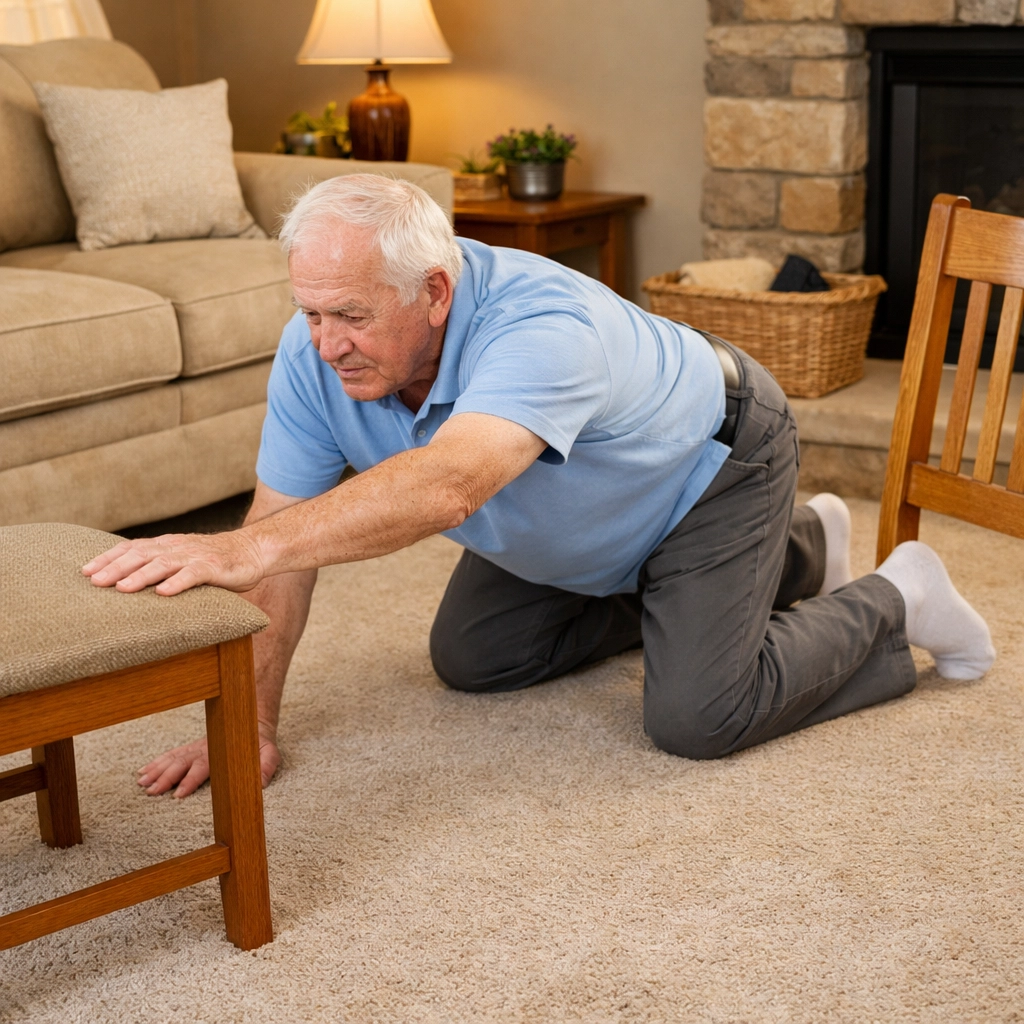
Move to a Kneeling Position
From all fours, walk your hands toward your knees until you're in an upright kneeling position. If you've crawled to a chair or couch, place your hands on the seat for support.
At this point, you're already halfway up. Your major joints: hips and knees: are in alignment, and you're positioned to use your strongest leg muscles for the final push.
Create a Lunge Position
This is the trickiest step, so take it slowly. Choose your stronger leg (or either leg if they feel equally strong) and swing it forward, placing that foot flat on the floor. You'll end up in something like a low lunge position: one knee still on the ground, one foot flat in front of you.
If you have something to hold onto, keep both hands on it for balance. If not, you can keep one hand on the floor for stability.
Push to Standing
Here's the final move: using the strength of your front leg and pushing with your hands against your support (or the floor), stand up. Lead with your head and chest, and let your back leg follow naturally.
Once you're upright, don't immediately walk away. Stand still for a moment, holding onto something stable, and let your body adjust. You might feel dizzy from the position changes: that's normal. Wait until you feel steady before taking your first steps.
Practice Makes Prepared
Here's something most people don't think about: you should practice this technique before you actually need it. Physical therapists often have their patients rehearse getting up from the floor during regular sessions.
Why practice when you haven't fallen? Because in the moment after a real fall, you might be shaken, scared, or confused. If you've practiced the sequence multiple times, your muscle memory will kick in. You'll know what to do even if you're not thinking clearly.

To practice safely:
- Do it during the day when you're alert
- Have someone else home with you
- Use a yoga mat or carpet for cushioning
- Lower yourself down slowly and controlled
- Go through each step of the sequence
- Repeat once or twice a week until it feels natural
When to Call for Help Instead
This technique assumes you're physically capable of getting up and haven't sustained an injury. But there are situations where you should not attempt to get up on your own:
Call for help immediately if:
- You can't move a limb or it feels numb
- You hit your head and feel confused or dizzy
- You have severe pain in your hip, back, or any joint
- You tried to get up and couldn't complete the sequence
- You're alone and feel too weak to attempt it
- You're bleeding significantly
- You've been on the floor for more than 15-20 minutes and feel cold or stiff
Being alone when you fall is particularly challenging. This is exactly why medical alert systems exist: they give you a direct line to help without needing to reach a phone. Many seniors keep a phone in their pocket at all times for this reason.
Common Mistakes to Avoid
Even with the right technique, people sometimes make mistakes that make the process harder or more dangerous:
Don't try to stand straight up from lying down. This puts tremendous strain on your core and legs, and most people simply don't have the strength or balance to do it safely.
Don't rush through the steps. Each position in the sequence gives you a chance to rest and assess how you're feeling. Skipping ahead increases injury risk.
Don't grab unstable objects. A rolling chair, a small side table, or a stack of books won't support your weight. Only use furniture that's heavy and stable.
Don't panic if you can't complete a step. If one approach isn't working, rest for a moment and try a slightly different angle or technique. Panicking wastes energy you need for the actual task.
Building Strength Makes It Easier
The physical therapist's method works for most people, but it definitely gets easier as you build strength and flexibility. Core strength, leg strength, and hip flexibility all contribute to your ability to get up from the floor.
Simple exercises that help include:
- Chair sits and stands (sitting down and standing up repeatedly)
- Leg raises while lying in bed
- Gentle stretching of hips and legs
- Balance exercises like standing on one foot
- Core exercises like gentle crunches or planks
You don't need to become an athlete. Even small improvements in strength and flexibility can make a significant difference in your ability to recover from a fall.

The Psychological Side of Falling
Here's something physical therapists understand but don't always talk about: falling affects your confidence. After experiencing a fall, many seniors develop a fear of falling again. This fear can lead to reduced activity, which actually increases fall risk because muscles weaken and balance deteriorates.
Knowing you can get up safely helps break this cycle. When you've practiced the technique and understand the process, falling becomes less terrifying. You know it's not the end of the world. You have a plan.
This confidence translates into more willingness to stay active and engaged in life. You're not avoiding activities out of fear. That psychological shift is just as important as the physical technique.
What Happens After You're Up
Once you've successfully gotten to your feet, your work isn't quite done. Take these steps immediately after:
Sit down in a sturdy chair. Don't try to walk around right away. Give your body a few minutes to recover from the exertion.
Check yourself again for injuries. Sometimes adrenaline masks pain in the immediate moment. Look for bruising, swelling, or tender spots.
Drink some water. The process of getting up can be physically demanding, and dehydration makes dizziness worse.
Rest. Even if you feel fine, your body has been through a stressful experience. Give yourself permission to take it easy for the rest of the day.
Tell someone. Let a family member, friend, or doctor know you fell, even if you weren't hurt. They should be aware, and it helps establish a timeline if symptoms develop later.
Prevention Is Still the Goal
Learning how to get up after a fall is important, but preventing falls in the first place remains the primary goal. Work with healthcare providers on:
- Reviewing medications that might affect balance
- Addressing vision problems
- Removing trip hazards from your home
- Installing grab bars and safety rails where needed
- Using appropriate mobility aids if recommended
- Maintaining regular physical activity and strength training
Think of the get-up technique as your backup plan: important to know but not something you want to use frequently.
Moving Forward with Confidence
Falls don't have to mean loss of independence. With the right knowledge and preparation, you can handle the situation calmly and safely. The physical therapist's method gives you a clear roadmap from floor to standing, using your body's natural mechanics and strength.
Practice the technique when you're feeling well. Build your strength gradually through regular activity. Make your home as safe as possible. And remember that asking for help: whether that means installing safety equipment, using a medical alert system, or calling 911 after a fall: isn't a sign of weakness. It's smart planning.
You've got this. And now you know exactly what to do if you ever find yourself on the floor looking up.

