
Here's something that doesn't get talked about enough: knowing how to fall is important, but knowing how to get back up safely might be even more critical. If you or someone you care for experiences a fall, those first moments on the floor can feel overwhelming. Panic sets in, you might feel embarrassed, or you could be genuinely hurt. But having a clear plan for getting up safely can make all the difference between a minor incident and a serious injury.
This isn't about being negative or expecting the worst. It's about being prepared. Just like you know where the fire extinguisher is or how to perform CPR, understanding the proper technique for getting up after a fall is a life skill that everyone should have in their back pocket.
Why This Knowledge Matters More Than You Think
Falls happen to people of all ages, though they become more common as we get older. According to various health organizations, about one in four adults over 65 experiences a fall each year. But here's the concerning part: many people who fall remain on the floor for extended periods, not because they're seriously injured, but because they don't know the safe method for getting back up.
Lying on the floor for an extended time can lead to complications like pressure sores, dehydration, hypothermia, or pneumonia. It can also create a deep fear of falling again, which sometimes causes people to limit their activities and lose even more strength and independence.
Learning the right technique ahead of time means you can act confidently if a fall happens, reducing both physical risk and emotional trauma.
Before You Attempt to Get Up: The Critical First Steps
The moments immediately after a fall are crucial. Your first instinct might be to hop right back up, especially if you feel embarrassed or want to prove you're okay. Resist that urge.

Stay Calm and Breathe
Take a few deep breaths. This isn't just feel-good advice: it's practical. When you calm your nervous system, you can think more clearly and assess the situation accurately. Panic can cause you to move too quickly or in ways that might cause additional injury.
Do a Mental Body Scan
Before moving anything, mentally check your body from head to toe. Ask yourself:
- Does anything hurt sharply when you try to move it?
- Can you wiggle your fingers and toes?
- Does your neck or back hurt?
- Do you feel dizzy or disoriented?
- Are you bleeding anywhere?
If you experience severe pain, especially in your hip, back, or neck, or if you can't move a limb, don't try to get up. Call for help instead.
Look Around for Hazards
Check your surroundings. Is there broken glass nearby? Did you hit your head on something? Is the floor wet or slippery? Identifying what caused your fall helps you avoid repeating the same motion or crawling into another hazard.
The Safe Step-by-Step Method for Getting Up
If you've determined that you're not seriously injured and it's safe to move, follow this proven method. Take your time with each step: there's no prize for speed here.
Step 1: Roll Onto Your Side
Start by turning your head in the direction you want to roll. Your body naturally follows your head. Slowly roll your shoulders, then your hips, and finally your legs until you're lying on your side. Think of it as one smooth, connected movement rather than jerking each part separately.
This position is more stable and gives you better leverage for the next steps.
Step 2: Push Up to Hands and Knees
From your side, use your arms to push your upper body up while bringing your knees underneath you. You'll end up in a crawling position. This might feel a bit undignified, but it's the safest and most stable position for what comes next.
Take a moment here. Breathe. Make sure you feel steady before moving on.
Step 3: Crawl to Sturdy Support
Look around and identify the nearest stable piece of furniture: a solid chair, a couch, a coffee table, or even the bottom step of a staircase. The key word is "stable." Don't crawl toward a wheeled chair, a wobbly side table, or anything that might tip or slide.
Crawl slowly toward your chosen support. If you need to rest along the way, that's completely fine.
Step 4: Position Yourself for Kneeling
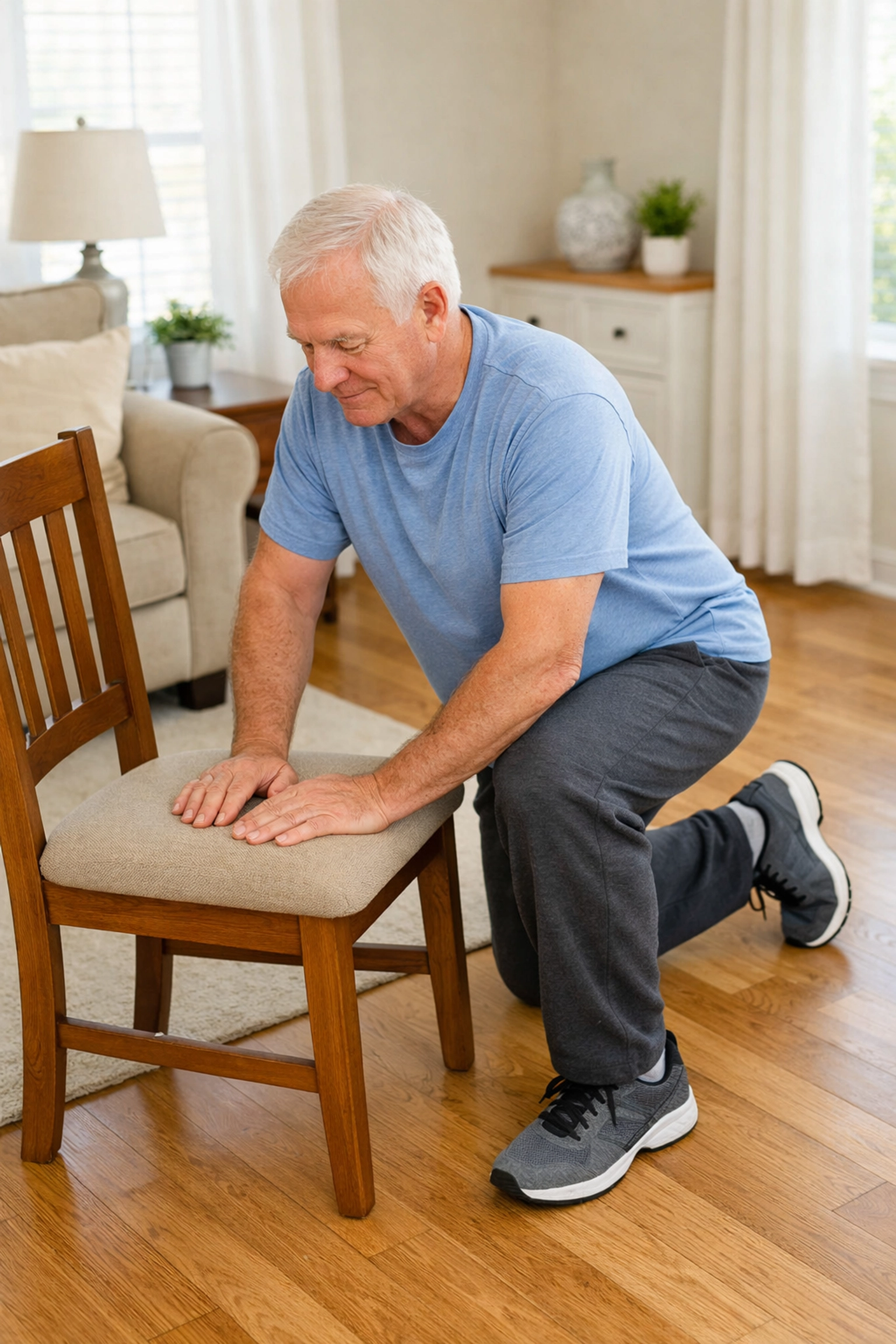
Once you reach your stable support, place both hands firmly on it. Now comes an important detail: identify your stronger leg. For most people, this is the dominant side: if you're right-handed, it's likely your right leg.
Bring that stronger leg forward, placing your foot flat on the floor while keeping your other knee on the ground. You're now in a kneeling position, like you're about to propose or tie a shoe. This is called a half-kneeling position, and it's incredibly stable.
Step 5: Push Up to Standing
This is where everything comes together. Using both your arms on the furniture and your legs, slowly push yourself up to standing. The key is to use your leg muscles to lift, not your back. Think about pushing the floor away with your front foot while your arms help with balance.
Don't rush. If you feel dizzy or unsteady, stay in the half-kneeling position until the feeling passes.

Step 6: Sit Down and Rest
Once you're standing, immediately turn around and sit down on the stable furniture you used to get up. Stay seated for several minutes. This gives your blood pressure time to regulate and allows you to catch your breath.
Monitor yourself during this rest period. Sometimes pain or other symptoms show up a few minutes after the initial fall.
When You Should NOT Attempt to Get Up Alone
There are specific situations where you should not try to get up by yourself, no matter how confident you feel:
Call for help immediately if:
- You have sharp, severe pain in your hip, leg, back, or neck
- You suspect you might have broken a bone
- You hit your head and feel confused or dizzy
- You cannot move a limb or it looks deformed
- You have significant bleeding
- You feel chest pain or difficulty breathing
- You tried to get up once and couldn't
- You simply feel too weak or unstable to safely perform the steps
There's no shame in calling for help. That's what emergency services are for. If someone is with you, never let them pull you up by your arms: this can cause shoulder injuries or make existing injuries worse.
After You're Up: What Happens Next
Getting back to your feet is just the first part. What you do in the hours and days following a fall is equally important.
Immediate Follow-Up
Even if you feel fine, tell someone about your fall: a family member, friend, or caregiver. Document what happened: what time it occurred, what you were doing, what might have caused it, and how you felt afterward.
Watch for delayed symptoms over the next 24 hours, including increased pain, swelling, bruising, or changes in how you feel. Some injuries, like minor concussions or internal bruising, don't show symptoms right away.
Schedule a Medical Evaluation
Contact your primary care doctor within a few days to report your fall, even if you weren't injured. Falls are a red flag that something has changed with your balance, strength, medication, or environment. Your doctor can:
- Perform a fall risk assessment
- Review your medications for side effects that affect balance
- Check for underlying health issues like low blood pressure or vitamin deficiencies
- Refer you to physical therapy if needed
Research consistently shows that experiencing one fall significantly increases your risk of falling again. A medical evaluation can help identify and address risk factors before another fall happens.
Practice This Method Before You Need It
Here's an often-overlooked suggestion: practice this getting-up technique when you're feeling good, not after a fall. Once or twice a month, intentionally go through the steps in a safe environment with someone nearby.
This serves two purposes. First, you'll build muscle memory, so the movements feel natural if you ever need them in an emergency. Second, you'll identify if any part of the process is difficult for you, which tells you where you might need to build strength or modify your approach.
If you find certain steps challenging during practice: like getting onto your hands and knees or pushing up from a kneeling position: talk to your doctor or a physical therapist. They can suggest exercises to improve your strength and flexibility in those specific areas.
Building Confidence, Not Fear
Learning how to get up safely after a fall isn't about expecting the worst or giving in to worry. It's about building confidence. When you know you have a plan, falls become less frightening. You're empowered with knowledge and technique rather than paralyzed by "what if."
This knowledge is especially valuable if you live alone or spend time by yourself. Knowing you can handle the situation independently if needed provides peace of mind for both you and your loved ones.
Remember that prevention is always the best strategy: keeping your home well-lit, removing tripping hazards, staying active to maintain strength and balance, and wearing appropriate footwear all reduce fall risk. But having this backup plan means you're prepared if prevention isn't enough.
The technique outlined here has been developed and refined by physical therapists and healthcare professionals over many years. It's based on biomechanics, safety research, and real-world experience with thousands of people. You can trust it.
Take the time to familiarize yourself with these steps. Share this information with friends and family members who might benefit. And most importantly, remember that getting up after a fall is a skill, just like any other: and skills can be learned, practiced, and mastered at any age.

