
When you or a loved one first starts using a walker or a rollator, it can feel like a major win for independence. Suddenly, the world opens up again. You can navigate the hallway with more confidence, get to the mailbox, or move through the grocery store without that constant fear of a stumble.
However, a mobility aid is only as helpful as the way it is used. At Fall Guys Products, we often see people who have the right intentions but have picked up a few "bad habits" with their equipment. Using a walker incorrectly doesn't just make walking more tiring; it can actually create new risks for falls.
If you feel like your walker is "getting in the way" or if you find yourself more exhausted after a short walk than you used to be, you might be making one of these common mistakes. Let’s look at how to fix them so you can stay safe and moving.
1. Setting the Height Incorrectly
This is the most common mistake we see, and it’s usually the root cause of back and shoulder pain. Many people inherit a walker from a friend or buy one second-hand and start using it immediately without adjusting the legs.
The Problem
If the walker is too low, you’ll find yourself hunching over. This puts an enormous amount of strain on your lower back and neck. More importantly, it shifts your center of gravity too far forward, which makes you more likely to trip.
If the walker is too high, your elbows will be bent at a sharp angle. This means you can’t push down effectively to take the weight off your legs, leading to quick fatigue in your shoulders and arms.
The Fix
The "Wrist Crease Rule" is the industry standard for a reason. To find your perfect height:
- Stand as upright as possible with your arms hanging naturally at your sides.
- Have someone adjust the walker handles so they align exactly with the crease on the inside of your wrist.
- When you grip the handles, your elbows should have a slight, comfortable bend: about 15 to 20 degrees.

2. Walking "Behind" the Walker Instead of "In" It
It’s a natural instinct to push the walker far out in front of you, almost like you’re pushing a shopping cart. However, a walker is not a cart; it’s a portable support frame.
The Problem
When you push the walker too far ahead, you end up leaning forward to reach it. This "reaching" posture is unstable. If you trip while the walker is two feet in front of you, it can’t catch you. In fact, if you fall forward, you might just push the walker even further away, leaving you with nothing to grab onto.
The Fix
You want to stay "inside the box." Imagine a square formed by the four legs of your walker. Your feet should ideally be stepping into that square, not trailing behind the back wheels.
- Move the walker forward just a small distance (about one step’s worth).
- Step into the center of the frame.
- Maintain an upright posture, keeping your eyes forward rather than looking down at your feet.

3. Using the Wrong Device for Your Needs
Not all mobility aids are created equal. A common mistake is choosing a device based on what looks "easier" or "sportier" rather than what your body actually requires for stability.
The Problem
Choosing a cane when you actually need the four-point stability of a walker is a major risk. Conversely, using a heavy rollator (the kind with four wheels and a seat) when you have balance issues can be dangerous because those devices can "run away" from you on a slope if you aren't quick with the brakes.
The Fix
Consult with a physical therapist for a formal mobility assessment. They can determine if you need:
- A Standard Walker: Best for those who need to put significant weight on the device or have very poor balance.
- A Two-Wheeled Walker: A middle ground that allows for a more natural gait without the device "rolling away."
- A Rollator: Great for people who have the balance to manage wheels and need frequent seated breaks.
- A Cane: Best for mild balance issues or offloading weight from a single painful joint.
4. Turning Too Sharply (The "Pivot" Trap)
We often see people reach a corner or a doorway and try to pivot their body while keeping the walker stationary, or they try to whip the walker around in one quick motion.
The Problem
Pivoting on one foot is a leading cause of trips. When you twist your body without moving your feet, you can easily get your legs tangled in the frame of the walker. Furthermore, sharp turns can cause the walker to tip if the weight isn't distributed evenly.
The Fix
Think like a clock. Instead of a single 90-degree twist, take several small "marching" steps to complete the turn.
- Always keep your body facing the front of the walker.
- Move the walker a few inches in the direction you want to go.
- Step your feet to follow the walker.
- Repeat until you are facing the new direction. It takes a few extra seconds, but it keeps your center of gravity firmly over your feet.

5. Using the Walker to Pull Yourself Up
When you’re sitting in a chair and getting ready to stand, the walker is right there in front of you. It’s tempting to grab the handles and pull yourself up.
The Problem
Most walkers and rollators are made of lightweight aluminum. They are designed for vertical pressure (pushing down), not horizontal pressure (pulling toward you). If you pull on the handles to stand up, the walker can easily tip over onto you, or the wheels can roll toward you, causing you to fall back into the chair: or worse, onto the floor.
The Fix
Never use the walker as a leverage point for standing up. Instead:
- Scoot your bottom to the edge of the chair.
- Place your hands on the armrests of the chair or the seat of the chair.
- Lean forward ("nose over toes") and push up using your leg strength and your arms on the chair.
- Once you are steady on your feet, reach forward and grip the walker handles.

6. Leaning Too Heavily on the Handles
A walker is a balance aid, but many users treat it like a primary weight-bearing structure.
The Problem
If you find yourself putting 80% of your weight into your wrists and shoulders, you are likely over-relying on the device. This makes the walker less stable, especially on uneven surfaces like a rug or a sloped driveway. It also prevents your legs from doing the work they need to do to stay strong.
The Fix
Try to use the walker for "light touch" stability rather than as a crutch. If you feel you must lean heavily to move, it may be a sign that you need to work on lower-body strengthening exercises with a professional. Physical therapy can help build the core and leg strength necessary so that the walker serves as a safety net, not a replacement for your muscles.
7. Wearing the Wrong Shoes
It’s easy to think that because you have a walker, your footwear doesn't matter as much. In reality, the opposite is true.
The Problem
Slippers, flip-flops, or loose-fitting loafers are a recipe for disaster. If your shoe slips or your heel slides out while you’re maneuvering a walker, your natural reaction is to grab the walker harder. As we learned in Mistake #5, pulling or jerking on a walker can cause it to tip. Additionally, shoes with very thick, "squishy" soles can actually decrease your "proprioception": your brain's ability to feel where your feet are in relation to the floor.
The Fix
Think of your shoes and your walker as a single safety system.
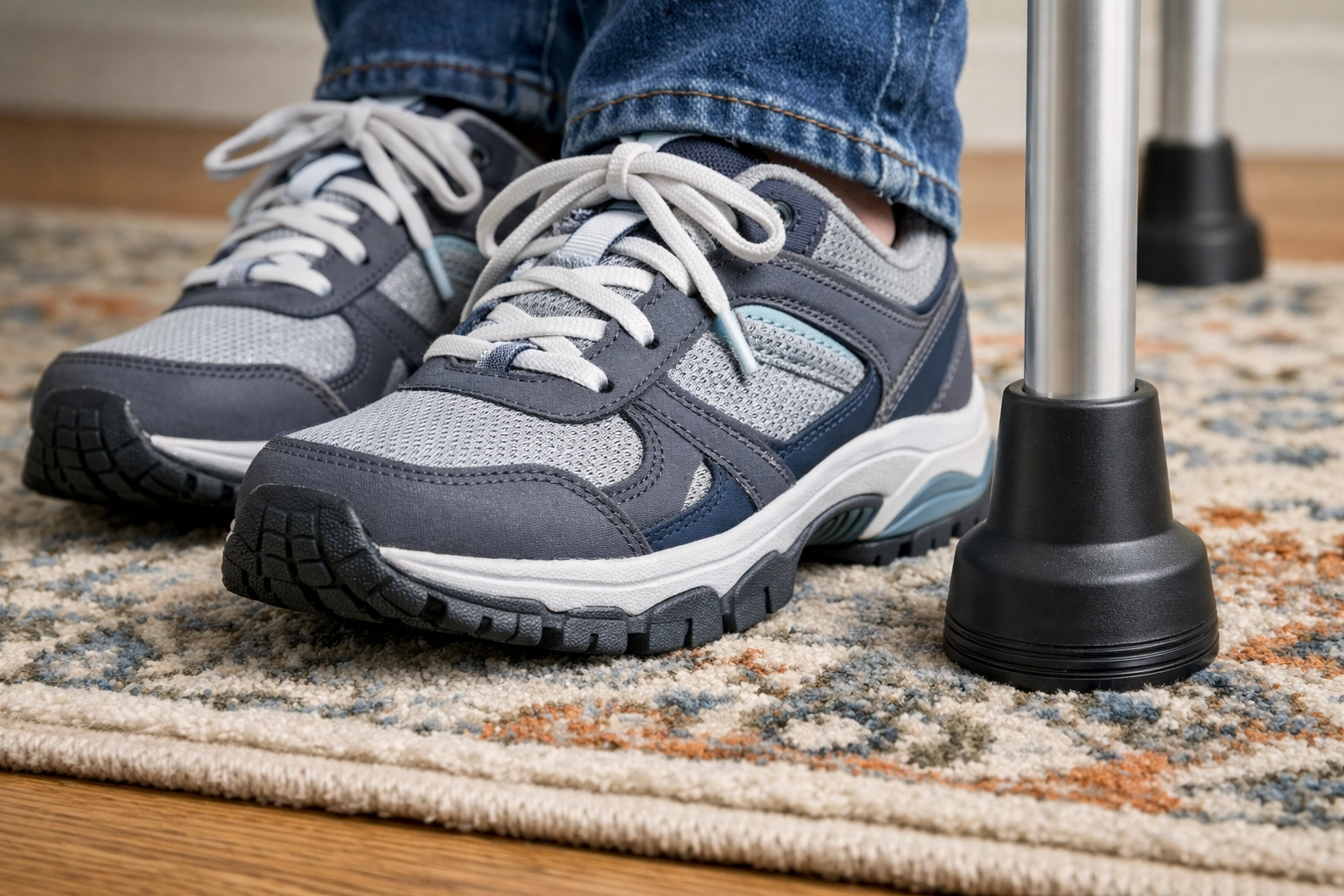
- Wear closed-toe, closed-heel shoes that fit snugly.
- Look for non-slip rubber soles with good grip.
- Avoid "backless" shoes that require your toes to "scrunch" to keep the shoe on.
- Ensure your laces are tied securely or use velcro straps that won't come undone and create a tripping hazard.
Bonus: Maintaining Your Equipment
Beyond how you use the walker, the condition of the tool itself matters. We recommend doing a "safety check" once a week.
Check the Rubber Tips: The rubber caps on the bottom of walker legs (or the brakes on a rollator) are like the tires on a car. If the tread is worn smooth, they won't grip the floor. If you see the metal of the walker leg poking through the bottom of the rubber tip, replace it immediately.
Check the Brakes: If you use a rollator, squeeze the brakes to ensure they lock the wheels completely. If the walker still moves when the brakes are engaged, it needs an adjustment.
Keep it Clean: Dust and hair can get caught in the axles of the wheels, making the walker harder to push and causing it to pull to one side. A quick wipe-down and a check of the wheels can prevent a lot of frustration.
Finding Your Rhythm
Using a walker is a skill. Like any skill, it takes a little bit of practice to get it right. Don't be discouraged if it feels awkward at first. The goal isn't just to move; it's to move with the kind of stability that gives you peace of mind.
By avoiding these seven common mistakes, you’re doing more than just preventing a fall: you’re ensuring that your mobility aid remains a tool for freedom, rather than a source of strain. Remember, if you’re ever in doubt, a single session with a physical therapist can provide a lifetime of safe habits. Stay upright, stay active, and keep moving forward.

