
Walkers and rollators are incredible tools. For many of us, they represent the difference between staying home and getting out into the world. They provide the stability needed to navigate a grocery store, visit family, or simply move safely from the bedroom to the kitchen. But here’s the thing: a walker is only as helpful as the way it’s used.
As a physical therapist or a caregiver will tell you, a walker used incorrectly can sometimes create more risks than it solves. It’s easy to pick up bad habits, especially if you’ve been using a mobility aid for a long time. You might not even realize you’re doing something that puts your balance at risk.
In this guide, we’re going to walk through the seven most common mistakes people make with their walkers and, more importantly, exactly how to fix them. Our goal is to make sure your walker is working for you, not against you.
1. Setting the Height Incorrectly
This is perhaps the most common mistake of all. Many people inherit a walker from a friend or buy one off the shelf and start using it without adjusting it to their specific height.
The Mistake:
If the walker is too low, you’ll find yourself hunching over. This puts an immense amount of strain on your lower back, neck, and shoulders. More dangerously, it shifts your center of gravity forward, making you more likely to tip.
On the flip side, if the handles are too high, your arms will be bent at an awkward angle. This means you can’t actually put your weight through your arms to support your legs. Instead of the walker helping you, you end up "carrying" the walker with your shoulders, which leads to rapid fatigue.
The Fix:
To find the "Goldilocks" height, follow these steps:
- Stand up as straight as you comfortably can.
- Let your arms hang naturally at your sides.
- Look at where your wrist meets your hand (the wrist crease). The handgrips of the walker should align exactly with that crease.
- When you grab the handles, your elbows should have a slight bend: about 15 to 20 degrees. This allows you to push down and support your weight effectively.

2. Walking "Behind" the Walker (The Grocery Cart Mistake)
Think about how you push a heavy grocery cart through the store. You push it out in front of you and walk along behind it. While that works for groceries, it’s a dangerous way to use a walker.
The Mistake:
When you push the walker far out in front and then "chase" it, you are effectively walking without support for several inches of every step. If you trip while the walker is two feet ahead of you, there is nothing to grab onto. Walking behind the walker also causes you to lean forward, which is a major fall risk.
The Fix:
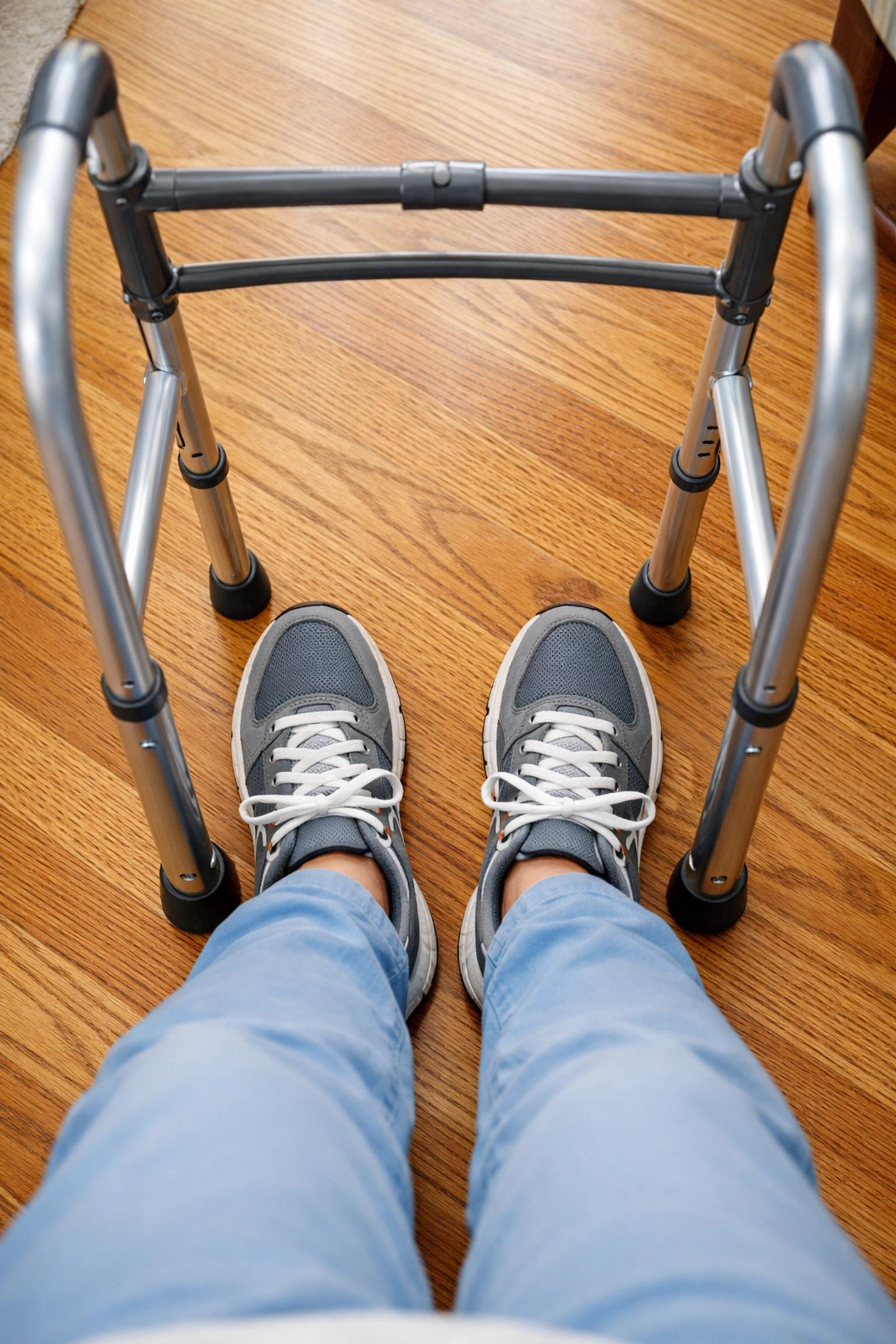
You want to walk inside the walker, not behind it.
- Move the walker forward just a small distance (about one step's length).
- Step into the center of the frame. Your feet should stay between the back legs of the walker.
- Keep your torso upright. You should feel like the walker is surrounding you, providing a "stable box" of support.
- Always stay close to the crossbar. If you can see the back legs of the walker clearly in front of your toes, you're likely too far back.
3. Forgetting the Brakes During Transitions
If you use a rollator (a walker with four wheels and a seat), the brakes are your best friend: but only if you use them.
The Mistake:
The most dangerous moment for a rollator user is the transition between sitting and standing. Many people try to sit down on the walker’s seat or stand up from it without engaging the loops or levers that lock the wheels. If you shift your weight and the walker rolls away, a fall is almost inevitable.
The Fix:
Make it a non-negotiable habit to "click" the brakes into the locked position every single time you stop to sit or stand.
- Before sitting: Back up until you feel the seat against the back of your legs. Reach down and lock both brakes. Test them with a tiny nudge to make sure they hold.
- Before standing: Ensure the brakes are locked before you push yourself up.
- Only once you are fully upright and have your balance should you release the brakes to begin walking.
4. Using the Walker to "Pull" Yourself Up
This is a mistake we see all the time, and it’s one of the most frequent causes of walker-related tipping accidents.
The Mistake:
When rising from a chair or a bed, it’s tempting to grab the walker handles and pull on them to get yourself upright. The problem is that walkers are designed to take vertical weight (pushing down). They are not weighted to handle horizontal force (pulling toward you). If you pull on a walker, it can easily tip over onto you, leaving you with no support and a heavy frame falling toward your chest.
The Fix:
Never use the walker as a leverage point to get out of a chair.
- Sit at the edge of your chair.
- Place your hands on the armrests of the chair or the surface of the bed.
- Push down through your legs and arms to stand up.
- Once you are steady on your feet, then: and only then: reach forward to place your hands on the walker handles.

5. Turning Too Sharply (The Pivot)
When you’re in a hurry to get to the door or the phone, it’s easy to want to whip the walker around. However, the physics of a walker don’t support quick pivots.
The Mistake:
Twisting your body while your feet stay planted (pivoting) is a recipe for a fall. Your feet can get tangled in the legs of the walker, or you might lose your balance as the walker moves faster than your center of gravity. Turning too sharply can also cause the walker to tip sideways if a wheel catches on a rug or a threshold.
The Fix:
Think of yourself like a large bus: you need a wide turning radius.
- Instead of twisting, take small, deliberate steps in a semi-circle.
- Always keep your body facing the front of the walker.
- Move the walker a little, then move your feet a little.
- Avoid "crossing" your feet. Keep a wide, stable base as you move through the turn.
6. Overloading the Front with Weight
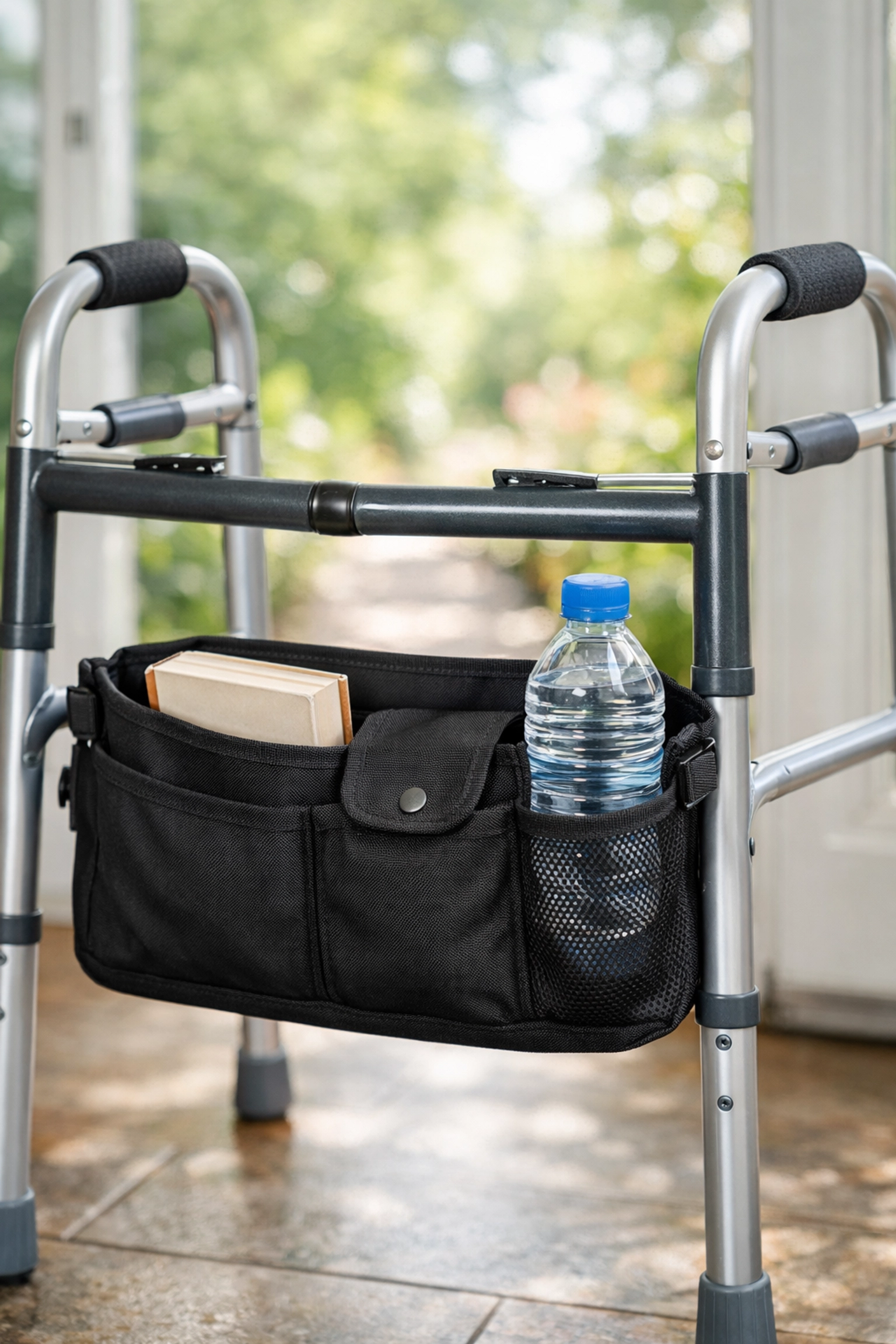
It’s natural to want to carry things with you: a book, a bottle of water, or a purse. But where you put those items matters.
The Mistake:
Hanging a heavy bag or purse over the front crossbar or the handles of the walker changes the balance of the device. It makes the walker "front-heavy." If you hit a small bump, like a door threshold or the edge of a rug, the extra weight can cause the walker to tip forward abruptly.
The Fix:
If you need to carry items, use accessories specifically designed for your walker model.
- Use a walker basket or a pouch that sits low and is centered within the frame.
- Keep the weight as low as possible. The higher the weight, the more unstable the walker becomes.
- If you find yourself needing to carry heavy groceries, it may be time to ask for assistance or look into a specialized cart, rather than relying on the walker to do the heavy lifting.
7. Walking Too Fast
We often use walkers because our balance isn't what it used to be. Ironically, having the walker can sometimes give us a false sense of security that leads us to speed up.
The Mistake:
Moving too quickly, especially with a rolling walker, allows momentum to take over. If the walker starts moving faster than your feet can keep up, you end up in that "chasing the walker" position we discussed earlier. On uneven surfaces, a fast-moving wheel can hit a pebble or a crack and stop instantly, while your body keeps moving forward.
The Fix:
The walker is a tool for stability, not speed.
- Maintain a slow, rhythmic pace.
- Be especially careful when transitioning from one floor surface to another (like moving from carpet to hardwood).
- If you feel the walker "running away" from you, gently apply the brakes or slow your step. Focus on the quality of each step rather than how quickly you reach your destination.
Bonus: Maintenance Matters
Beyond how you move, the condition of the walker itself plays a huge role in your safety. A walker with worn-out parts is a hazard.
- Check the Tips: If you have a standard walker (no wheels), the rubber tips on the bottom will eventually wear down, just like the tread on a tire. If you see the metal tube poking through the rubber, replace the tips immediately. Smooth rubber can slide on tile floors, which is very dangerous.
- The "Ski" Glides: If you use tennis balls or plastic "skis" on the back legs of a two-wheeled walker, check them for wear. When they get thin, they can catch on carpets and cause a trip.
- Wobble Check: Periodically check the bolts and folding mechanisms. If the walker feels "jiggly" or loose, it’s not providing the rigid support you need.
Final Thoughts
Using a walker correctly takes a bit of practice and mindfulness. It might feel a little tedious at first to remember to lock the brakes every time or to take small steps when turning. But these habits are the foundation of your independence.
By avoiding these seven common mistakes, you’re not just using a mobility aid: you’re mastering a tool that keeps you active, safe, and moving through life with confidence. Take it slow, stay "inside the box," and always remember that your walker is there to support you, one steady step at a time.

