
Hey there, I’m Brian Kerr, the founder here at Fall Guys Products. Over the years, I’ve spoken with hundreds of folks who are working hard to stay mobile and independent. One thing I’ve noticed is that while walkers and canes are incredible tools for freedom, they don't exactly come with a detailed "driver’s manual" when you pick them up at the store.
Using a mobility aid is a bit like learning to ride a bike: there’s a technique to it. If you get it right, it feels like an extension of your body. If you get it wrong, it can actually make you less stable and lead to more aches and pains than you had to begin with.
I want to walk you through some of the most common mistakes I see every day and, more importantly, how you can fix them to stay safe and confident on your feet.
1. Using the Cane on the "Painful" Side
This is easily the most common mistake people make. It feels intuitive, doesn't it? If your right knee hurts, you want to put the cane in your right hand to support that side.
However, your body actually moves in a contralateral pattern. When you walk, your right arm swings forward at the same time as your left leg. By putting the cane in the hand opposite your "bad" leg, you are mimicking the body’s natural rhythm and widening your base of support.
The Fix: Always use your cane in the hand opposite of your weaker or more painful leg. If your left hip is the issue, the cane goes in your right hand. As you step forward with your left leg, move the cane forward at the same time. This allows the cane to take some of the weight off that left hip while keeping your center of gravity right where it needs to be.
2. The "Wrist Crease" Rule: Getting the Height Right
Whether it’s a cane or a walker, height is everything. If the aid is too high, your shoulders will be up by your ears, causing neck and upper back pain. If it’s too low, you’ll be hunched over, which is a recipe for a fall because it shifts your weight too far forward.
Most people "eyeball" the height, but there is a much more scientific way to do it.
The Fix: Stand up as straight as you can with your shoes on (the shoes you wear most often). Let your arms hang naturally at your sides. Look at your wrist: specifically that little crease where your hand meets your arm. The top of your cane or the handles of your walker should line up exactly with that wrist crease. When you grip the handles, you should have a slight, comfortable bend in your elbow (about 15 to 20 degrees).

3. The "Walker Hunch" and Distance Issues
When using a walker, especially the ones with wheels (rollators), many people treat them like a shopping cart. They push the walker way out in front of them and then "chase" after it. This creates a "hunch" in the back and leaves you vulnerable. If the walker slips away or you trip, you’re already leaning forward and have no way to catch yourself.
The Fix: You should always walk inside the walker, not behind it. Your toes should generally stay in line with the rear wheels or the back legs of the frame. Think of the walker as a protective bubble around you. When you move the walker forward, only move it about one step’s length. Then, step into the center of the frame. Keeping the device close to your body ensures that your weight is supported by the frame rather than your back muscles.
4. Pulling on the Aid to Stand Up
This is a mistake that can lead to an immediate fall. When you’re sitting in a chair and need to stand up, it’s tempting to grab the handles of your walker or the grip of your cane and pull yourself up.
Mobility aids are designed for downward pressure, not horizontal pulling. If you pull on a walker, it can tip over toward you, and because it has wheels or slick tips, it can slide right out from under you.
The Fix: Never use your mobility aid to pull yourself out of a seated position. Instead, use the armrests of the chair or the surface of the bed to push yourself up. Once you are steady on your feet, then you can reach out and place your hands on the walker or cane. When sitting back down, the same rule applies: reach back for the chair’s arms first, rather than holding onto the walker as you descend.

5. Ignoring the "Tires" (Maintenance)
Just like a car, the parts of your walker or cane that touch the ground will wear out. The rubber tips on the bottom of canes and walkers are there to provide grip. Over time, that rubber gets smooth, hard, or even cracks. Once the "tread" is gone, a cane can slide out on a hardwood floor like a skate on ice.
Similarly, on rollators, the brakes can loosen over time. If you go to sit on your rollator seat and the brakes aren't holding tight, the walker can roll away, leading to a fall.
The Fix: Do a "weekly check-up." Look at the bottom of your cane or walker tips. If you see the metal washer peeking through the rubber, or if the bottom looks smooth and shiny, it’s time to replace them. For rollators, test your brakes while standing still. If you squeeze the brakes and can still push the walker forward, they need an adjustment. Most of these fixes are simple and can be done with basic tools or by a local pharmacy technician.
6. Carrying Too Much (The "Dangling Bag" Syndrome)
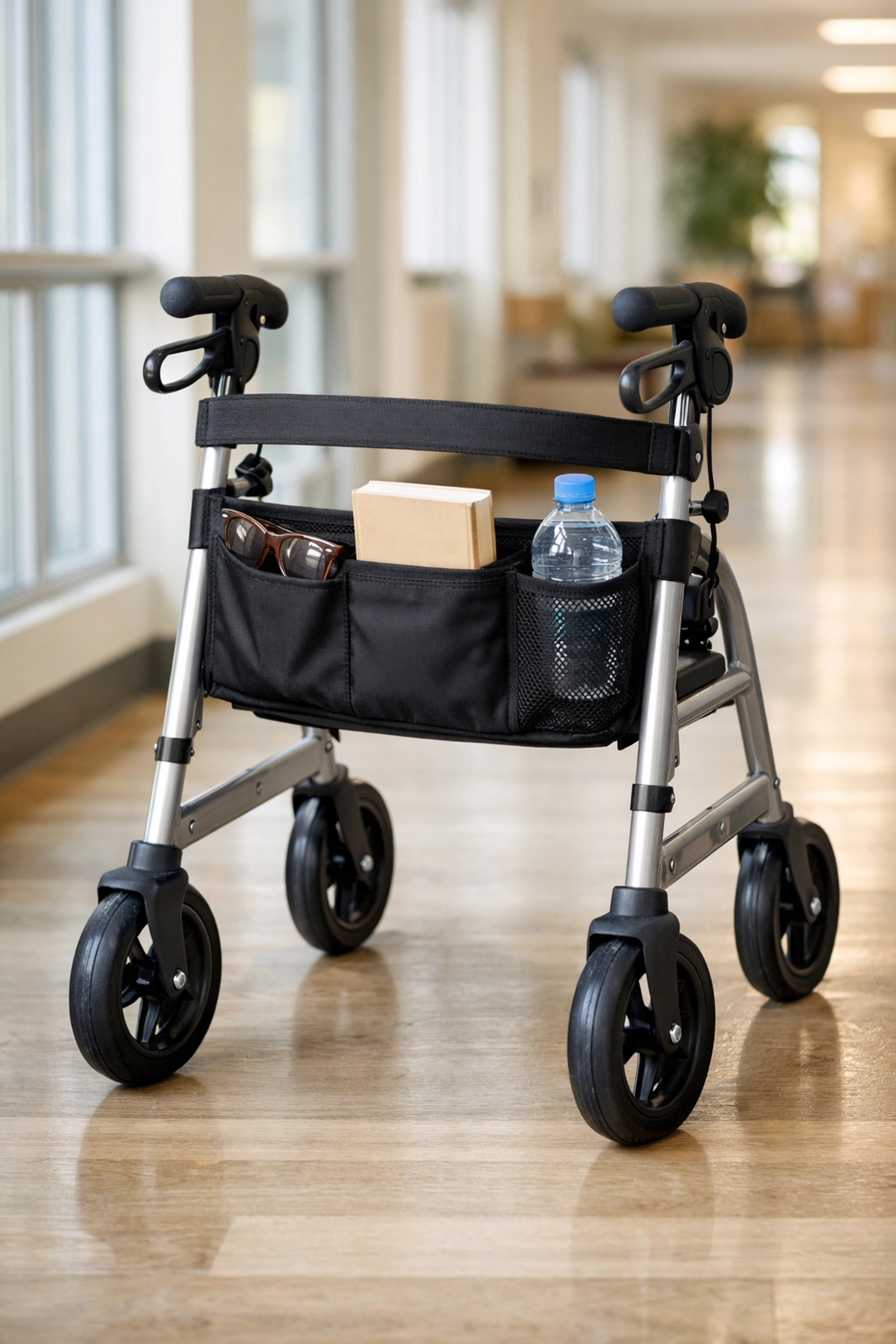
We all need to carry things: a phone, a bottle of water, a book. However, hanging a heavy bag over the handles of a walker or the crook of a cane is dangerous. It changes the center of gravity of the device. If the bag is too heavy, it can cause the walker to tip backward or sideways. If it’s hanging from a cane, it creates a pendulum effect that can throw off your balance mid-stride.
The Fix: For walkers, use a basket or a pouch that attaches to the front or center of the frame. This keeps the weight balanced and low. For cane users, consider a small crossbody bag or a fanny pack. This keeps your hands free to focus entirely on the cane and keeps the weight centered on your body rather than on the mobility aid.
7. Choosing "Looks" Over Function
I see this a lot with canes. People love the look of an antique wooden cane with a round "tourist" handle or a decorative silver knob. While they look great, these handles often don't distribute your weight evenly across your palm. This can lead to carpal tunnel issues, numbness in the fingers, or hand fatigue, which eventually makes you stop using the cane altogether.
The Fix: Prioritize an ergonomic handle. An "offset" cane (which has a bit of a question-mark shape at the top) is often best because it puts your weight directly over the shaft of the cane. Handles with a flat, padded top (often called "Derby" or "Palm" grips) are much easier on the joints and offer more stability. Save the decorative cane for a photo op, and use a functional, ergonomic one for your daily walks.
Mastering the Rhythm: How to Walk Properly
Once you’ve corrected these mistakes, the next step is getting your rhythm down. Walking with an aid should be a three-part process.
For Cane Users:
- Move the cane forward about 6-10 inches.
- Step forward with your weak leg.
- Step through with your strong leg.
Remember: Cane and weak leg move together.
For Walker Users:
- Push the walker forward a short distance (staying within reach).
- Step into the walker with one leg.
- Bring the other leg to meet it or step through.
Avoid the "bunny hop" (jumping with both feet). It’s much safer to take distinct, controlled steps.

Navigating Stairs and Curbs
Stairs are the "final boss" of mobility aids. The golden rule to remember is: "Up with the good, down with the bad."
Going Up:
- Keep your cane or walker on the level you are currently standing on.
- Step up with your stronger leg.
- Then, bring your weaker leg and the mobility aid up to the same step.
Going Down:
- Place your cane or walker down onto the lower step first.
- Step down with your weaker leg.
- Bring your stronger leg down to join it.
By following this pattern, your strongest muscles are always doing the heavy lifting (going up) and the steady braking (going down).
When to Talk to a Professional
If you’ve tried adjusting your height and your technique but you still feel "wobbly," it might be time for a professional assessment. A Physical Therapist (PT) or Occupational Therapist (OT) is the best resource for this. They can look at your specific gait, your strength levels, and your home environment to recommend the exact right piece of equipment.
Sometimes a person using a cane really needs a walker for better lateral stability. Other times, someone using a standard walker might benefit from a rollator with wheels to help with their endurance. There’s no shame in moving from one to the other: the goal is always the same: keeping you moving safely.
Final Thoughts
Using a walker or a cane isn't a sign of "giving up." In my view, it’s exactly the opposite. It’s a sign that you value your independence enough to use the tools available to keep yourself out in the world.
Take a few minutes today to check your cane tip, look at your posture in a mirror, and make sure your height is set correctly at the wrist crease. Those small adjustments can make a world of difference in how you feel and how safely you move through your day.
Stay safe and keep moving!

