
Stairs are often the most daunting part of a home for seniors and their families. While they represent a way to access different parts of a cherished house, they also represent a significant risk for falls. At Fall Guys Products, we believe that staying safe shouldn't mean staying limited to one floor. It’s about understanding the environment and making the necessary adjustments to keep life moving smoothly.
Hi, I’m Brian Kerr, the founder here. We spend a lot of time looking at how people move through their homes. What we’ve noticed is that many stair-related falls aren't just "accidents": they are often the result of small, overlooked habits or environmental factors that have been ignored for too long.
Let’s walk through the seven most common mistakes people make with stair safety and, more importantly, how you can fix them today to stay steady on your feet.
1. The "I Know These Stairs" Mentality (Ignoring the Handrail)
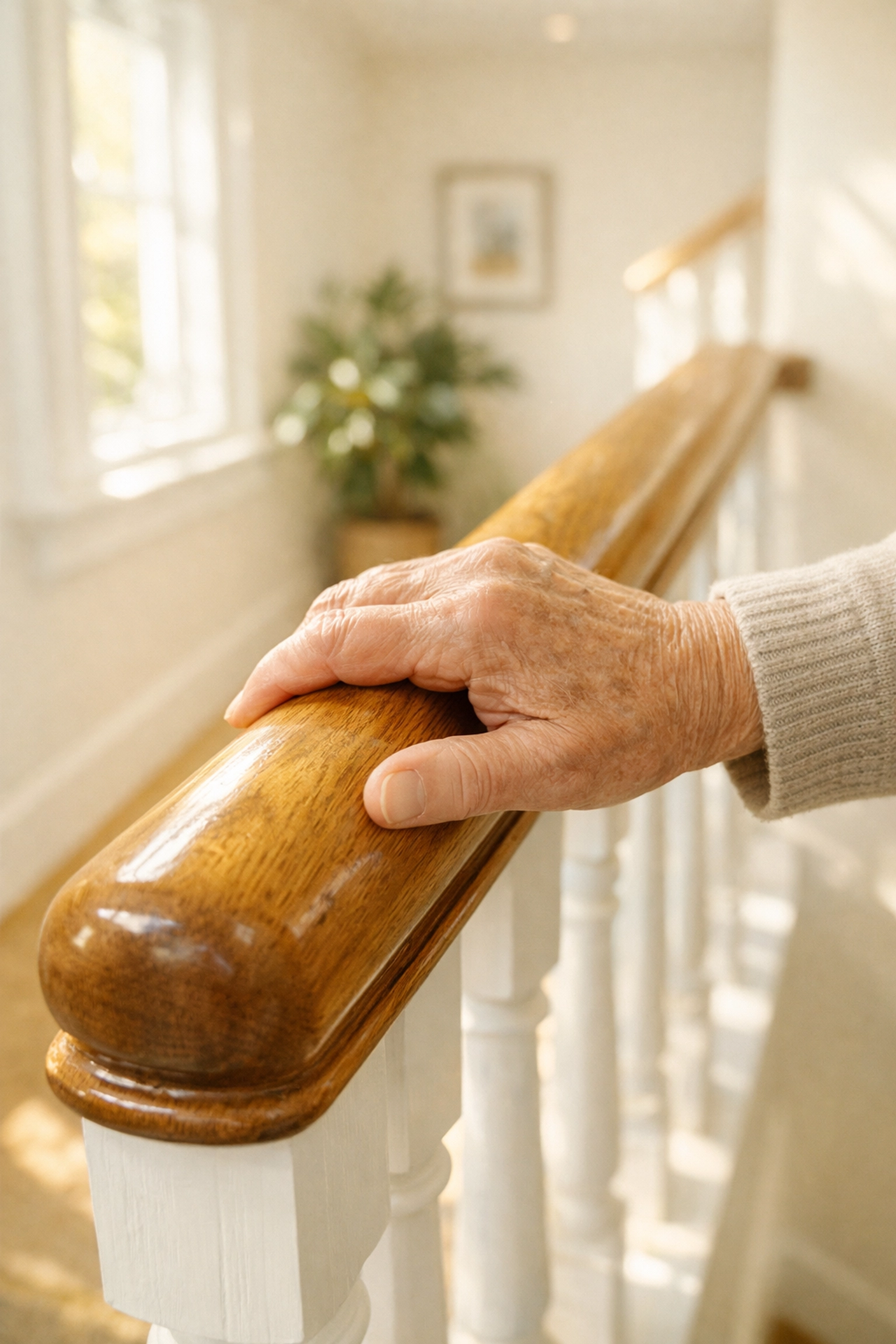
One of the most common mistakes is familiarity. When you’ve lived in a home for twenty or thirty years, you feel like you could walk those stairs in your sleep. This leads many people to stop using the handrail entirely, often carrying items in both hands or keeping their hands in their pockets.
The Fix:
Treat every trip on the stairs with the same focus you would use on a hiking trail. Always keep at least one hand on a sturdy handrail. If your stairs only have a rail on one side, consider installing a second one. Having rails on both sides provides a much higher level of stability and allows you to use your stronger arm for support whether you are going up or down.
A good handrail should be mounted at a height where your elbow is slightly bent when holding it: typically between 34 and 38 inches from the floor. It should also extend slightly past the top and bottom steps so you have support before you start climbing and after you finish.
2. Rushing the Transition
We all live busy lives. Maybe the phone is ringing, or someone is at the front door. The impulse is to "hop" up or down the stairs quickly. Speed is the enemy of stability. When we rush, our center of gravity shifts too far forward, and our steps become shallower. We stop placing our full foot on the tread, which significantly increases the chance of a slip.
The Fix:
Adhere to the "one step at a time" rule. Instead of trying to maintain a rhythmic walking pace, plant both feet on a step before moving to the next one if you feel at all fatigued or unsteady. Even if you are moving "normally," consciously slow your pace. Take a breath at the top and bottom of the stairs to ensure your vision is clear and your balance is centered before you begin.
3. The Slipper and Sock Trap
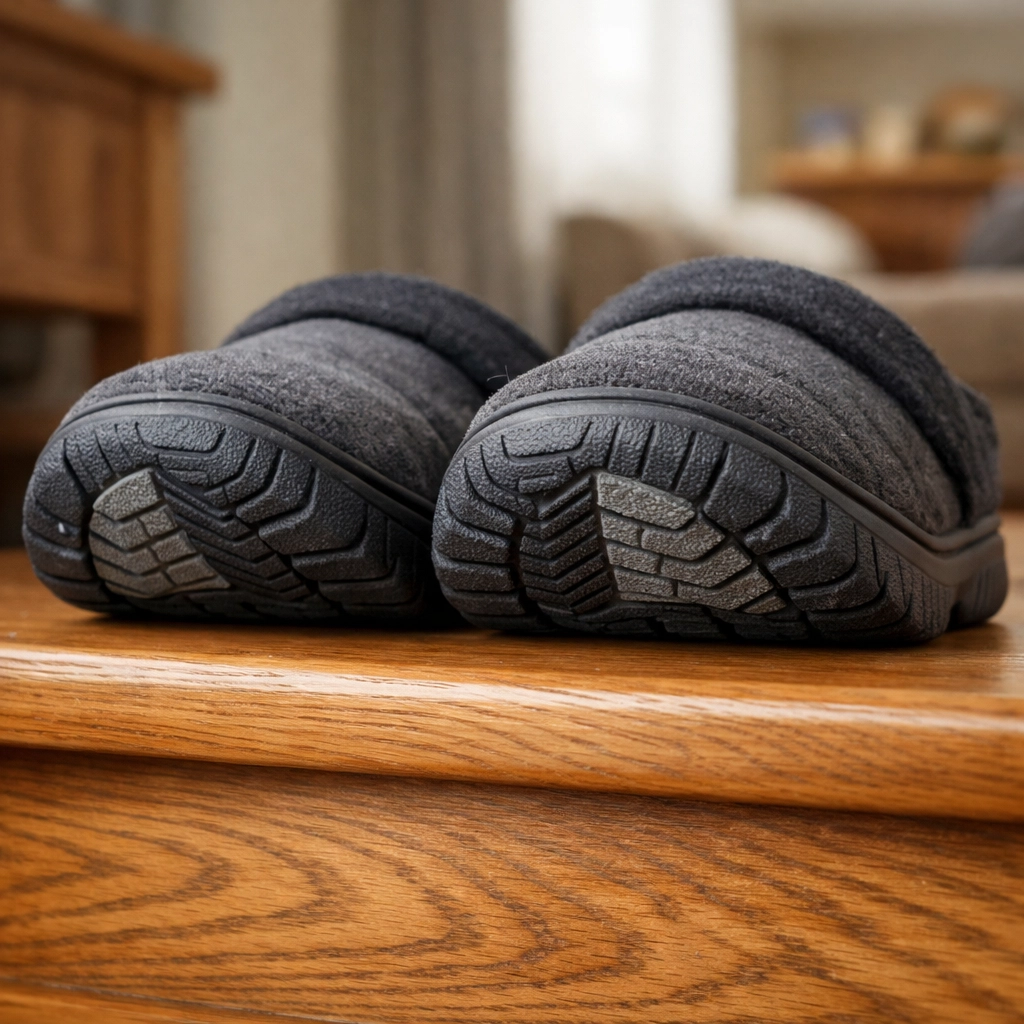
What you wear on your feet is just as important as the stairs themselves. Many of us love the comfort of a pair of thick wool socks or loose-fitting slippers around the house. However, on wooden or polished stone stairs, socks act like little skis. Slippers without backs can easily slide off, causing a trip or forcing you to adjust your gait mid-step to keep them on.
The Fix:
Choose footwear with a non-slip rubber sole and a closed back. If you prefer to be "shoeless" in the house, look for high-traction grip socks that have rubberized patterns on the bottom. However, for maximum safety, a supportive indoor shoe with a firm heel is always the better choice. Avoid walking on stairs in bare feet if you have any issues with sensation or foot pain, as this can affect how you perceive the edge of the step.
4. Treating the Bottom Step Like a Storage Unit
It’s a common habit: "I’ll just leave this laundry basket/stack of books/pair of shoes here on the bottom step and take it up next time I go." This creates a significant tripping hazard. Not only does it physically block your path, but it also creates "visual noise." When your brain sees a pile of objects, it can become distracted, making it harder to accurately judge where the actual edge of the step is.
The Fix:
Implement a "Clear Path" policy. Nothing should ever be stored on the stairs, even temporarily. If you have items that need to go up or down, place them on a small table or a designated "staging area" near the stairs, but never on the steps themselves. If you are a caregiver, do a daily sweep of the stairwell to ensure no stray items have migrated onto the treads.
5. Navigating the "Twilight Zone" (Inadequate Lighting)
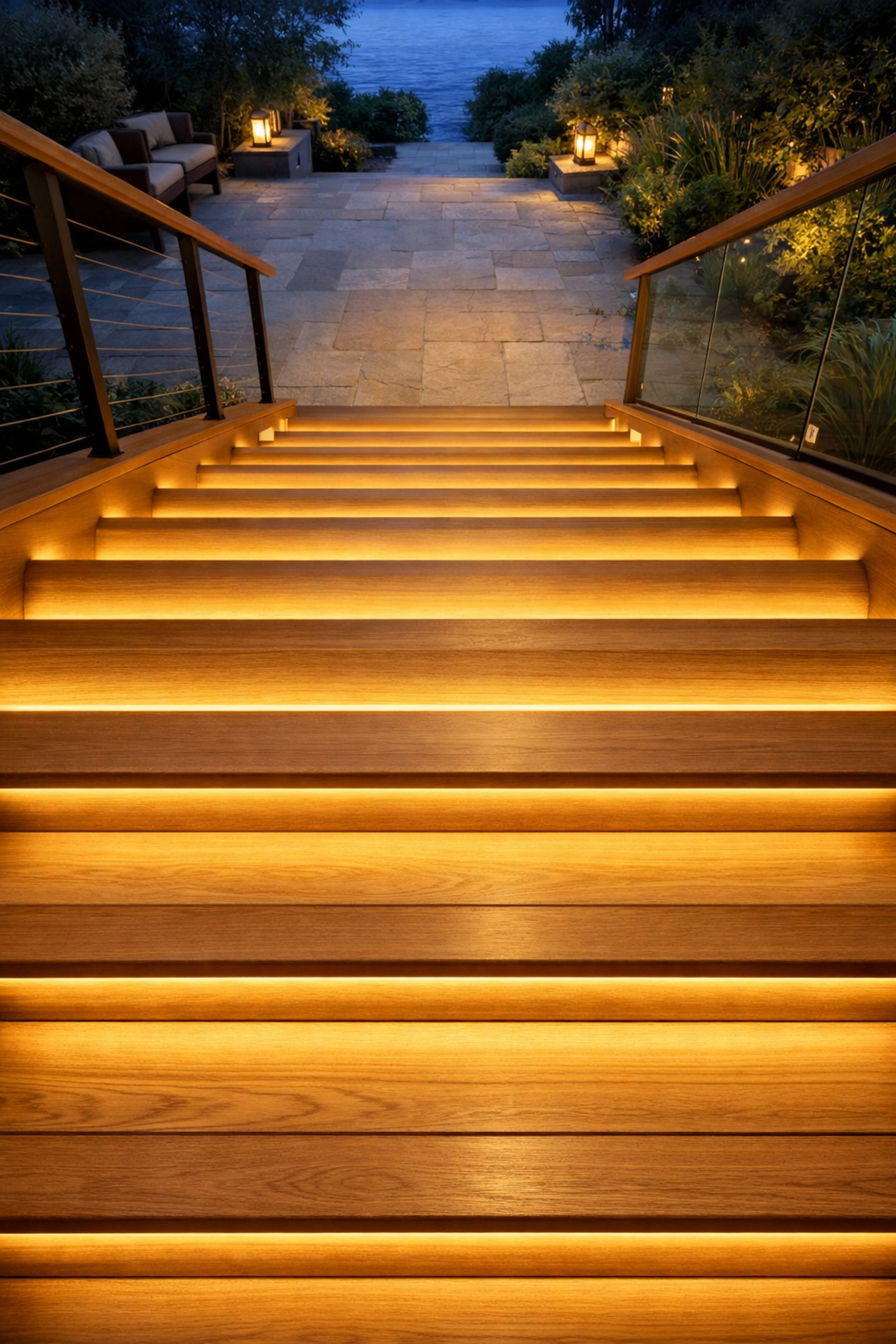
Many staircases are poorly lit, especially those leading to basements or older second stories. A single dim bulb at the top of the stairs often casts long shadows over the lower steps. If you can’t clearly see the "nose" (the front edge) of each step, your brain has to guess where to place your foot. This is particularly dangerous for those with age-related vision changes like cataracts or glaucoma, which can decrease depth perception.
The Fix:
Ensure the entire stairwell is flooded with light. Install light switches at both the top and the bottom of the stairs so you never have to navigate them in the dark to reach a switch. Consider adding motion-sensor LED strips under the lip of each step or along the baseboards. These provide clear, glare-free illumination that defines exactly where one step ends and the next begins.
6. Distracted Climbing and "The Full-Hand Carry"
We are a society of multi-taskers. We try to carry a laundry basket, a phone, and a cup of tea all at once while navigating the stairs. This is a recipe for disaster. When your vision of your own feet is blocked by a large object, you lose your primary source of feedback for balance. Furthermore, if both hands are full, you have nothing to grab onto if you do lose your footing.
The Fix:
Always keep one hand free. If you need to move items between floors, use a backpack or a small shoulder bag to keep your hands empty. If the item is too large, ask for help or move it in smaller, manageable trips. Never use a mobile phone while on the stairs. Finish your text or your call at the top, put the phone in your pocket, and focus entirely on the movement of your body until you reach the bottom.
7. Neglecting Basic Maintenance
Over time, stairs wear out. Carpeting can become loose or frayed, creating a loop that catches a toe. Wooden treads can become slick as the finish wears down. Handrails can begin to wobble as the screws in the drywall loosen. We often ignore these small issues because we "get used to them," but they are the primary mechanical causes of falls.
The Fix:
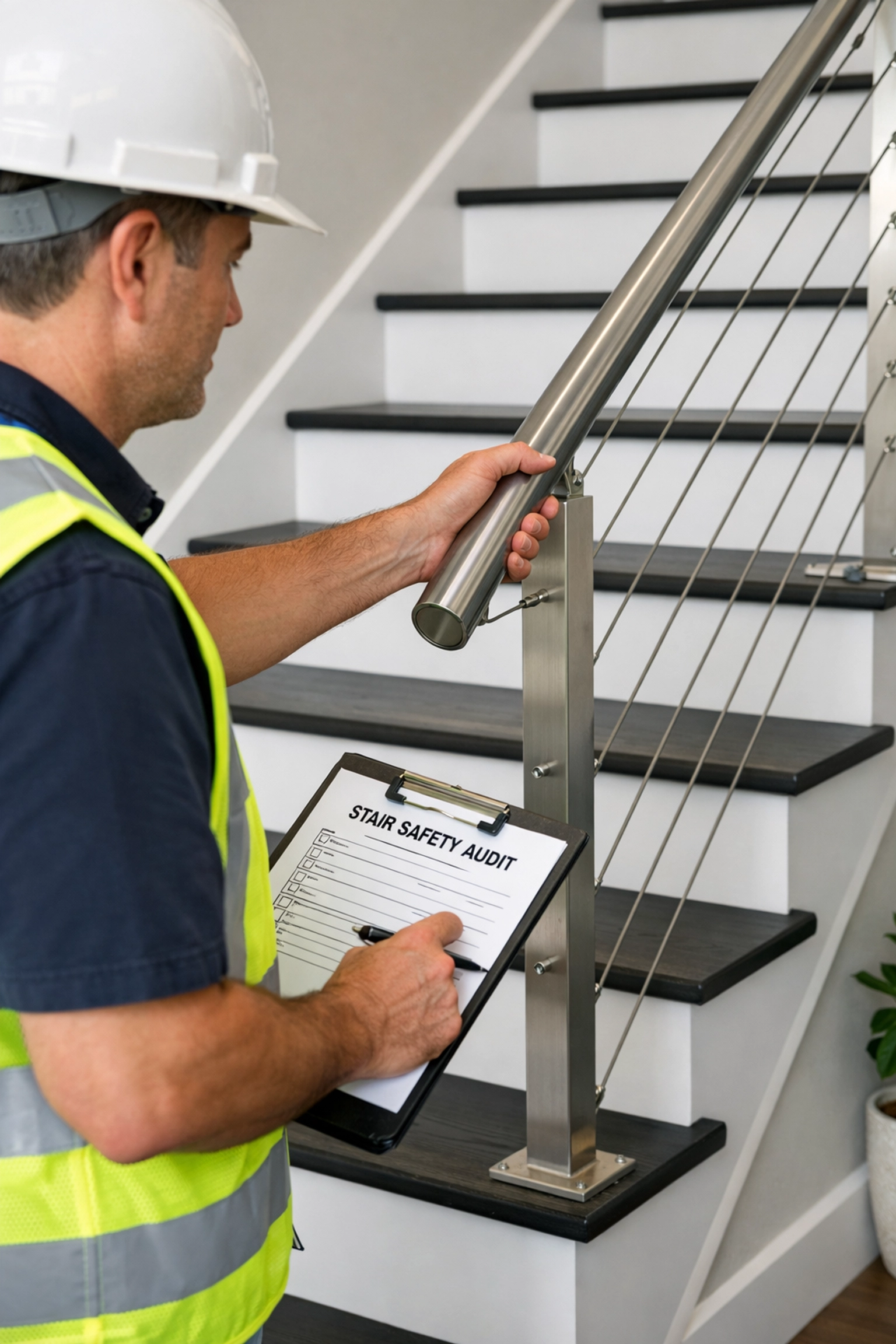
Perform a "Stair Audit" every few months. Walk up and down and check for the following:
- Loose Carpet: If the carpet is "bubbling" or loose on the tread, it needs to be re-stretched or tacked down immediately.
- Slippery Surfaces: If wooden stairs are too slick, apply anti-slip adhesive strips. These are clear or colored textured tapes that provide extra grip without ruining the look of the wood.
- Wobbly Rails: Tug on your handrail. If it moves at all, it needs to be tightened or re-mounted into a wall stud.
- Consistent Height: Sometimes, in older homes, the "riser" height (the vertical part of the step) is inconsistent. If one step is even half an inch taller than the others, it can cause a trip. While fixing the structure is a big job, highlighting the edge of an uneven step with high-contrast tape can help your eyes spot the difference.
The Anatomy of a Safe Step
Beyond fixing mistakes, it helps to understand what makes a staircase "safe" by design. If you are considering a renovation or moving to a new home, look for these features:
- Tread Depth: The flat part where you put your foot should be deep enough to accommodate most of your foot (usually 10 to 11 inches).
- Riser Height: The vertical rise should be consistent and ideally between 6 and 7 inches. High steps are harder on the knees and harder to balance on.
- The "Nosing": The edge of the step should be rounded, not sharp, but it shouldn't overhang too far, as an excessive overhang can catch the toe of a shoe as you move upward.
- Contrast: Stairs that are all one color (like dark wood or beige carpet) are harder to navigate than those with contrast. A white riser with a dark tread makes the stairs much easier to see.
Physical Readiness for the Stairs
While the environment is half the battle, your body is the other half. Maintaining the strength and balance needed for stairs doesn't necessarily require a gym membership.
Simple exercises, such as "sit-to-stands" from a sturdy chair, can help build the quadriceps and glute strength necessary to lift your body weight up a step. Balance exercises, like standing on one foot while holding onto a kitchen counter, can improve the proprioception (your brain's awareness of your body's position) that keeps you upright.
Always consult with a physical therapist or a doctor before starting a new exercise routine. A physical therapist, in particular, can offer a "mobility assessment" to see exactly how you are using your stairs and offer personalized tips to improve your technique.
A Final Word of Encouragement
Making these changes doesn't mean admitting defeat or getting "old." It’s about being smart. Just like we wear seatbelts in cars or helmets on bikes, optimizing our stairs is a proactive way to ensure we can keep enjoying our homes for years to come.
Take a look at your stairs today. Which of these seven mistakes can you fix before the sun goes down? Maybe it’s clearing off those shoes or changing a lightbulb. These small wins add up to a much safer, more confident life at home. Stay safe out there!

