
Hi, I’m Brian Kerr, the founder of Fall Guys Products. Over the years, I’ve walked through hundreds of homes and talked to countless families about one specific area that causes more anxiety than almost any other: the stairs.
It’s understandable. Stairs are the "Everest" of the home. They require balance, strength, and good vision all at once. But here’s the thing: most stair-related accidents aren't just "bad luck." They are usually the result of small, overlooked issues that have been there for years. We get used to the creak in the third step or the dim light in the hallway, and we stop seeing them as hazards.
My goal today is to help you see your staircase with fresh eyes. We’re going to look at seven common mistakes people make with stair safety and, more importantly, how to fix them without needing a full home renovation.
1. The Trap of Inconsistent Step Heights
In a perfect world, every step on a staircase would be exactly the same height. Our brains are actually incredibly efficient at "mapping" a staircase. After the first two steps, your brain automates the movement. You stop thinking about how high to lift your foot because you expect the next step to be identical to the last.
The mistake many homeowners make is ignoring "variations." In older homes, especially, it’s common to find steps that differ by even half an inch. This is often caused by settling or DIY repairs. A particularly dangerous version of this is the "Top Step Trap," where the top landing is slightly wider or the riser is a different height than the rest of the flight.
The Fix:
Ideally, a standard riser (the vertical part) should be between 15 and 18 cm, and the tread (the horizontal part) should be 25 to 30 cm deep. If your steps are uneven, and a professional carpenter isn't an option right now, you can improve safety by adding high-contrast stair nosing. By highlighting the edge of each step with a different color or texture, you force the brain to stay "engaged" rather than relying on muscle memory, which reduces the chance of a trip.
2. Decorative Over Functional Handrails
I see this all the time: beautiful, ornate handrails that look like they belong in a museum but are nearly impossible to actually hold onto. Many modern or "designer" handrails are too wide, too flat, or have sharp edges.
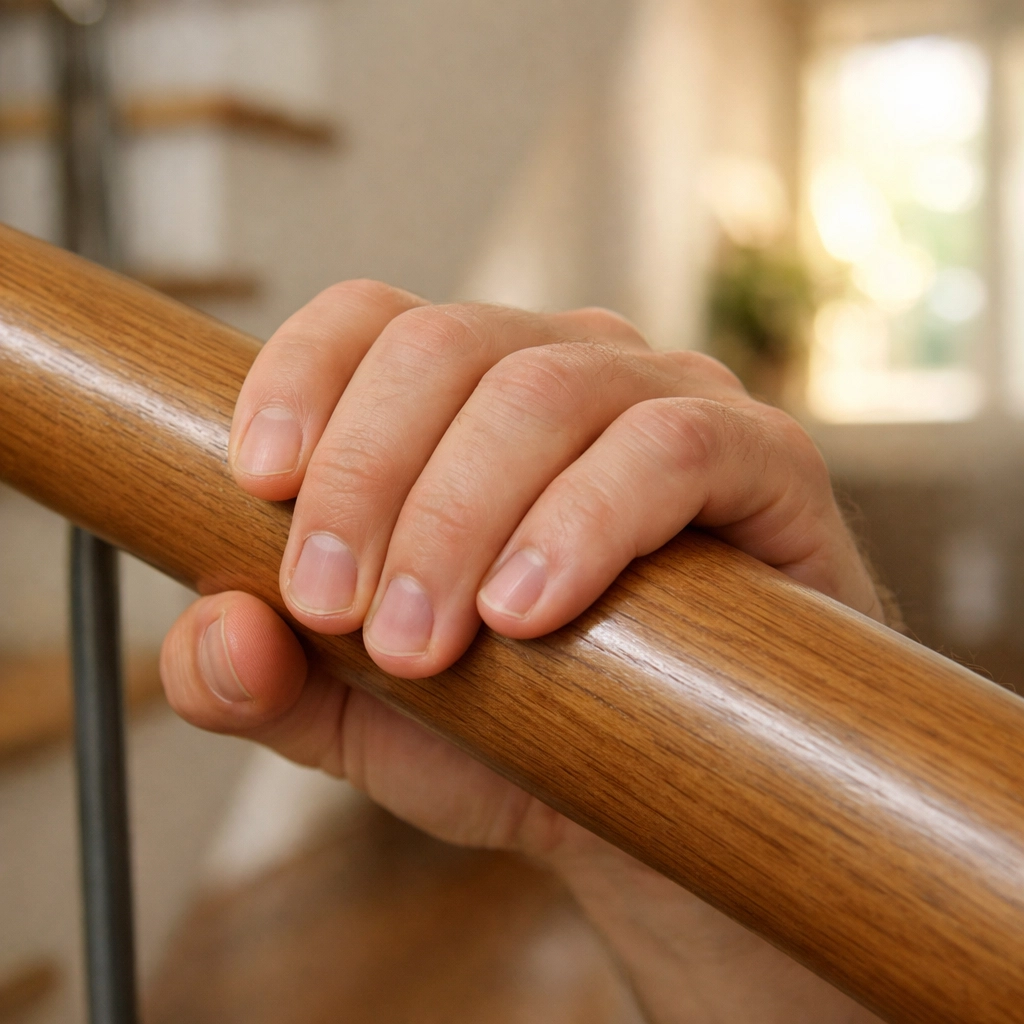
The mistake here is prioritizing aesthetics over the "power grip." If you were to slip, you need a rail you can wrap your hand all the way around. If you can only pinch the top of the rail with your fingers, you won't have the leverage to stop a fall.
The Fix:
Upgrade to a "graspable" handrail. The best shape is a round rail with a diameter of about 1.25 to 2 inches. This allows your hand to encircle the wood or metal completely. Furthermore, ensure the handrail extends past the top and bottom steps. Many people let go of the rail just as they are transitioning onto the flat floor, which is exactly where balance can waver. If your current rail is loose, don't just tighten the screws: use heavy-duty wall anchors or ensure the brackets are screwed directly into the wall studs.
3. The Danger of the "Socks-Only" Slide
We all love the feeling of a polished hardwood staircase. It looks clean and elegant. However, polished wood, tile, or even painted concrete are incredibly low-friction surfaces. The biggest mistake here is navigating these surfaces in socks or smooth-soled slippers.
Socks on polished wood are essentially skis. There is almost zero traction, and if your heel catches the edge of a step just slightly wrong, there is nothing to stop the foot from sliding forward.
The Fix:
You have two main paths here. The first is environmental: apply non-slip transparent tape or adhesive treads to the edge of each step. These provide a "grit" that catches the foot without ruining the look of the wood. The second is behavioral: commit to a "no-socks" rule on the stairs. Wear shoes with rubber soles or high-quality non-slip socks with rubber grips on the bottom. It sounds simple, but this one change can prevent a significant percentage of household slips.
4. Neglecting the "Minor" Maintenance
We tend to ignore the small stuff. A slight wiggle in the banister, a carpet runner that’s starting to bulge, or a floorboard that squeaks. We tell ourselves we’ll "get to it next weekend."
The mistake is thinking these are just annoyances. A loose carpet runner is a literal tripwire. A banister that wiggles under 10 pounds of pressure will absolutely fail under 150 pounds of pressure during a fall.
The Fix:
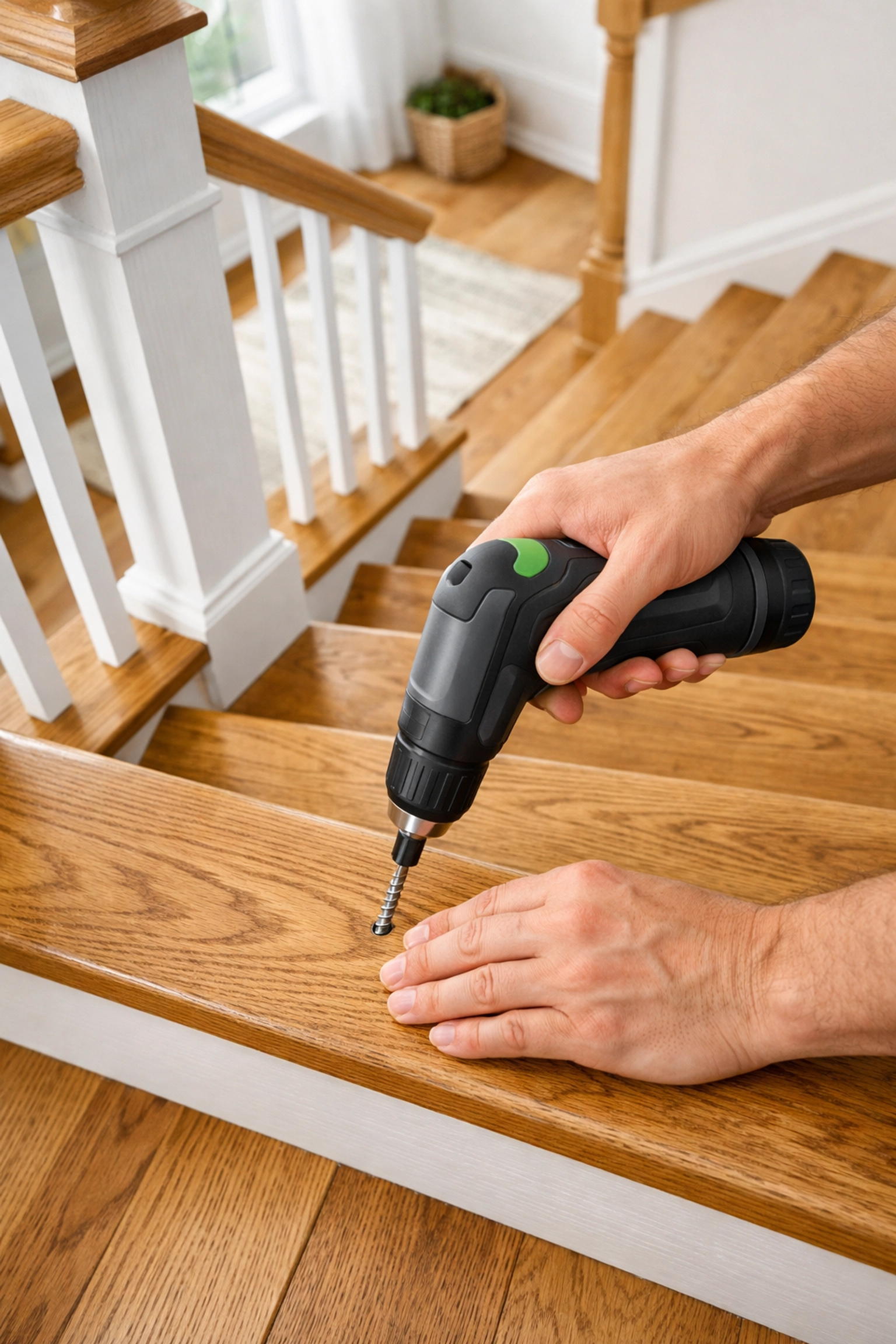
Conduct a "Seasonal Stair Audit." Once every few months, walk the stairs slowly. Feel for any movement in the treads. If a board is loose, use wood screws rather than nails to secure it; screws have much better "pull-out" resistance and won't pop back up over time. If you have carpet, ensure the staples or transition strips are flush and tight. If you see any fraying, trim it immediately so it doesn't catch on a shoe.
5. Shadow Zones and Poor Lighting
Lighting is often an afterthought, but on a staircase, it’s a primary safety feature. A common mistake is having a single, dim light bulb at the top of the stairs that casts a long shadow over the lower steps. If you can't see the exact "nose" or edge of the step, you are guessing where to put your feet.
As we age, our eyes require significantly more light to see the same level of detail, and our depth perception can become less sharp. Shadows can look like flat ground, and flat ground can look like a step.
The Fix:
Install lighting that illuminates the entire path. Motion-sensor LED strips are a fantastic, low-cost solution. You can place these under the lip of each step or along the baseboard. They trigger as soon as you approach, ensuring you never have to "fumble" for a light switch in the dark. Also, ensure there are light switches at both the top and the bottom of the stairs. If you have to walk down in the dark to turn the light on, the system is broken.
6. Using the Stairs as a "Temporary" Shelf
We’ve all done it. You have a pair of shoes, a book, or a stack of mail that needs to go upstairs, so you set it on the bottom step to take up "next time you’re going that way."
This is one of the most dangerous habits you can have. Stairs should be treated like a high-traffic runway: nothing should ever be left on them. Even if you think you’ll remember the item is there, a middle-of-the-night trip to the kitchen or a moment of distraction can lead to a disaster.
The Fix:
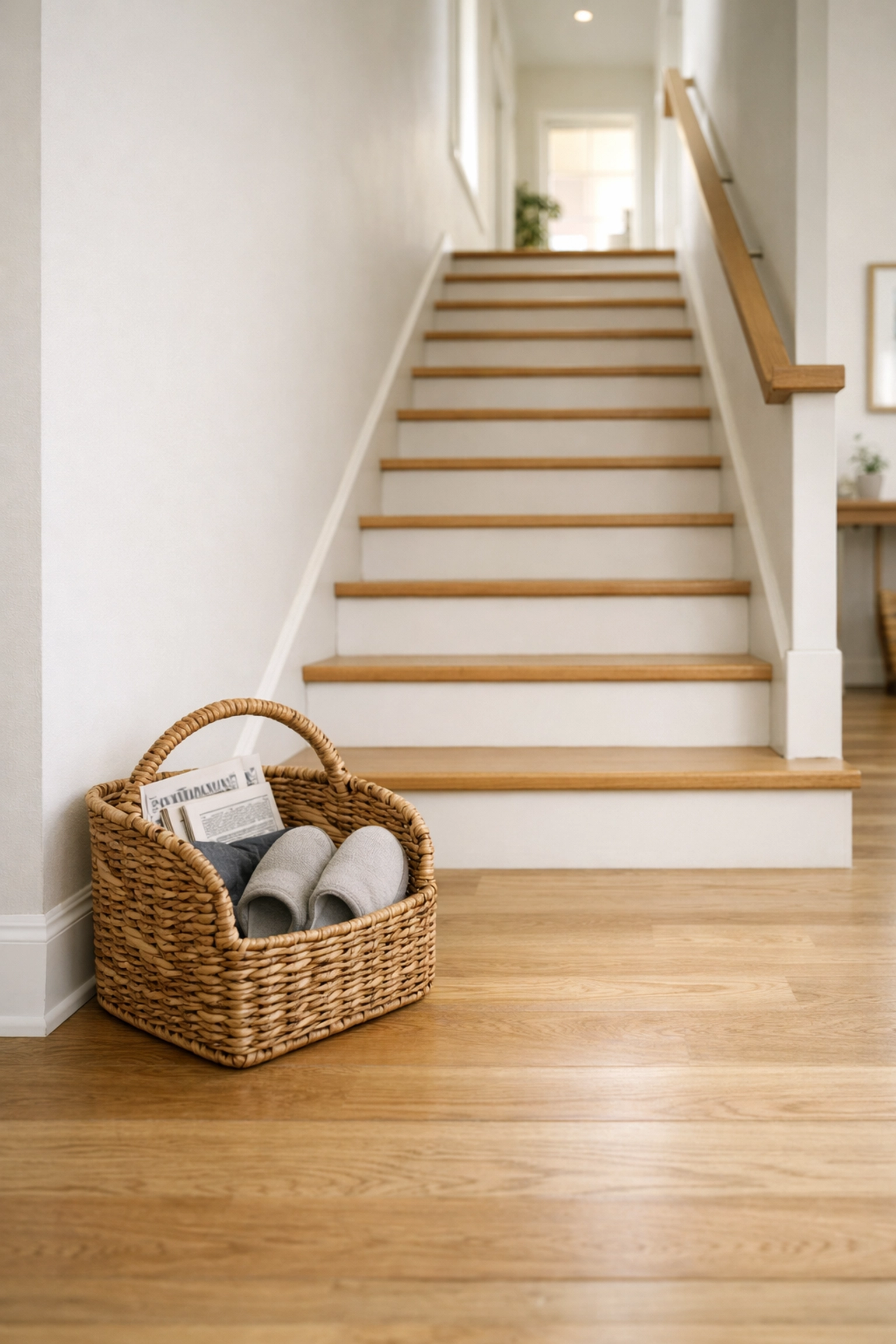
Adopt the "Clear Path" policy. If something needs to go up, it either goes up immediately or it sits in a designated "stair basket" located on the floor beside the stairs, not on the steps themselves. This keeps the walking surface 100% clear at all times. If you have children or grandchildren, make this a firm rule in the house: no toys on the stairs, ever.
7. The "One-Hand" or "No-Hand" Rush
The final mistake is behavioral: rushing. Many falls happen when we are in a hurry to answer the door, grab a ringing phone, or check something in the kitchen. When we rush, we often stop using the handrail, or we only use one hand while carrying something in the other.
Carrying items while using the stairs significantly shifts your center of gravity and obscures your view of your feet.
The Fix:
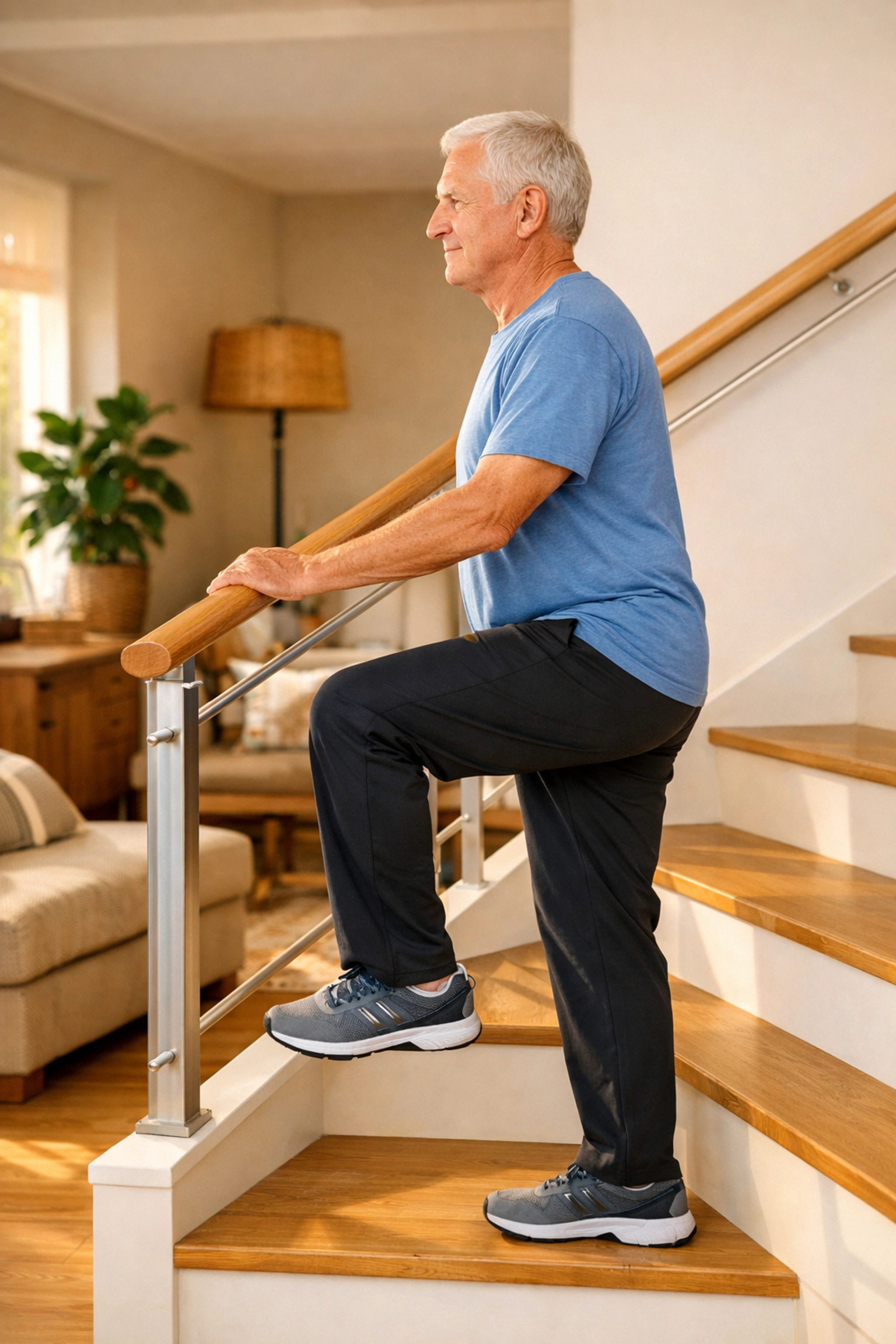
Practice the "Three Points of Contact" rule. At any given moment, you should have at least one hand firmly on the rail and both feet in contact with the steps (or one hand and one foot moving). If you need to move items between floors, consider using a sturdy backpack. This keeps your hands free to use the rails on both sides (if available) and keeps your weight centered over your hips. If a backpack isn't an option, make two trips. It takes sixty seconds longer, but it's infinitely safer.
The Role of Physical Awareness
Beyond the physical environment of the stairs, your own body plays a huge role. Stair safety is just as much about leg strength and ankle flexibility as it is about handrails.
Often, we find that people who struggle with stairs are dealing with "foot drop" or reduced proprioception (the body's ability to sense its position in space). Working with a physical therapist can help you build the specific muscle groups needed for stair climbing: namely the glutes, quads, and calves. They can also teach you the "step-to" pattern (bringing both feet to the same step before moving to the next), which is much more stable than the traditional "step-over-step" method.
Final Thoughts
Stair safety isn't about one big change; it’s about a series of small, intentional adjustments. By fixing the lighting, securing the handrails, and clearing the clutter, you’re not just making your home safer; you’re maintaining your independence.
I always tell people: don't wait for a "near miss" to take these steps. Take a walk over to your staircase right now. Is it bright enough? Is the rail sturdy? Is there a pair of shoes sitting on the third step?
Take it one fix at a time. Your future self will thank you.
Stay safe,
Brian Kerr
Founder, Fall Guys Products

