
Stairs are often the most intimidating part of a home as we age or face mobility challenges. It’s a common concern I hear from families: "I’m worried about Mom on those stairs," or "I’ve started taking the steps one at a time, very slowly."
At Fall Guys Products, we believe that your home should be a place of comfort, not a source of anxiety. My name is Brian Kerr, and as the founder, I’ve spent a lot of time looking at how environments impact our safety. Stairs are essentially a series of controlled falls: every time you take a step, you are momentarily off-balance. If the environment isn't set up correctly, that "controlled" part of the fall can quickly disappear.
The good news is that most stair-related accidents are preventable. By identifying common mistakes and making simple adjustments, you can regain your confidence and significantly reduce the risk of a fall. Let’s walk through the seven most common mistakes people make with stair safety and, more importantly, how to fix them.
1. The "I Don’t Need the Rail" Mindset
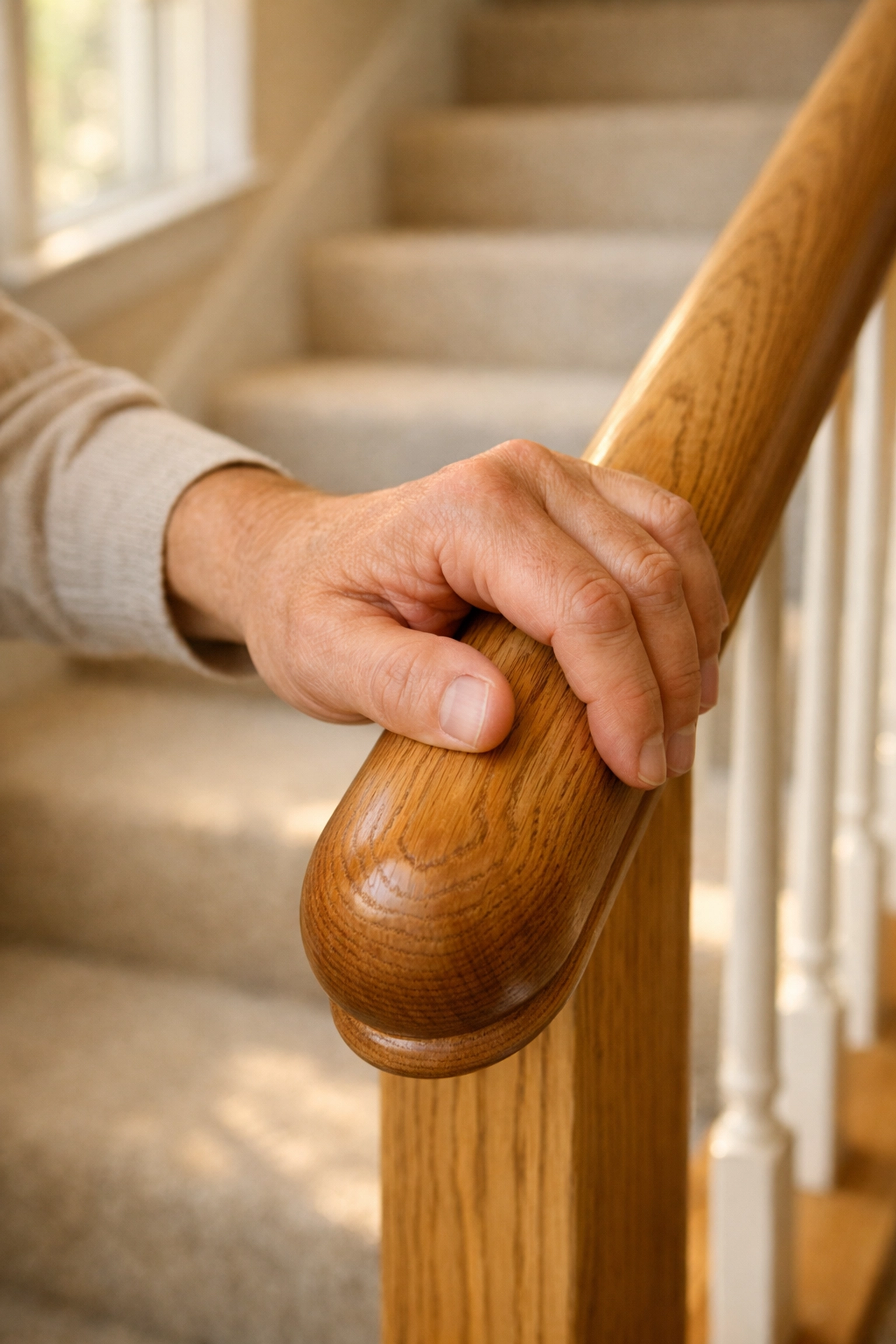
One of the most frequent mistakes is simply not using the handrail. Many people feel that if they are having a "good day" or if they are only carrying a light item, they don't need to hold on. Others might have handrails that are decorative but not functional: perhaps they are too wide to grip or too low to be helpful.
The Fix:
Make it a non-negotiable habit to keep at least one hand on the rail at all times. In the world of safety, we often talk about "three points of contact." When climbing stairs, this means having both feet and one hand (or one foot and two hands) in contact with a stable surface at all times.
If your stairs only have a rail on one side, consider installing a second one. Having rails on both sides provides double the support and allows you to use your strongest side regardless of whether you are going up or down. Ensure the rail is at a comfortable height (usually between 34 and 38 inches) and that it is "graspable": meaning your hand can comfortably wrap around it to provide a secure grip.
2. Navigating in the Shadows
As we age, our eyes require more light to see clearly and distinguish between different levels. Poor lighting is a leading cause of missteps, particularly at the top and bottom of the staircase where the transition between flat floor and steps occurs. If you find yourself squinting or "feeling" for the next step with your toe, your lighting is likely insufficient.
The Fix:
Install bright, non-glare LED lighting that illuminates the entire flight of stairs. It’s important to ensure there are switches at both the top and the bottom so you never have to navigate in the dark to reach a light switch.
For an extra layer of safety, consider motion-sensor lights. These are fantastic because they turn on automatically as you approach, which is especially helpful during middle-of-the-night trips to the kitchen or bathroom. Another professional tip: use contrasting colors. Placing a strip of brightly colored tape or a different colored tread on the edge (nosing) of each step can help your eyes quickly identify where one step ends and the next begins.
3. Using the Stairs as a Temporary Shelf
We’ve all done it: we have a stack of books or a basket of laundry that needs to go upstairs, so we set it on the bottom step to take up "later." This creates a major tripping hazard. Even if you think you’ll remember it’s there, distractions happen. A ringing phone or a doorbell can cause you to move quickly, forgetting about the obstacle in your path.
The Fix:
Adopt a "clear stairs" policy. Nothing should ever be placed on the steps, even temporarily. If you have items that need to go to a different floor, use a "stair basket" with a handle that sits on the floor next to the stairs: not on them.
Keep the path completely clear of clutter, including decorative rugs at the top or bottom of the landing. These rugs can easily slide or catch a toe, leading to a fall. If you must have a rug, ensure it is low-profile and firmly secured with a non-slip backing or double-sided rug tape.
4. Overlooking the "Socks and Smooth Wood" Danger
Many falls on stairs occur not because of a trip, but because of a slip. Polished hardwood, tile, or even worn-down carpet can be incredibly slick, especially if you are walking in socks or smooth-soled slippers. Socks offer zero traction, and on a wooden staircase, they can act like little skis.
The Fix:
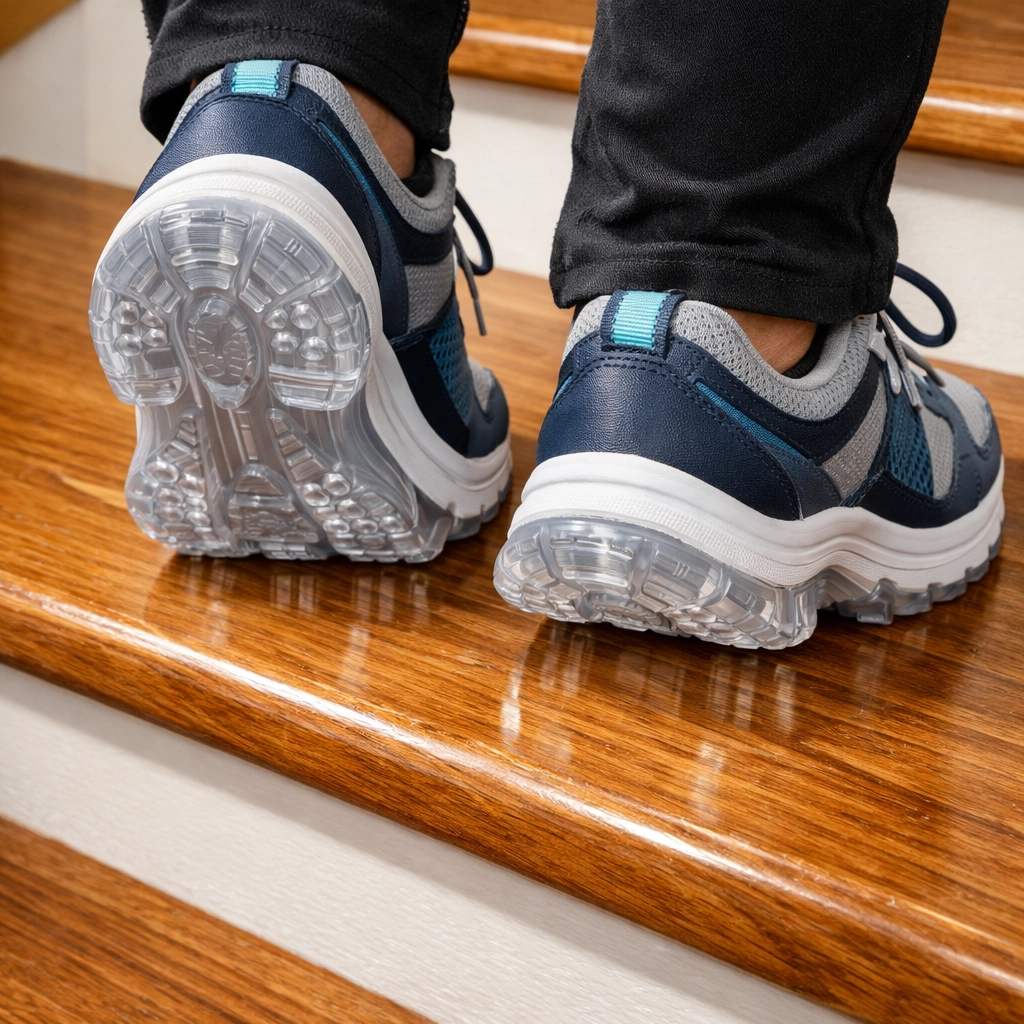
First, evaluate your footwear. The safest way to navigate stairs is with well-fitting shoes that have rubber, non-slip soles. Avoid walking on stairs in stocking feet or loose-fitting "scuff" slippers that can slide off your heel.
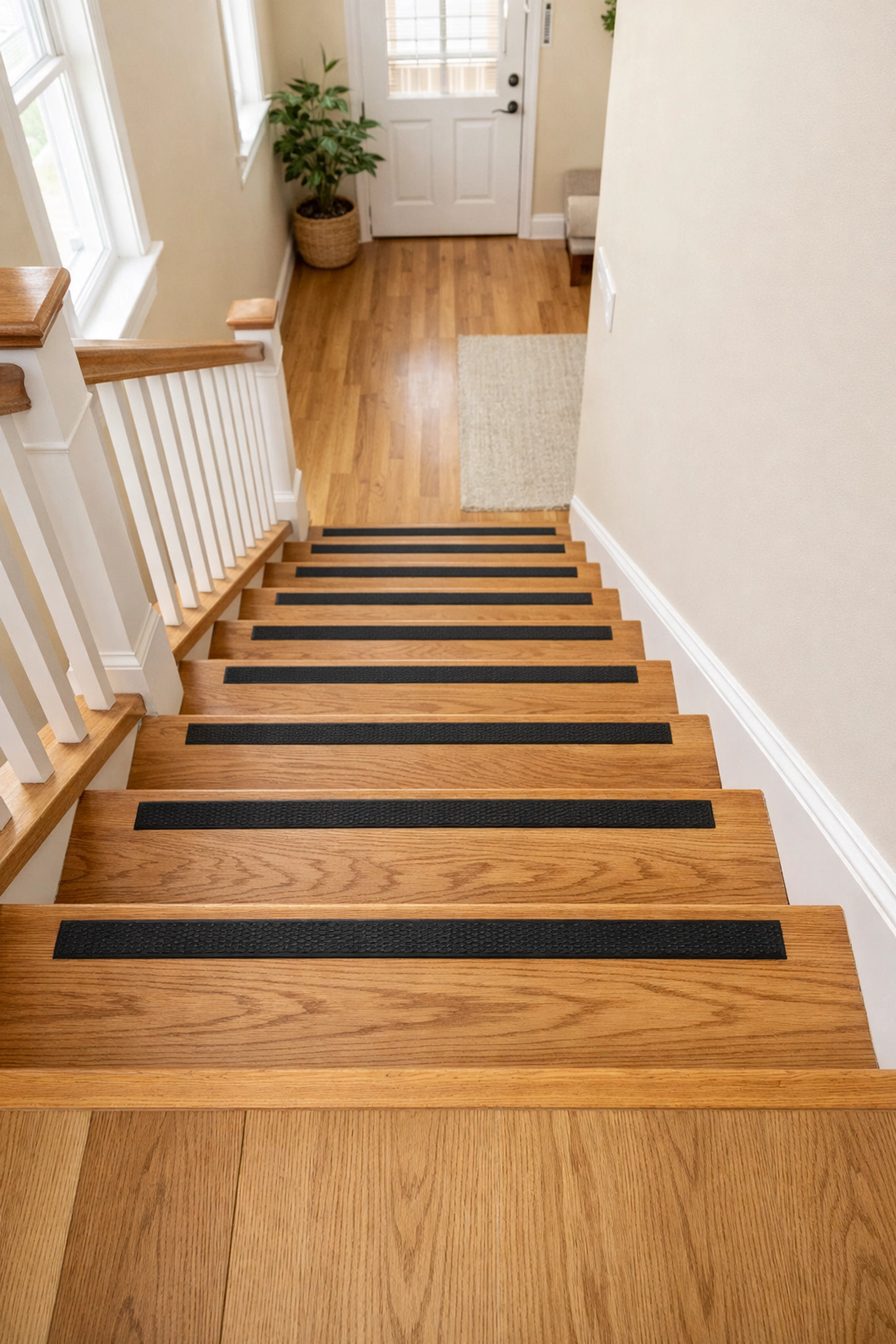
Second, look at the stair surface itself. If you have wooden steps, consider adding anti-slip adhesive strips or transparent "grip" tape to the edge of each step. If your stairs are carpeted, ensure the carpet is tight and not "rolling" over the edge of the steps. Worn carpet should be replaced, as it loses its grip over time and can become a hazard.
5. Rushing and Distractions
In our fast-paced world, we are often in a hurry. We try to carry too many things at once, or we’re looking at our phones while moving between floors. Rushing changes your gait and reduces your reaction time if you do happen to lose your balance.
The Fix:
Treat the stairs as a focused activity. When you are on the stairs, that is the only thing you should be doing.
- Don't carry large loads: If you have a large basket of laundry, consider breaking it into two smaller loads so you always have one hand free for the rail.
- One step at a time: It’s not a race. Take your time to plant your foot firmly on each tread.
- Eye on the prize: Look where you are going. Don’t look at your phone, and try not to carry items that are so bulky they block your view of your feet.
6. Ignoring Inconsistent Step Heights
Not all staircases are built perfectly. In older homes especially, you might find that one step is slightly taller or shorter than the others. The human brain is incredibly good at identifying patterns; after the first two steps, your brain "automates" the movement. If the fourth step is an inch higher than the third, your foot will likely catch the edge, causing a trip.
The Fix:
While you can’t always rebuild your staircase, you can make these defects more visible. Use the contrasting tape method mentioned earlier to highlight the edges of uneven steps.
Another common design defect is the "bottom-of-flight illusion." This happens when the pattern on the stairs matches the pattern on the floor landing, making it look like the stairs have ended when there is actually one more step. You can fix this by using a different colored rug on the landing or a different color of paint/stain on the final step to clearly signal the end of the transition.
7. Skipping Regular Maintenance
Like any other part of the home, stairs undergo wear and tear. Handrails can become loose over time due to constant use. Wooden treads can creak or crack, and carpet staples can work their way loose. Small issues that seem minor today can become the cause of an accident tomorrow.
The Fix:
Perform a "stair audit" once every few months. Walk up and down the stairs specifically looking for issues:
- Grip the handrail: Give it a firm shake. Does it wiggle? If the brackets are loose or the wood is pulling away from the wall, it needs to be tightened or reinforced immediately.
- Check the treads: Are there any loose boards? Does the carpet feel "puffy" or loose on any specific step?
- Check the lighting: Are any bulbs flickering or dim?
If you aren't handy with tools, don't hesitate to call a local handyman or a family member to help with these quick fixes. It’s a small investment of time that provides huge peace of mind.
A Note on Physical Strategy
Beyond the environment, how you move matters. Physical therapists often recommend the "step-to" pattern for those who feel unsteady. Instead of alternating feet (left, right, left), you move one foot to the next step and then bring the second foot to join it on the same step. This ensures you are always balanced on a flat surface before moving again.
Always remember: it is okay to ask for help. If you feel dizzy or particularly tired, wait a few minutes before attempting the stairs, or ask someone to walk with you.
Reclaiming Your Independence
Stair safety isn't about limiting your movement; it's about empowering you to move freely within your own home. By addressing these seven mistakes, you transform a potential hazard into a safe, functional part of your daily routine.
At Fall Guys Products, our goal is to provide the education and reassurance you need to stay safe and independent. Take a look at your stairs today: is there one small fix you can make right now? Maybe it's clearing a pair of shoes off the bottom step or checking that the hallway light bulb is bright enough. Those small steps lead to a much safer journey.

