
Staircases are one of those things we use every single day without giving them much thought. From the time we’re toddlers to our golden years, we go up and down them thousands of times. But that’s exactly where the problem lies. Familiarity often leads to a bit of a "safety blind spot." We stop noticing the loose carpet, the dim bulb, or the way we tend to carry a heavy laundry basket that blocks our view of our feet.
In the world of home safety, the staircase is a high-priority zone. Falls on stairs are often more complex than falls on flat ground because gravity and momentum come into play. The good news is that most stair-related accidents aren't caused by a lack of coordination or "getting old." They are caused by specific environmental factors and habits that we can actually control.
If you’re looking to make your home a bit safer for yourself or a loved one, here are seven common mistakes people make with stair safety and, more importantly, the practical ways to fix them.
1. The Trap of Inconsistent Step Dimensions
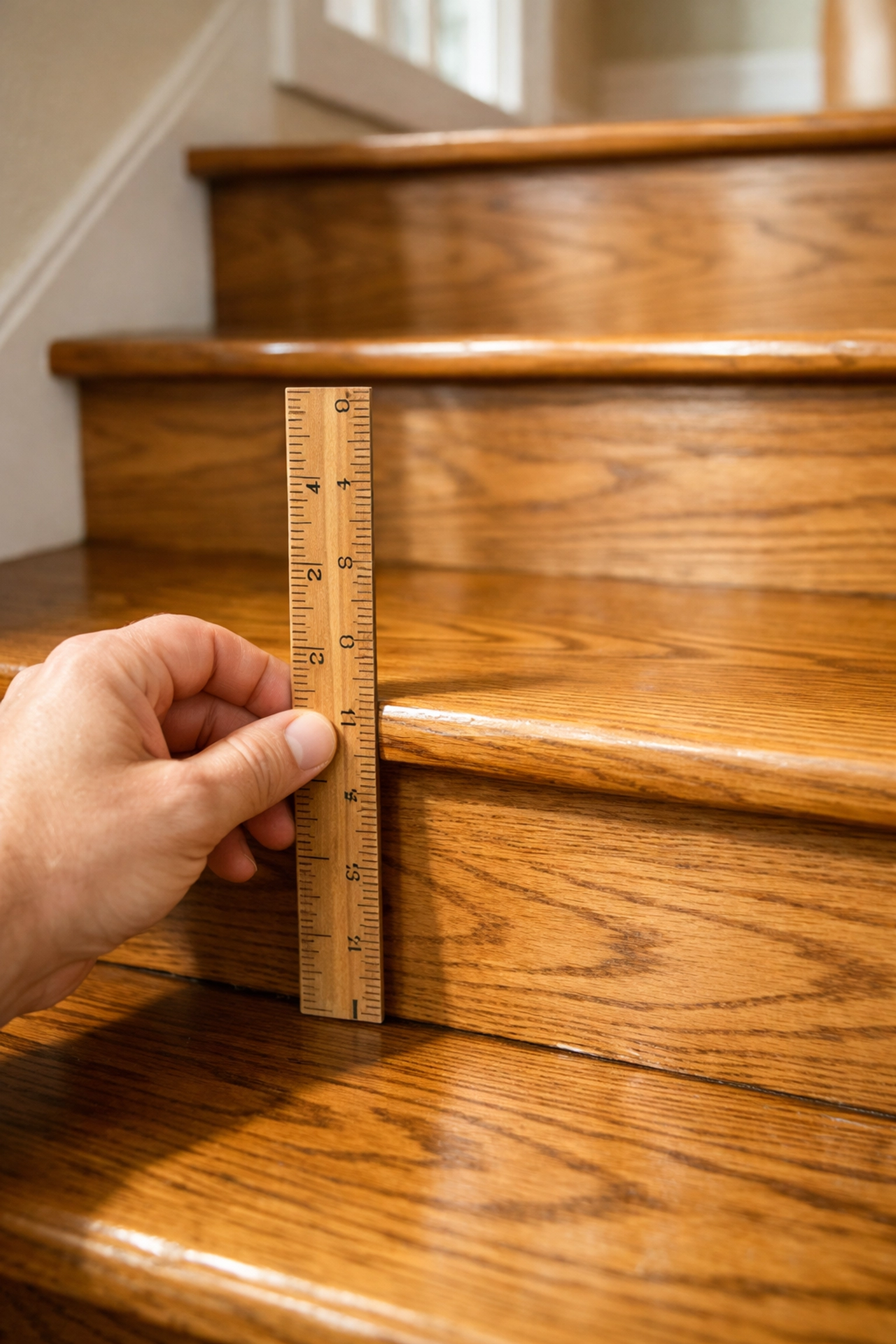
Believe it or not, your brain is a master at math: even when you aren't trying to be. When you start climbing a flight of stairs, your brain "maps" the height (rise) and depth (run) of the first two steps. It then puts your legs on autopilot for the rest of the climb.
The mistake happens when the steps aren't uniform. If the third step is even half an inch taller than the second, or if the top landing is slightly wider than the treads below it, your rhythm is broken. This often happens in older homes where wood has settled or during renovations where a new floor was laid over an old one, changing the height of the final step.
How to Fix It:
The first step is awareness. Take a tape measure and check the height of each riser and the depth of each tread. If you find a significant discrepancy (more than a quarter of an inch), it’s a red flag. While a full staircase remodel is a big job, you can use high-contrast tape or a different texture of "nosing" (the edge of the step) to signal to the brain that this specific step is different. This visual cue tells the brain to "wake up" from its autopilot mode.
2. Thinking One Light Switch is Enough
We’ve all done it: we’re at the bottom of the stairs, it’s dark, and the light switch is at the top. Or we’re at the top, and the switch is at the bottom. We decide to "brave it" because we know the stairs like the back of our hand.
Inadequate lighting is perhaps the most common cause of missteps. As we age, our eyes require more light to distinguish between the edge of a step and the shadow cast by the step above it. Dim lighting can make a staircase look like a flat ramp, leading to a "phantom step" where you think there’s one more, but there isn’t: or vice-versa.
How to Fix It:
Ensure you have "three-way switches" at both the top and bottom of the stairs. If your home isn't wired for this, don't worry: you don't necessarily need an electrician. There are excellent battery-powered, motion-sensing LED lights that can be adhered to the wall or the underside of the handrail.
Ideally, you want "overhead" lighting that minimizes shadows. If the light is only coming from one end of the hall, it creates long shadows that hide the "nosing" of the steps. Aim for even, bright light across the entire flight.
3. Treating Handrails as Decorations
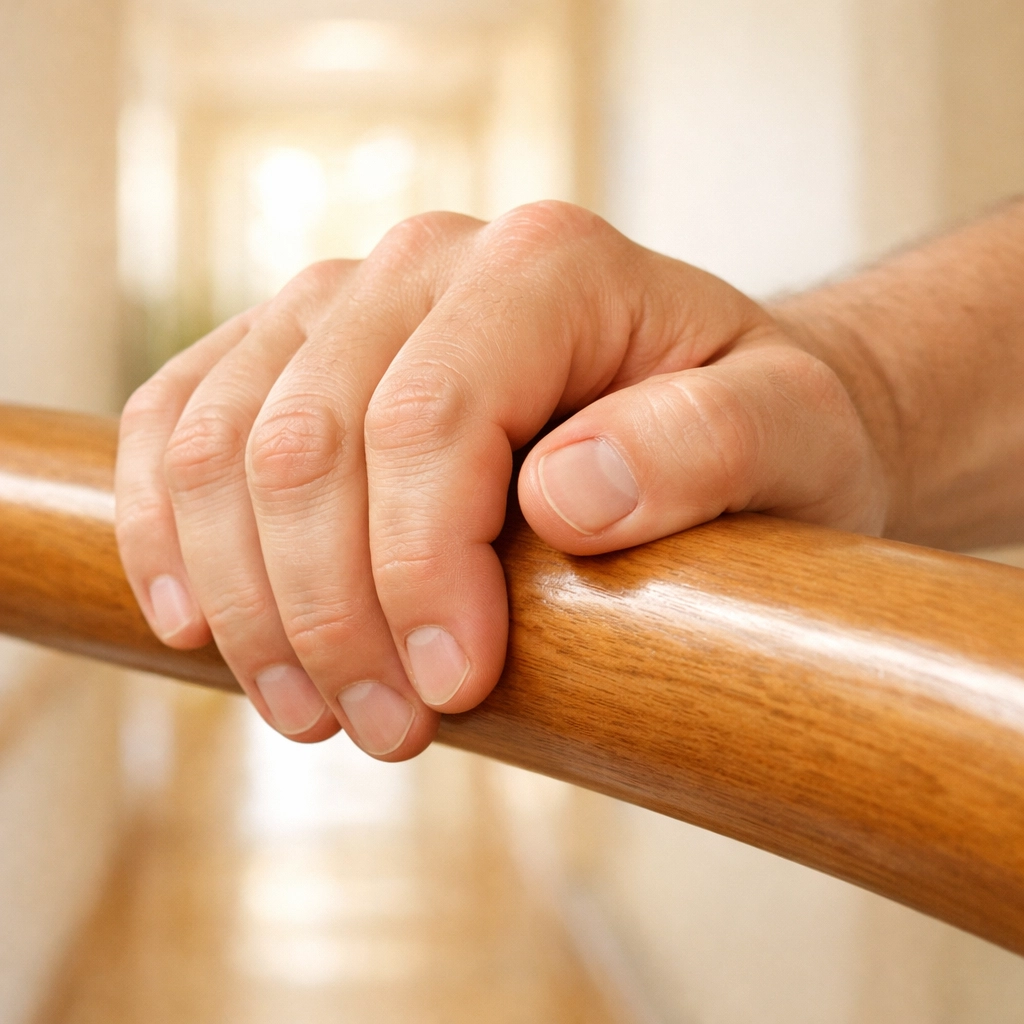
Many handrails in modern homes are designed for aesthetics rather than ergonomics. Some are too wide to get a full grip around, some are too low, and others are "decorative" pieces of wood that don't actually offer much support.
A handrail shouldn't just be something you rest your hand on for balance; it needs to be something you can actually grab if you start to slip. If a rail is too thick (like a wide piece of finished lumber), your hand can't encircle it, which means you lose about 75% of your grip strength during a fall.
How to Fix It:
The "Goldilocks" handrail is round or oval and has a diameter of about 1.25 to 2 inches. This allows for a "power grip," where the thumb and fingers can overlap.
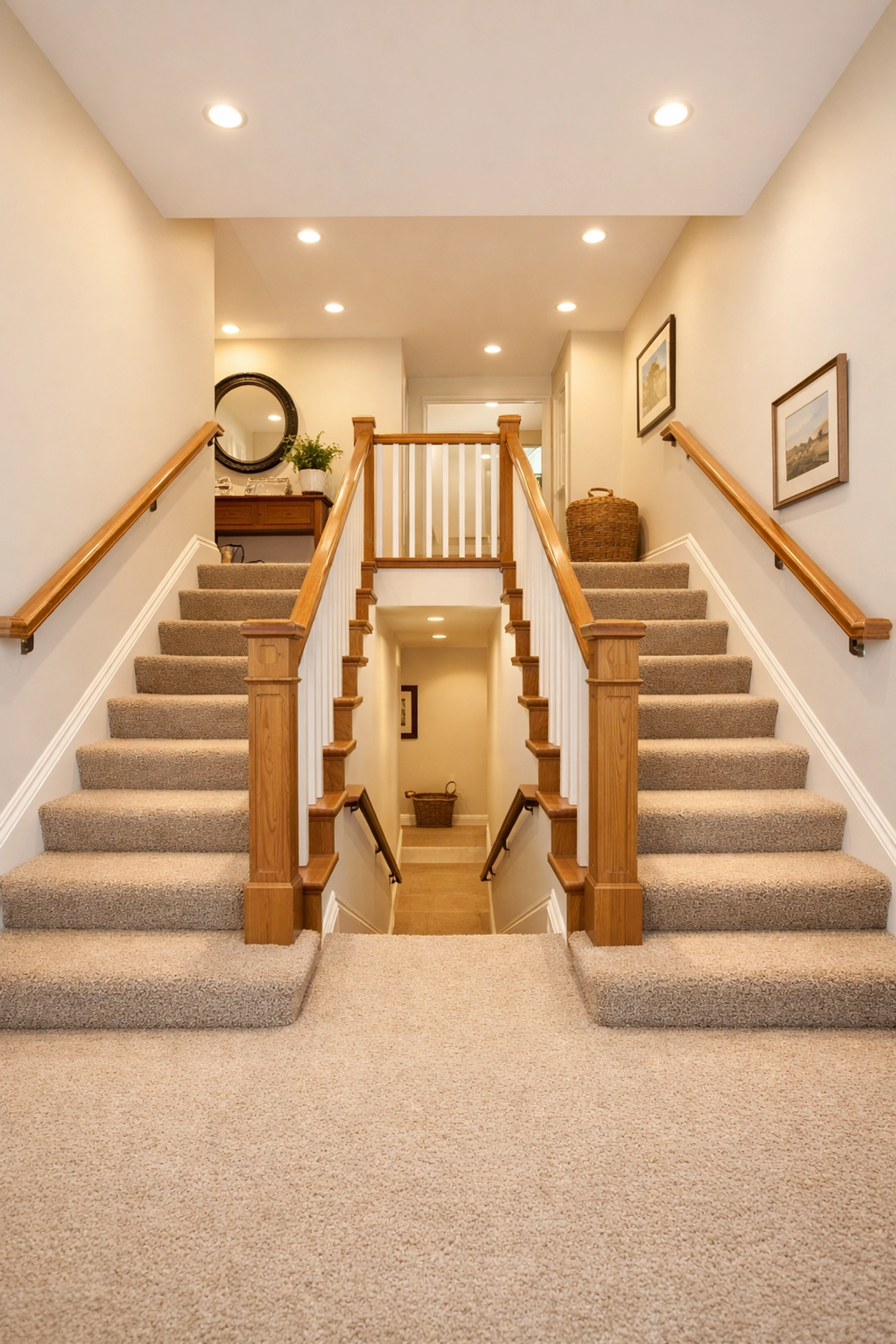
Also, check the height. A handrail should be between 34 and 38 inches above the "nosing" of the steps. If yours is too low, you'll find yourself leaning forward, which shifts your center of gravity and actually makes a fall more likely. Finally, ensure the rail is continuous. If you have to let go of the rail to navigate a landing or a turn, you are at your most vulnerable during that transition.
4. The "Slippery Slope" of Flooring Choices
Polished hardwood stairs are beautiful. So are stairs with deep-pile carpeting. Unfortunately, both can be safety hazards. Hardwood is naturally slick, especially if you’re wearing socks. Carpeting, on the other hand, can round off the "nose" of the step, making the actual landing surface for your foot smaller than it looks.
Worn-out carpeting is even worse. If the carpet is loose or has a "bubble" in it, it becomes a trip hazard that is almost impossible to see from above.
How to Fix It:
For wooden stairs, consider adding non-slip adhesive treads. These come in clear versions if you don't want to hide the wood grain. For carpeted stairs, ensure the carpet is pulled tight and stapled securely to every riser.
If you're choosing new flooring, look for a low-pile, "tight" carpet. It provides enough friction to prevent sliding but doesn't disguise the shape of the step. And here’s a simple, free fix: avoid walking on the stairs in just socks. Bare feet or shoes with rubber soles provide the traction your body needs to stay upright.
5. Ignoring the "Warning Creaks" (Maintenance)
We often ignore the little creaks and wobbles in our homes, treating them as "character." But a creak in a staircase often indicates a loose tread, and a wobble in a handrail indicates a failing bracket.
Over time, the screws and nails holding a staircase together can loosen due to the constant pressure of weight and the natural expansion/contraction of wood. A step that gives way just a few millimeters under your weight can be enough to throw off your balance.
How to Fix It:
Perform a "stress test" once every few months. Walk up and down the stairs slowly, intentionally stepping on different parts of the tread (the left, the right, the center). Listen for movement and feel for "give."
Grab your handrail and give it a firm shake. It should feel like it’s part of the wall. If it wiggles even slightly, tighten the brackets or add more support. It’s a five-minute fix that could prevent a major incident.
6. Using the Stairs as a Temporary Shelf
We've all done this: you have a stack of mail or a pair of shoes that needs to go upstairs, so you leave them on the bottom step to take up "on the next trip."
Stairs are not storage units. Even if the items are tucked to the side, they narrow the walking path and create a psychological distraction. You’re looking at the clutter instead of the steps. In an emergency, or even just a midnight trip to the kitchen, those items become high-risk obstacles.
How to Fix It:
Implement a "zero-tolerance" policy for items on the stairs. If something needs to go up, take it all the way up immediately, or place it in a dedicated "stair basket" that sits completely off the stairs on the landing. By keeping the path clear, you ensure that your full attention: and your full foot space: is dedicated to the task of climbing or descending safely.
7. The Habit of Rushing and Carrying Too Much
Life is busy, and we’re often in a hurry. We rush down the stairs to answer the door or the phone, often with our hands full. When you carry a large box or a laundry basket in front of you, you lose visual contact with your feet and the steps.
Furthermore, rushing changes your body mechanics. When you move quickly, your center of gravity moves further forward. If you trip while moving fast, your momentum makes it much harder to recover.
How to Fix It:
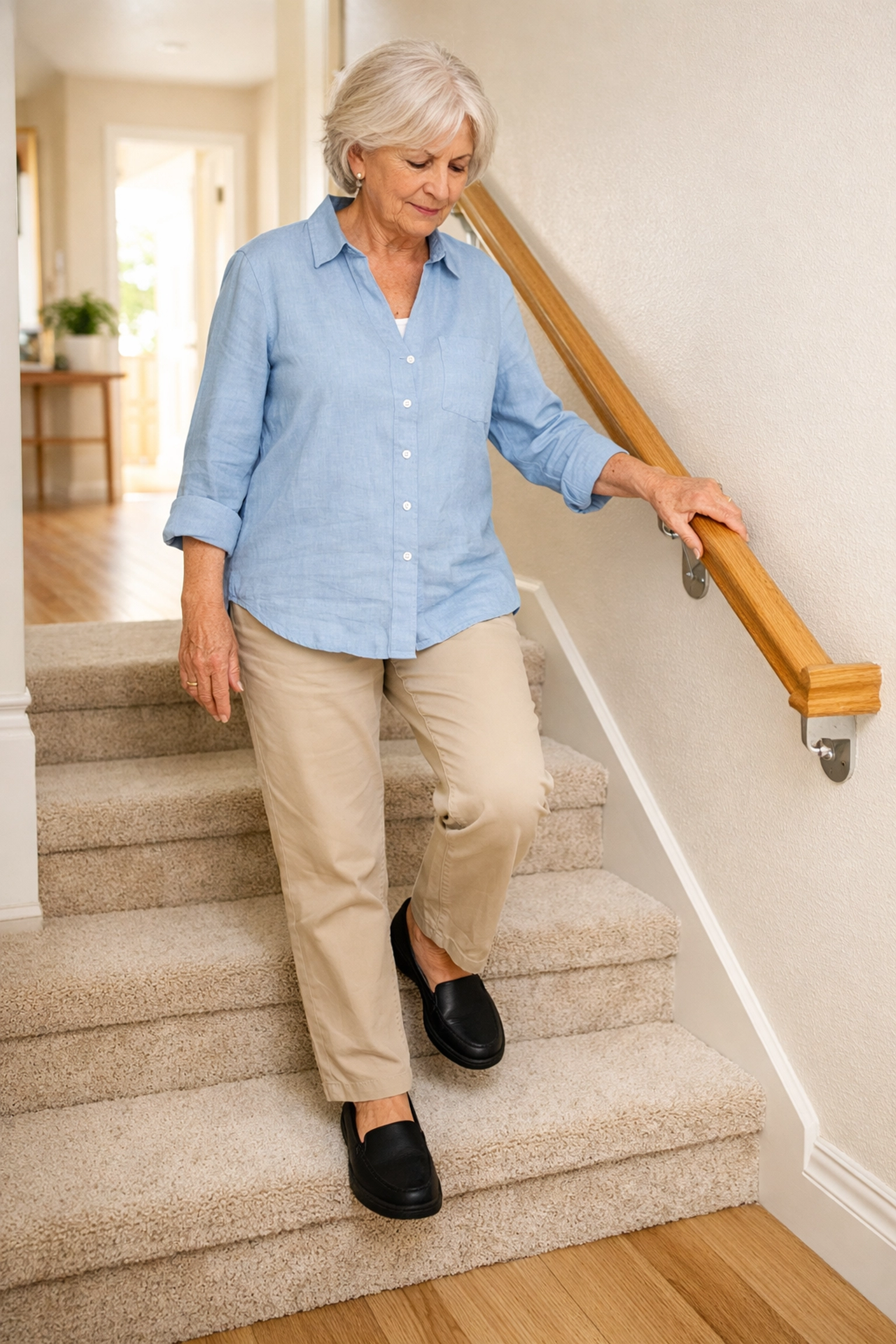
Adopt the "one hand for the ship" rule. This is an old sailor's trick: always keep one hand free to hold the railing. If you have a lot to carry, make two trips or use a backpack. It might take an extra 60 seconds, but it ensures you always have a point of contact with the house.
Also, focus on your "landing." Instead of just placing the ball of your foot on the step, try to get as much of your foot as possible onto the tread. This increases the surface area for friction and stability.
Final Thoughts: A Reassuring Approach to Home Safety
It’s easy to feel overwhelmed by the idea of "fall-proofing" a home, but it doesn't have to be a daunting task. Most of the fixes mentioned above: tightening a screw, adding a motion-sensor light, or clearing away clutter: cost very little and can be done in an afternoon.
The goal isn't to live in fear of your stairs. It’s about respecting the physics of the staircase and making small, smart adjustments that support your independence. By fixing these seven common mistakes, you aren't just making your stairs safer; you're making your entire home a more comfortable, reassuring place to live.
Safety is a journey, not a destination. Take it one step at a time, literally.

