
Hi, I’m Brian Kerr, the founder here at Fall Guys Products. Over the years, I’ve walked through hundreds of homes, and if there is one area that consistently causes the most anxiety for seniors and their families, it’s the staircase.
Stairs are a fundamental part of our homes, but as we get older, the margin for error on those steps gets smaller. We often think of stair safety as just "being careful," but the reality is that the physical environment of your staircase plays a massive role in whether you stay upright or take a tumble. Most homes were built for able-bodied younger adults, not for someone navigating changes in vision, balance, or joint strength.
The good news is that most stair-related risks are predictable. If they are predictable, they are preventable. Today, I want to walk you through the seven most common mistakes I see people making with their home stairs and, more importantly, exactly how you can fix them to keep your home a safe place to live.
1. Prioritizing Design Over Functionality
We all want a beautiful home. Modern architecture has brought us some stunning designs, like "floating" stairs with no backs, curved spiral staircases, or minimalist glass railings. While these look like they belong in a magazine, they can be a nightmare for daily safety.
The mistake here is choosing aesthetics that ignore how our brains and bodies actually process a staircase. Floating stairs (those without "risers" or backings) can create a sense of vertigo. When you can see through the steps to the floor below, it can throw off your depth perception, making it harder to place your foot confidently.
How to Fix It:
If you are planning a renovation or looking at a new home, stick to traditional "closed" staircases. If you already have open-riser stairs, you don’t necessarily need to tear them out. A professional can often install "riser plates" to close the gap between the steps. This provides a visual backstop for your feet and reduces the confusing visual input of seeing the floor moving beneath you as you climb.
2. Using Incorrect Tread and Riser Dimensions
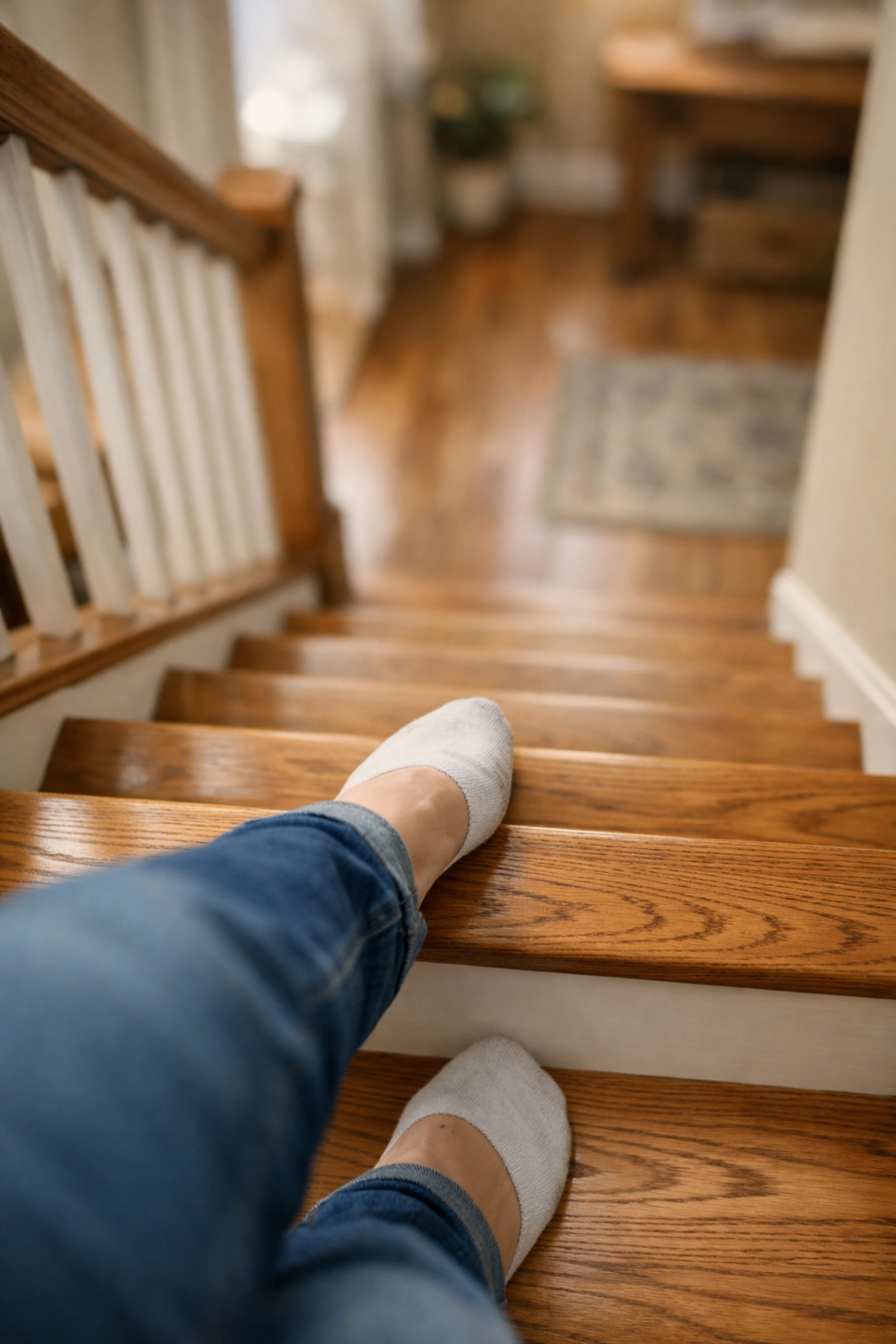
Have you ever walked up a flight of stairs and felt like you were "stumbling" even though you weren't rushing? It’s often because the stairs weren't built with consistent dimensions. Our brains actually memorize the height of the first two steps and then put our legs on "autopilot" for the rest of the flight. If one riser is even a quarter-inch higher than the others, your toe will likely catch it.
Common mistakes include "risers" (the vertical part) that are too high, or "treads" (the horizontal part you step on) that are too narrow. If the tread is too small, your heel or toe might hang off the edge, reducing your stability.
How to Fix It:
Building codes generally suggest a "Golden Ratio" for stairs: a riser height of about 7 inches and a tread depth of about 11 inches.
- Measure your stairs: Check if the height of each step is uniform. If they aren't, this is a significant structural hazard.
- Increase the "landing" area: If your treads are too narrow, you can sometimes have them extended by a carpenter, though this is a larger project.
- The 3/8-inch rule: Ensure there is no more than a 3/8-inch difference between the highest and lowest riser in the entire flight.
3. Creating or Keeping a Slope That’s Too Steep
In older homes or basement transitions, stairs are often squeezed into tight spaces, resulting in a very steep incline. A steep staircase requires significantly more lower-body strength and puts a much higher strain on the heart and lungs. It also makes a downward fall much more dangerous because gravity has a "straighter" shot at the floor.
How to Fix It:
The ideal angle for a residential staircase is between 30 and 50 degrees, with 37 degrees being the "sweet spot" for most people.
- Structural Change: If your stairs are dangerously steep, the only permanent fix is a structural rebuild to "lengthen" the staircase.
- Compensating: If a rebuild isn't possible, you must ensure that other safety features, like dual handrails and perfect lighting, are at 100% to compensate for the steepness.
4. Inadequate or Improperly Positioned Handrails
This is perhaps the most common issue I see. Many homes only have one handrail, or worse, a handrail that stops a few inches before the stairs actually end. A handrail isn't just a suggestion; it’s your primary safety net.
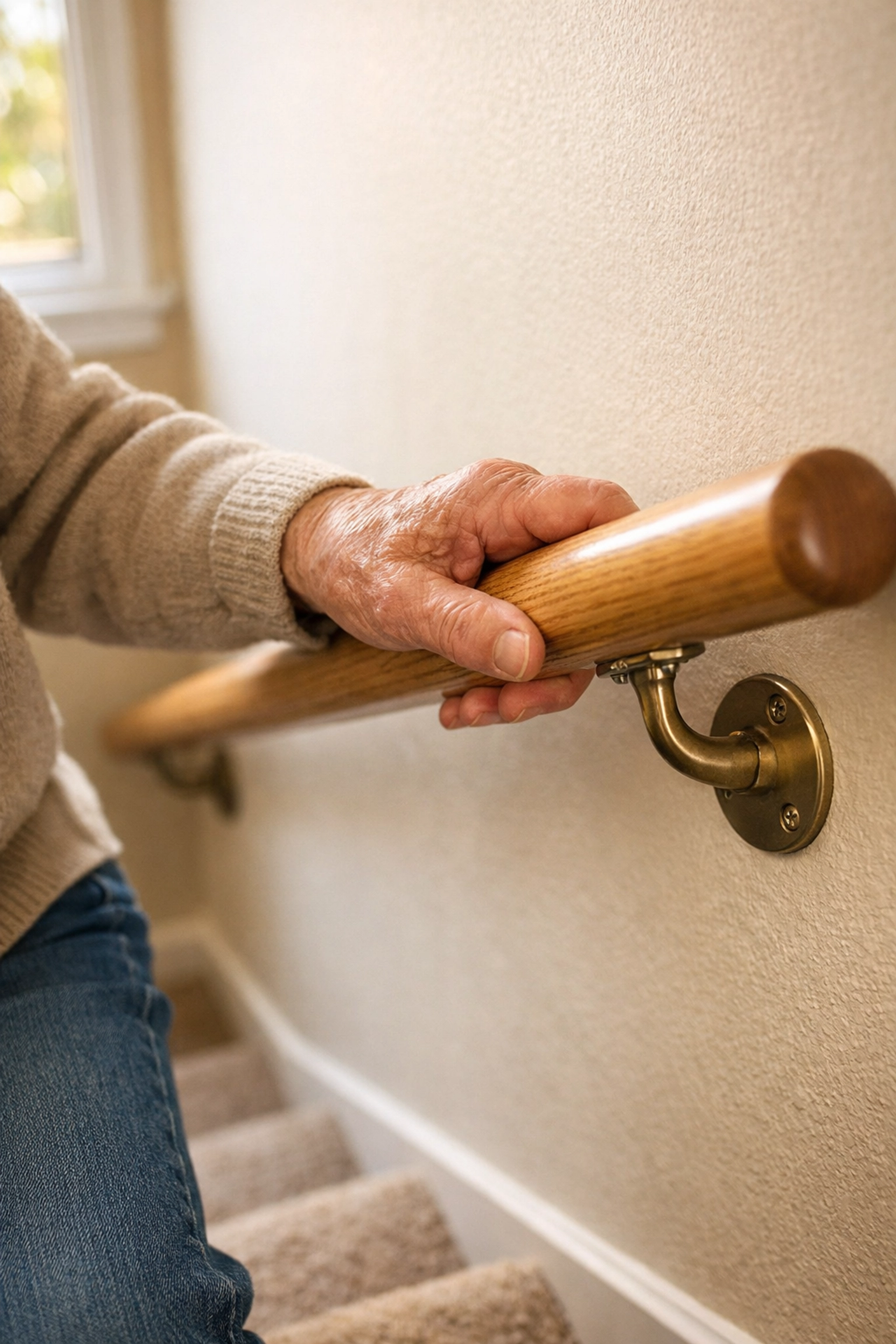
People often make the mistake of having a wobbly rail or one that is too thick to actually grip. If you can't wrap your fingers and thumb around the rail (a "power grip"), it won't help you much if you actually start to fall.
How to Fix It:
- Install Dual Rails: Every staircase should have a handrail on both sides. This allows you to use your strongest hand whether you are going up or down.
- Height Matters: Handrails should be mounted between 34 and 38 inches above the "nosing" (the edge) of the steps.
- Extension: The rail should extend at least 12 inches past the top step and the bottom step. This gives you a stable handle to hold onto before you start moving and after you’ve finished the climb.
- The "Grip" Test: Ensure the rail is "circular" or "pear-shaped" so your hand can fully enclose it. Avoid wide, flat decorative rails that you can only rest your palm on.
5. Neglecting Proper Lighting
As we age, the amount of light reaching the back of our retina decreases. A 60-year-old needs significantly more light to see the same level of detail as a 20-year-old. Many staircases are lit by a single, dim bulb at the top that casts long, confusing shadows over the steps. If you can't tell where the edge of the step is, you’re at risk.
How to Fix It:
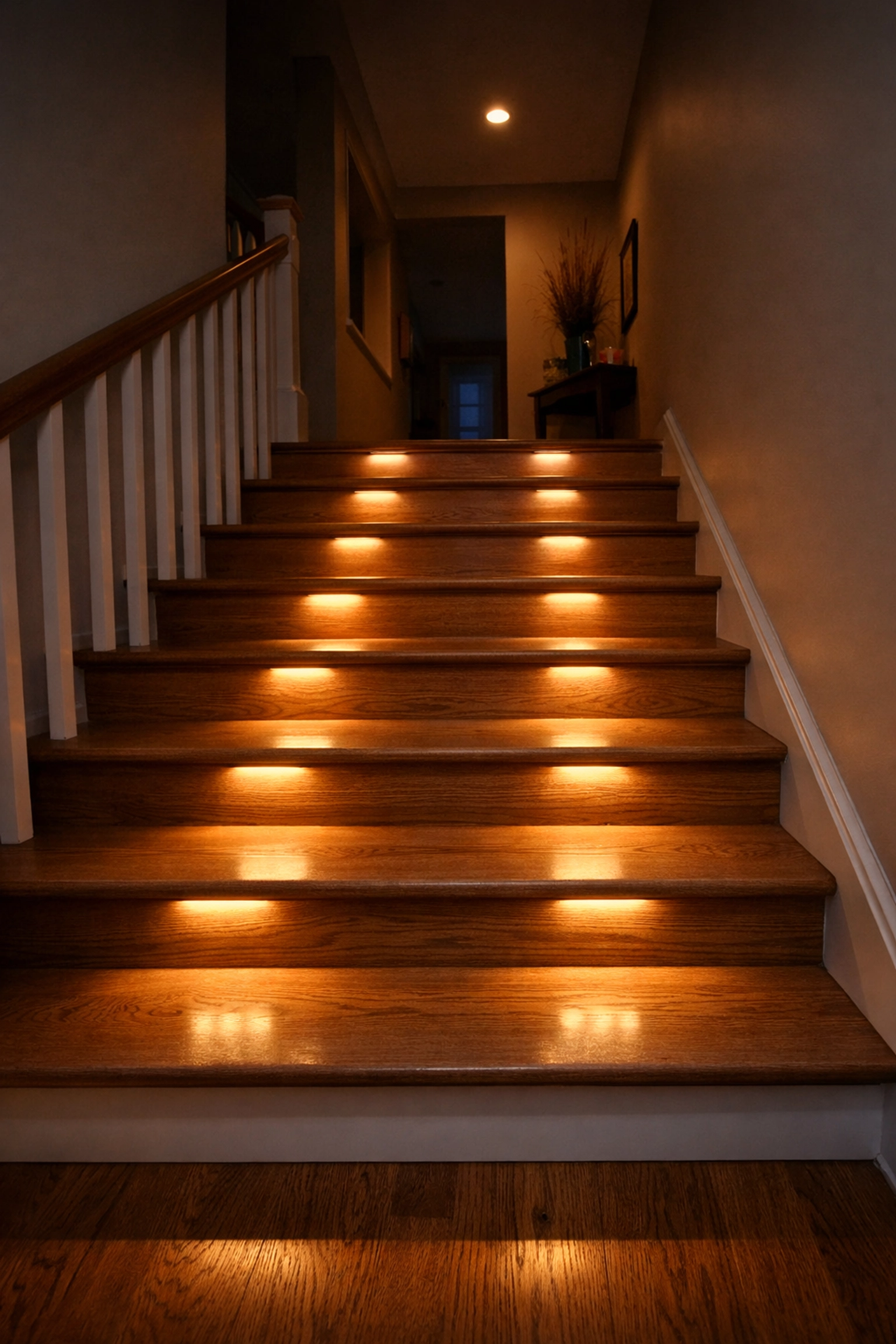
- Eliminate Shadows: Light should be even across the whole flight.
- Motion Sensors: Install battery-operated, motion-sensing LED lights along the baseboards. These light up the actual path of your feet the moment you approach the stairs.
- Dual Switches: Ensure there is a light switch at both the top and the bottom of the stairs. Never try to navigate the stairs in the dark to reach a switch.
- Contrast Strips: If the stairs are a dark wood or a uniform carpet color, it’s hard to see the edges. You can add a strip of high-contrast tape or a different colored "nose" to the edge of each step to make it visually obvious where each one ends.
6. Providing Insufficient Headroom Clearance
It might seem strange to talk about the ceiling when discussing stair safety, but low headroom is a major trip hazard. If a person has to duck or even subconsciously "tuck" their head while descending, it shifts their center of gravity forward. This shift makes it much easier to lose balance.
How to Fix It:
Standard code requires at least 6 feet, 8 inches of "vertical headroom" measured from the edge of the step to the ceiling.
- Clear the Way: If there are low-hanging pipes or bulkheads, they should be padded or painted in a bright, contrasting color (like yellow) to alert the user.
- Posture Awareness: If your home has low clearance, focus on keeping your weight back over your heels when descending, rather than leaning forward to avoid the ceiling.
7. Compromising on Material Quality and Traction
The surface of your stairs is just as important as the structure. We see two main extremes: beautiful, polished hardwood that is as slick as an ice rink, or thick, plush carpeting that "rounds off" the edge of the steps.
Slippery surfaces are obvious hazards, but "rounding" is more subtle. When carpet is too thick, it hides the actual edge of the wood underneath. Your foot might feel like it’s on solid ground, but it’s actually on a soft, sloping edge of carpet, causing your ankle to roll or your foot to slip.
How to Fix It:
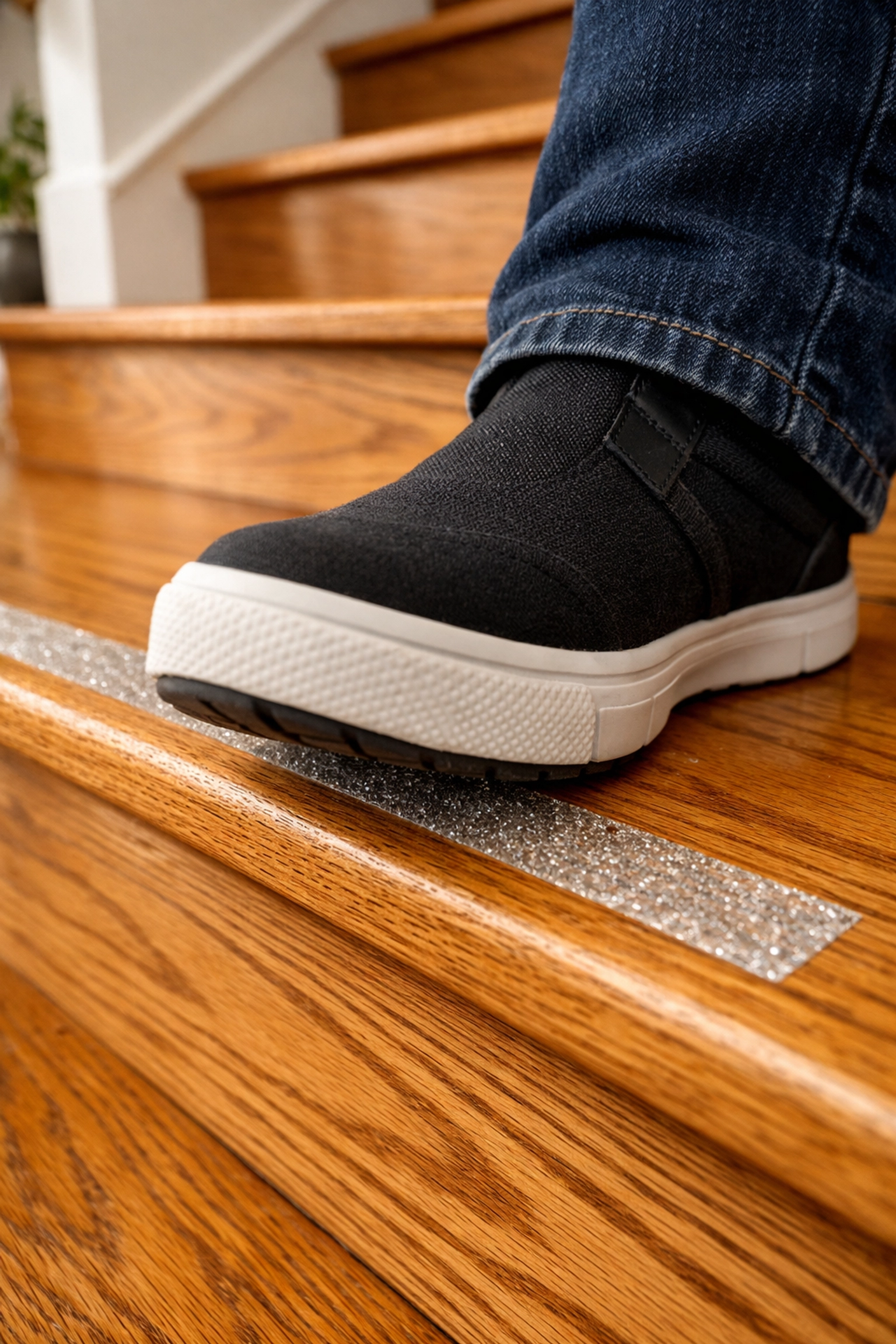
- Non-Slip Treads: For wooden or tile stairs, clear adhesive anti-slip strips are a lifesaver. They add grit without ruining the look of the wood.
- Low-Pile Carpet: If you prefer carpet, use a "commercial grade" or low-pile version. It should be stretched very tightly so there is no bunching and the edges of the steps remain sharp and defined.
- Avoid "Stair-Socks": This is a behavioral fix, but never walk on stairs in just socks. Bare feet or shoes with rubber soles are the only safe way to navigate uncarpeted steps.
Beyond the Structure: Behavioral Safety
Fixing the physical mistakes is the first step, but how we use the stairs matters too. Even a perfect staircase can be dangerous if we aren't mindful.
The "Landing" Zone
The areas at the top and bottom of the stairs should always be clear of clutter. No shoes, no decorative rugs that can slide, and no piles of laundry waiting to go up. These "transition zones" are where many falls begin or end.
The Rule of One Hand
I always tell people: "Keep at least one hand on the rail at all times." If you are carrying a laundry basket with both hands, you can't see your feet and you have no way to catch yourself if you slip. If you need to move items between floors, consider using a small backpack or making two trips so one hand is always free for the railing.
Regular Maintenance
Stairs take a lot of abuse. Over time, wood can warp, nails can pop up, and handrail brackets can loosen. Once a season, do a "shake test." Grab your handrails and give them a firm tug. If they move at all, they need to be tightened. Check for loose carpet or squeaky boards that might indicate the structure is shifting.
A Reassuring Word
I know that looking at this list might feel overwhelming. You might be looking at your stairs right now and seeing three or four of these mistakes. Please don't panic. Home safety isn't about achieving perfection overnight; it's about making incremental improvements that reduce your risk.
Start with the easiest fixes. Adding a motion-sensor light or putting non-slip strips on your wooden steps takes less than an hour and costs very little, but it can make a world of difference.
Your home should be a place where you feel confident and secure. By respecting the physics of your staircase and fixing these common mistakes, you aren't just "preventing a fall": you’re protecting your independence and your peace of mind.
If you ever feel unsure about whether your stairs are safe, it’s always a good idea to have a professional assessment. Sometimes a fresh pair of eyes can see a shadow or a loose rail that you’ve walked past for twenty years. Stay safe, take it one step at a time, and remember that we’re here to help you navigate these changes with confidence.

