
Getting used to a walker can feel like a bit of a learning curve. For many, a walker is a symbol of continued independence: a tool that lets you keep moving, visiting friends, and navigating your home safely. However, simply having a walker isn't the same as using one correctly.
I’m Brian Kerr, and over the years, I’ve seen many folks treat their walker as a suggestion rather than a precision tool. When used incorrectly, a walker can actually become a trip hazard itself. The good news is that most of the common errors are incredibly easy to fix. By making a few small adjustments to your posture and your habits, you can significantly reduce your risk of a fall and make your daily walks much more comfortable.
Let’s dive into the seven most common mistakes people make with walkers and, more importantly, how to correct them.
1. Setting the Height Incorrectly
This is arguably the most frequent mistake I see. Many people inherit a walker from a friend or pick one up at a second-hand shop and start using it exactly as it was set for the previous owner. Others simply guess what height "feels" right.
If your walker is too low, you’ll find yourself hunched over. This puts immense strain on your lower back, shoulders, and neck. It also shifts your center of gravity too far forward, making you more likely to tip. Conversely, if the walker is too high, your arms will be bent at an awkward angle, and you won’t be able to put enough weight through your arms to support your legs.
The Fix:
To find the perfect height, stand as straight as you can with your arms hanging naturally at your sides. Look at your wrists. The handgrips of the walker should be level with the crease on the inside of your wrist. When you place your hands on the grips, your elbows should have a slight, comfortable bend: about 15 degrees. This angle allows your muscles to support your weight effectively without overtaxing your joints.

2. Walking "Behind" the Walker Instead of "In" It
Imagine you are pushing a shopping cart. Usually, the cart is well out in front of you while you walk behind it. Many people try to use their walker the same way, pushing it far out in front and then "chasing" after it to catch up.
When the walker is too far ahead, you lose the stability it’s meant to provide. If you trip while the walker is two feet in front of you, you won’t have anything to grab onto. Your body is also leaning forward, which is a recipe for a balance mishap.
The Fix:
Think of your walker as a protective bubble. You want to walk inside the frame, not behind it. As you move, your feet should stay roughly between the back legs of the walker. Move the walker forward just a small distance (about one step’s worth), then step into the center of the frame. By staying "inside" the walker, your center of gravity remains supported by the four points of contact on the ground at all times.
3. Using the Walker to "Pull" Yourself Up
This mistake is particularly dangerous and is a common cause of tipping accidents. When someone is sitting in a chair or on the edge of the bed, they often reach out, grab the walker handles, and pull themselves up to a standing position.
Standard walkers are lightweight by design. They are meant to support downward pressure, not horizontal pulling. If you pull on the handles while seated, the walker can easily tip backward toward you, providing zero support and likely causing you to fall back into your seat or onto the floor.
The Fix:
Always remember: Push, don't pull. When you are ready to stand up, place your hands on the armrests of your chair or the surface of the bed. Push yourself up using your leg strength and your arms on the stable furniture. Once you are steady on your feet, then reach forward and place your hands on the walker grips. When sitting back down, do the reverse. Back up until you feel the chair against the back of your legs, reach back for the armrests, and lower yourself slowly.

4. Turning Too Sharply (The Pivot Mistake)
In our everyday lives, we often pivot on one foot to change direction. It’s a natural, fluid movement. However, when you’re using a walker, that pivot can be your undoing.
If you try to twist your body while the walker is stationary, or if you try to swing the walker around in one big motion, you risk tangling your feet in the legs of the device. Furthermore, pivoting puts your weight on one leg in a twisted position, which is where many balance losses occur.
The Fix:
Think like a clock. Instead of one big turn, make several small, deliberate steps. Move the walker a few inches in the direction you want to go, then move your feet to match. Repeat this until you’ve completed the turn. It might take a few extra seconds, but keeping your body aligned with the walker during the entire turn ensures you are always supported.
5. Overloading the Frame
It’s tempting to turn your walker into a mobile storage unit. I’ve seen heavy grocery bags, large purses, and even oxygen tanks strapped to the front or sides of walkers.
While it’s convenient, adding weight to the frame changes the physics of the device. If you hang a heavy bag on the front, the walker becomes front-heavy and can tip forward if you hit a small bump or rug. If you hang something on one side, it can pull the walker out of alignment, making it harder to steer and easier to tip sideways.
The Fix:
If you need to carry items, use accessories specifically designed for your walker model, such as a center-mounted basket or a pouch that attaches to the horizontal bar. These keep the weight centered and low. Always be mindful of the weight limit suggested by the manufacturer. If you have a lot to carry, it might be safer to ask for help or use a small rolling cart separately.

6. Forgetting the Brakes (On Rollators)
If you use a rollator: the type of walker with four wheels, a seat, and hand brakes: the most common mistake involves the "sitting" feature. Many people forget that the wheels move easily, even on flat indoor surfaces.
Trying to sit down on a rollator without engaging the brakes is a major fall risk. As you shift your weight to sit, the walker can roll forward or backward, leaving you falling toward the floor.
The Fix:
Before your backside even thinks about touching that seat, you must "lock" the brakes. Most rollators allow you to push the brake levers downward until they click into a locked position. Always give the walker a little nudge to make sure it won't budge before you sit. Also, never sit on a rollator while someone else is pushing you; they are not designed to be used as wheelchairs and can easily tip over.
7. Ignoring the "Tires" and Tips
We often forget that walkers require a bit of maintenance. The rubber tips at the bottom of a standard walker or the wheels on a rollator are what provide the grip and stability you rely on.
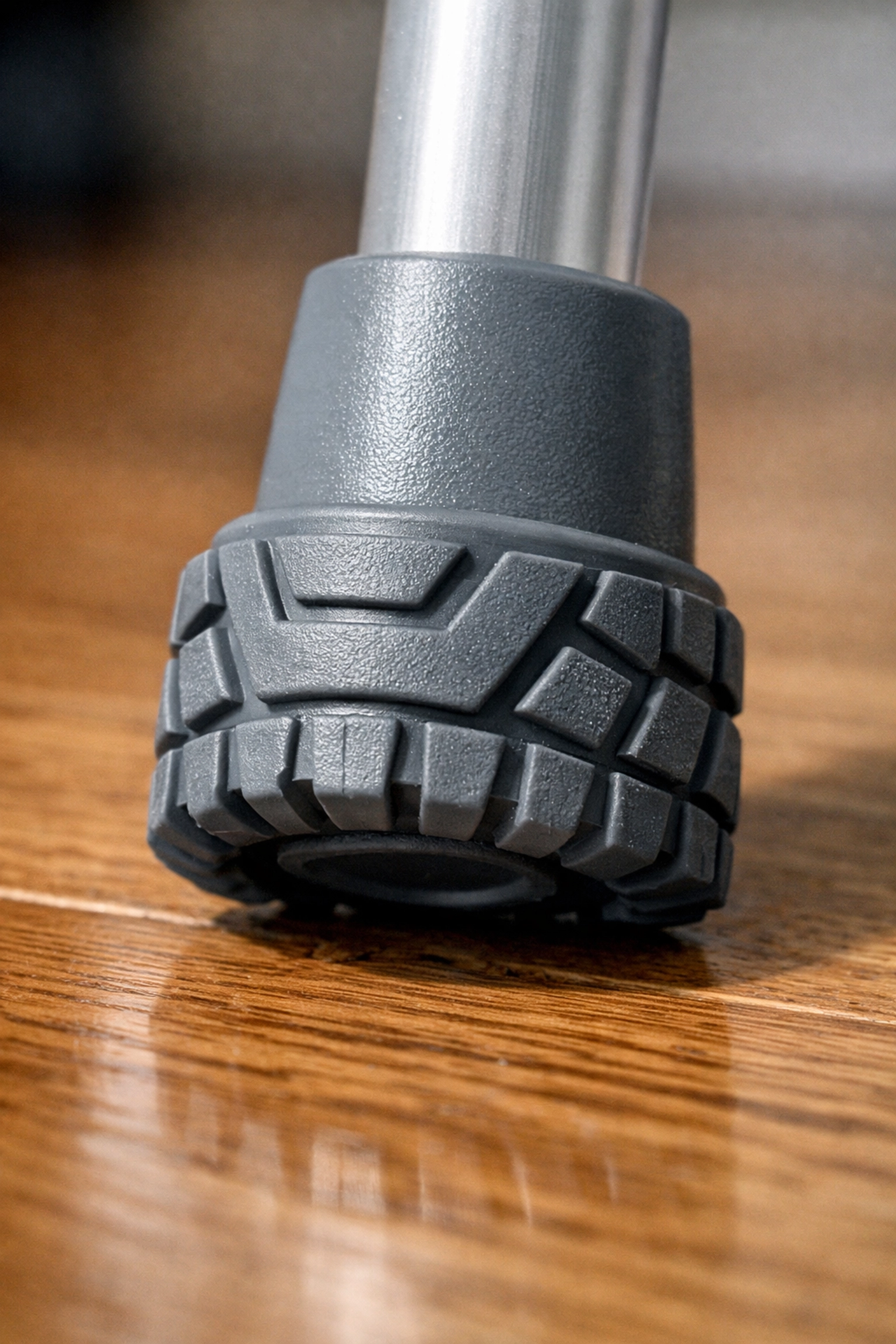
Over time, the rubber tips on the legs wear down, becoming smooth or even wearing through to the metal tubing. Smooth rubber doesn't grip the floor; it slides. Similarly, wheels can collect hair, lint, or debris, causing them to stick or glide unevenly.
The Fix:
Perform a weekly "safety check." Flip your walker over and look at the rubber tips. Do they still have deep treads? Are they cracked or brittle? If they look smooth like a bald tire, replace them immediately. They are inexpensive and can be found at most pharmacies. If you use tennis balls on the back legs to help the walker glide (a common trick), make sure they haven't worn through. Once the metal of the walker leg touches the floor, you’ve lost your traction.
Bonus Tip: Watch Your Path
Even if you use your walker perfectly, the environment can still throw you a curveball. Throw rugs, extension cords, and transitions from carpet to tile are the "natural enemies" of the walker.
When you're using a walker, your "footprint" is much wider than it used to be. You need to clear a wider path through your home. Ensure that your furniture is spaced far enough apart to allow the walker through without you having to turn sideways.
The Importance of Professional Guidance
While these tips can help you correct common mistakes, nothing replaces the personalized advice of a physical therapist. A PT can evaluate your specific gait, strength, and balance to recommend the exact type of walker that fits your needs. They can also provide "gait training," which is essentially professional coaching on how to walk with your new device.
If you find that you are constantly leaning heavily on your walker or if you feel "pushed" by it, it might be time for a reassessment. Sometimes a change in medication, vision, or muscle strength means you need a different type of mobility aid altogether.
Using a walker is a skill, and like any skill, it takes practice to master. By avoiding these seven common mistakes, you aren't just using a tool; you're mastering your mobility and taking a proactive step toward a safer, more active life. Keep your head up, stay inside the "bubble," and move with confidence. You’ve got this.

